Direct Answer
For buyers developing bikini hair removal products private label, comfort cannot be treated as a single claim or solved by simply making a formula milder. The right product must align chemistry, texture, application time, removal mechanics, packaging, and instructions with the intended body area. A depilatory cream designed for legs may not be suitable for the external bikini line, while a wax strip that performs well on the arms may grip too aggressively on shorter, coarser hair.
Start by defining the exact use zone, consumer routine, hair profile, and removal format. Then validate formula performance and packaging together through irritation-risk review, stability testing, leakage checks, and supervised use testing. Clear instructions should specify where the product may be used, where it must not be used, how long it may remain on skin, and what aftercare is recommended. This area-led approach gives buyers a stronger brief for custom hair removal product development and reduces costly reformulation after packaging artwork has already begun.
Key Takeaways for Private Label Buyers
- Define the use area first. Separate external bikini-line, leg, underarm, body, and face positioning before selecting a cream, waxing system, or aftercare formula.
- Evaluate comfort as a complete system. Formula strength, contact time, wax temperature, strip adhesion, removal technique, and post-depilation care all affect the user experience.
- Test the formula inside the final pack. Viscosity, dispensing, cartridge seals, strip liners, jar compatibility, and label adhesion can change during warm or cold storage.
- Make instructions operational. Include patch-testing guidance, application thickness, maximum contact time, contraindicated areas, residue removal, and aftercare steps.
- Approve samples against measurable criteria. A fast 3-5 day sample is useful only when the buyer also receives a defined texture target, packaging scope, test plan, and revision pathway.
- Build compliance into development. Review claims, ingredient declarations, safety substantiation, and labeling requirements before launch artwork is locked.
Buyer Context
Hair-removal products ask consumers to perform a controlled, temporary intervention on skin at home. That creates a narrower margin for vague positioning than many everyday cosmetic categories. Consumers may apply too much depilatory cream, leave it on longer when hair is resistant, overheat warm wax, reuse a strip repeatedly, or apply aftercare immediately after an aggressive pass. Thoughtful development anticipates these behaviors rather than assuming perfect use.
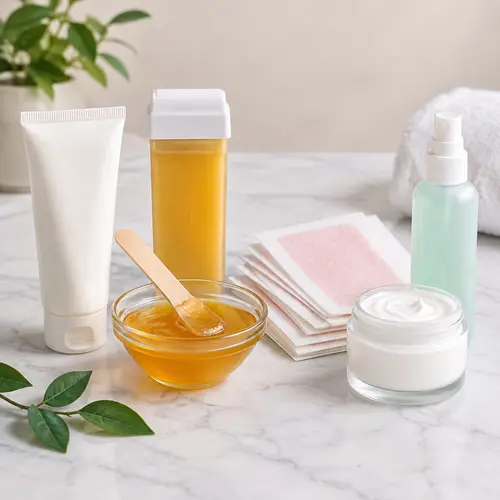
The first sourcing decision is format. Depilatory cream offers convenient, low-skill removal but requires careful control of contact time, odor, spreadability, and rinse behavior. Buyers can review the development variables on a dedicated custom depilatory cream formulation pathway. Wax strips support portable, water-free routines, but their adhesion must balance hair capture with acceptable pull on skin. Hot wax, sugar wax, and roll-on cartridges introduce temperature, melting, reheating, and leakage considerations. A broader custom wax strips and hot wax program should therefore include application tools and instructions, not just the wax compound.
Use area changes the brief further. External bikini-line hair is often coarse, while the surrounding skin may experience friction from clothing. Underarms have folds, moisture, and directional hair growth. Legs provide a larger, flatter surface but require easy spreading and sufficient working time. Products for the face need a separate risk and claims review rather than being treated as smaller versions of body products. Buyers comparing these applications can map formats through hair removal product solutions before requesting samples.
Compliance also affects speed. The Modernization of Cosmetics Regulation Act of 2022 increased the importance of documented cosmetic safety and responsible market preparation in the United States. The FDA Cosmetics Labeling Guide is equally relevant when instructions, warnings, identity statements, and ingredient information move into packaging artwork. A supplier running formulation, stability, packaging, and documentation tracks in parallel can support an under-30-day development target without treating compliance as an end-stage paperwork exercise.
Technical and Packaging Factors
Formula Strength, Texture, and Contact
A buyer should not approve a hair-removal formula from an ingredient list alone. For a cream, review how evenly it spreads, whether it stays in place on curved areas, how easily it rinses, and whether the odor profile remains acceptable during use. Viscosity should be expressed as a target range with a defined test method because a single number without spindle, speed, and temperature has limited value. The sample review should also record application thickness and removal time rather than relying on impressions such as smooth or gentle.
For sensitive positioning, ask how the base formula, fragrance system, and soothing components were selected and what evidence supports the finished-product claim. The formulation path for low irritation hair removal products should include a structured irritation-risk review, not simply the removal of one recognizable ingredient. Relevant scientific context may be screened through peer-reviewed research indexed by PubMed and NCBI, but literature on an individual ingredient does not replace assessment of the complete formula.
Wax Behavior and Removal Mechanics
Wax development should define the intended heating method, application temperature window, spread thickness, working time, flexibility, residue level, and breakage behavior. A brittle wax may fracture during removal, while an overly elastic formula may stretch without lifting coarse hair efficiently. For strips, test adhesion after aging because adhesive transfer and liner release can shift over time. For roll-on cartridges, review roller movement, cap fit, seal integrity, and formula flow after repeated heating and cooling.

Packaging Compatibility and Storage
Packaging is part of performance. Depilatory cream can interact with tube layers, pump components, seals, or printed surfaces. Warm wax may distort an unsuitable jar, while oils can weaken labels or create seepage around closures. A practical compatibility plan should compare room-temperature storage with warm and cold conditions. An accelerated check at 40°C can be included as one screening condition, but its duration and acceptance criteria should be set by the formula and pack rather than copied mechanically from another project.
Include a 24-hour inverted or side-storage leakage observation for tubes, bottles, jars, and roll-on wax cartridges, followed by longer stability monitoring. Check odor, color, viscosity, separation, pack deformation, dispensing, label adhesion, and net-content loss. For products entering the Amazon FBA fulfillment program, secondary packaging should also withstand parcel handling and storage without opening, crushing, or contaminating adjacent units.
Instructions and Aftercare
Instructions should be validated during sampling, not written by a marketing team after formulation approval. The label and insert should define patch testing, preparation, application quantity, contact or heating limits, removal direction, rinsing, repeat-use intervals, and excluded areas. Avoid language that encourages consumers to extend exposure when removal is incomplete. Instead, explain when to stop and when a later repeat application may be considered.
Aftercare can be developed as a complementary soothing gel, lotion, or serum, especially for bikini and waxing kits. Review compatibility with freshly depilated skin and avoid implying that aftercare can correct improper use. Buyers can compare soothing gel after hair removal options or evaluate an after hair removal serum for a broader routine. The claim set must remain aligned with cosmetic evidence and target-market rules.
Decision Framework
| Factor | What to Check | Why It Matters | ODM Buyer Note |
|---|---|---|---|
| Use area | External bikini line, legs, underarms, body, or face | Hair type, skin exposure, friction, and application geometry differ | Approve separate claims and instructions for each intended area |
| Formula texture | Spread, hold, rinse, residue, odor, viscosity, or wax flexibility | Texture determines application control and perceived comfort | Request measurable specifications and an approved reference sample |
| Removal performance | Contact time, hair capture, breakage, repeat passes, and residue | Poor first-pass performance encourages overuse | Test on the intended hair profile and application zone |
| Packaging | Seal, dispensing, leakage, label adhesion, and material compatibility | A stable formula can still fail in an unsuitable pack | Run testing in the final component set and decoration system |
| Storage and shipment | Warm, cold, inverted, and repeated heat-cycle conditions | Temperature changes can alter flow, adhesion, or closure integrity | Align the protocol with route, warehouse, and consumer use |
| Instructions | Patch test, limits, exclusions, removal steps, and aftercare | Clear directions reduce foreseeable misuse | Review copy before artwork approval and regulatory filing |
| Scale readiness | 1,000-unit pilot capability, component supply, and formula transfer controls | Launch consistency matters as demand increases | Confirm the same validated formula and process continue after the pilot |
Before approving a supplier, request a documented hair removal manufacturing process covering sampling, filling, packaging, quality control, and shipment release. This provides more decision value than a long catalog of unqualified formulas. A focused partner for private label hair removal products should be able to connect the use-area brief to a specific test plan, packaging recommendation, instruction review, and launch-ready documentation set.

ODM Manufacturing Considerations
For bikini hair removal products private label development, ODM decisions should be made as a connected system: formula, application method, use area, package, instructions, order quantity, and distribution route. A wax that performs well in a laboratory cup may behave differently in a retail jar, cartridge, or pre-coated strip. Buyers should therefore approve a complete commercial-format sample rather than confirming only fragrance, color, or removal strength.
Sample confirmation: Create a signed approval record covering appearance, odor, texture, fill weight, application amount, removal performance, residue, and after-feel. For warm wax or sugar wax, also record the intended heating method and acceptable working consistency. For strips, confirm fabric or film dimensions, wax loading, peel behavior, and the number of usable pieces per carton. Retain an approved reference sample so later batches can be compared against a defined standard.
Formula customization: Custom work should begin with a measurable brief. State the intended body areas, hair type, desired removal strength, fragrance position, color limits, and ingredient restrictions. A ready-developed base can still be differentiated through resin balance, emollient selection, botanical oil sourcing, fragrance design, strip substrate, aftercare pairing, and instructions. Buyers using a custom hair-removal development program should request documentation showing which elements are exclusive and which remain part of the supplier’s standard platform.
Package and formula fit: Evaluate the actual filled unit, not empty components alone. Check seal compression, cap torque, cartridge roller movement, label legibility, dispensing control, and whether wax or cream contacts adhesives, liners, or printed surfaces. Natural oils, fragrance components, heat, and product weight can soften plastics, weaken seals, or distort cartons. Confirm that any environmental packaging claim is supported by material specifications, supplier declarations, recycled-content evidence, or recognized chain-of-custody records.

Stability and order quantity: The review plan should track color, odor, pH where applicable, phase uniformity, wax flexibility, strip release, removal performance, net weight, and package shape over the agreed period. MOQ discussions should separate unavoidable setup costs from variable unit costs. Buyers can then model landed cost against expected conversion rate, returns, CAC, and channel fees instead of judging the product only by its ex-works unit price.
Labeling and shipment: Request an ingredient declaration, product specification, batch coding format, safety or quality summary, artwork checklist, and supporting records needed for the destination market. The FDA cosmetics labeling guidance explains requirements involving identity, net contents, business information, ingredient declaration, warnings, and information placement. ([fda.gov](https://www.fda.gov/cosmetics/cosmetics-labeling-regulations/cosmetics-labeling-guide)) Before shipment, define carton count, unit orientation, protective inserts, pallet pattern, temperature exposure assumptions, and acceptance criteria for damaged or leaking units. Marketplace sellers should also verify current barcode, preparation, sealing, and fulfillment rules before approving retail packaging. ([sell.amazon.com](https://sell.amazon.com/blog/fba-packaging-prep-labeling?utm_source=openai))
Common Problems or Failure Cases
- Wax brittleness: Hard wax breaks during lifting or removal because its flexibility window is too narrow, the layer is applied too thinly, or the formula becomes harder after storage.
- Strip adhesion loss: Pre-coated strips no longer grip hair consistently after aging, wax migrates into the substrate, or release sheets separate unevenly.
- Cream separation: A depilatory cream develops watery pockets, graininess, or uneven active distribution, creating inconsistent spreading and contact.
- Cartridge leakage: Roll-on wax escapes around the roller or cap because component tolerances, product flow, sealing pressure, and transit orientation were not validated together.
- Fragrance sensitivity: A pleasant scent may introduce avoidable allergen concerns or mask changes in the base. Published research on waxing products has identified fragrance, botanicals, colophony, color additives, and related materials as relevant contact-allergen review points. ([pubmed.ncbi.nlm.nih.gov](https://pubmed.ncbi.nlm.nih.gov/39501881/?utm_source=openai))
- Package deformation: Jars, caps, cartons, or trays warp, loosen, stain, or collapse when exposed to heat, product oils, stacking pressure, or fulfillment handling.
Failure analysis should identify whether the root cause is formula, component selection, filling parameters, consumer instructions, storage, or shipping. Replacing the package without correcting wax flow, for example, may only move leakage to another seal point.

Supplier Checklist
- Confirm experience with depilatory cream, sugar wax, warm wax, roll-on cartridges, strips, and compatible aftercare rather than general cosmetics alone.
- Request relevant quality-system certificates and verify certificate numbers, scope, site name, issuing body, and validity directly.
- Define sample acceptance criteria for texture, viscosity or melting behavior, odor, removal efficiency, residue, and skin-comfort review.
- Ask for a written customization matrix separating standard platform elements, adjustable features, and brand-exclusive elements.
- Review component drawings, material declarations, seal design, fill tolerances, and finished-unit compatibility evidence.
- Check the proposed stability protocol, evaluation intervals, retained samples, pass criteria, and responsibility for corrective work.
- Compare MOQ options using total landed cost, setup charges, packaging commitments, freight, marketplace fees, and realistic CAC.
- Verify ingredient records, specifications, batch traceability, artwork controls, labeling files, and destination-market compliance support.
- Require substantiation for clean beauty, cruelty-free, natural-origin, recycled-content, or responsible-sourcing statements.
- Confirm confidentiality terms, ownership of custom formulas and artwork, restrictions on disclosure, and procedures for controlled document access.
- Review backup capacity and change-control procedures if the project is replacing a failed supplier or resolving an urgent supply constraint.
- Inspect the supplier’s manufacturing and quality process and relevant hair-removal product scope before final approval.
FAQ
Can an Asian supplier genuinely follow Western clean beauty and cruelty-free standards?
Location alone does not prove or disprove compliance. Ask for signed ingredient policies, animal-testing declarations, raw-material supplier statements, restricted-substance controls, audit records, and market-specific claim reviews. Verify quality certificates with the issuing organizations and define your clean beauty standard in the contract, since the term does not have one universal definition.
Will a low MOQ make the unit price impossible to support against CAC?
Smaller runs usually carry higher setup and packaging costs per unit, but the correct comparison is contribution margin and inventory risk. Model several quantities using landed cost, fulfillment fees, expected returns, advertising CAC, and sell-through time. A higher unit cost may be rational if it avoids excess stock while the formula and positioning are still being validated.
Will a turnkey or ready-developed formula make the product indistinguishable from competing brands?
It can if the only changes are fragrance and label color. Differentiation can instead come from wax mechanics, application format, use-area positioning, sourced oils, strip material, kit configuration, aftercare, instructions, and packaging experience. Require the supplier to document meaningful adjustable variables and disclose which elements are shared.
What should be finalized before approving a hair-removal sample?
Approve the complete filled pack, formula standard, use instructions, heating or application method, removal result, residue level, fragrance, fill quantity, artwork dimensions, and coding location. Keep a signed reference sample and written specification for future batch comparison.
Which documents should accompany the labeling review?
At minimum, request the ingredient list, product identity, net quantity basis, responsible business details, directions, warnings, batch-code format, country-of-origin information where applicable, and artwork proof. The brand owner should still obtain market-specific regulatory review rather than relying only on a supplier template.
How should shipment conditions be written into the purchase agreement?
Specify master-carton configuration, unit orientation, protective materials, acceptable temperature assumptions, barcode placement, lot identification, inspection method, defect thresholds, and responsibility for transit damage. For fulfillment programs, check the platform’s current preparation rules before printing cartons or labels.
References
- FDA Cosmetics Labeling Guide
- FDA overview of MoCRA requirements ([fda.gov](https://www.fda.gov/cosmetics/cosmetics-laws-regulations/modernization-cosmetics-regulation-act-2022-mocra))
- Peer-reviewed research indexed by PubMed on potential contact allergens in depilatory waxing products ([pubmed.ncbi.nlm.nih.gov](https://pubmed.ncbi.nlm.nih.gov/39501881/?utm_source=openai))
- Amazon FBA fulfillment program guidelines