Direct Answer
The best hair removal products for sensitive skin are not defined by a single ingredient or format. They are products built around controlled exposure, low-friction application, clear use limits, compatible packaging, and evidence that the formula remains stable through storage and shipment. For a private-label brand, the right choice is usually a mild depilatory cream, carefully specified sugar wax, low-temperature wax, or an aftercare product that supports the customer experience after removal.
Start by matching the format to the body area, consumer skill level, climate, and brand positioning. Then require a documented irritation-risk review, application testing, packaging compatibility checks, heat and cold storage review, and samples from the same formula intended for mass production. A supplier that can provide fast samples, transparent labeling documents, and a clear path from pilot production to scale gives a creator-led brand more than speed. It gives the launch a defensible operating plan.
For buyers comparing sensitive skin hair removal products, the key question is simple: can the supplier control the user experience from formula selection to final shipment?
Key Takeaways for Private Label Buyers
- Choose by use case. Face, underarm, leg, and bikini-area positioning require different application limits, texture expectations, and consumer instructions.
- Review the formula, not just the ingredient list. Ask for viscosity, fragrance level, contact-time guidance, residue behavior, and the supplier’s irritation-risk review.
- Test the full pack. A depilatory cream can react differently in a tube, jar, sachet, or airless format. Wax can soften, leak, or separate when the package is exposed to heat.
- Request production-representative samples. A laboratory sample is not enough. Confirm that the pilot formula, filling method, closure, and label match the planned production version.
- Build storage into the brief. Review heat, cold, humidity, transport vibration, seal integrity, and expected shelf-life evidence before approving the SKU.
- Plan the launch around a controlled pilot. A 1,000-unit pilot can help validate demand, content performance, customer feedback, and fulfillment before a larger production run.
Buyer Context
Sensitive-skin positioning changes the buying decision across every hair-removal format. A consumer who experiences stinging, excessive redness, residue, pulling, or an unpleasant scent may not distinguish between a formula issue and a usage issue. The brand absorbs the entire perception risk. That is especially important for creator-led launches, where one poor customer experience can become visible in comments, reviews, and short-form video.
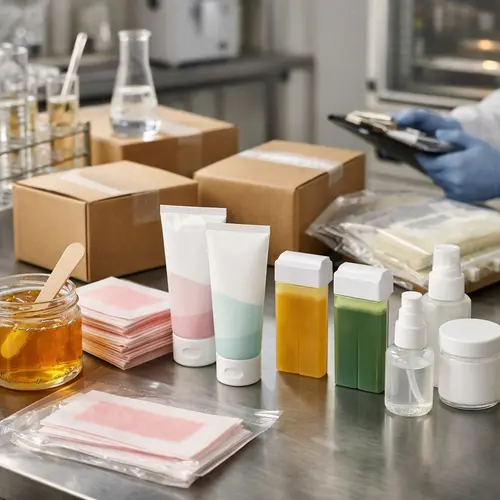
Depilatory cream offers a smooth, easy-to-demonstrate application, but it requires careful control of contact-time instructions, texture, scent, tube compatibility, and rinse behavior. Wax strips are convenient and travel-friendly, yet adhesion must be balanced against a gentle removal experience. Sugar wax can support a natural positioning, but temperature, consistency, and operator technique affect performance. Roll-on wax cartridges create strong visual content and convenient coverage, while also requiring close attention to roller movement, filling weight, leakage, and heat exposure.
Aftercare is part of the same product story. A soothing gel or recovery lotion can be developed as a companion SKU or included in a removal kit, provided the product claims, instructions, and packaging are reviewed for the target market. Buyers can compare options through hair removal product solutions and then narrow the brief around a specific body area, user profile, and retail channel.
The commercial context also matters. A TikTok Shop launch may prioritize an instantly visible texture, a fast demonstration, and compact fulfillment packaging. A salon distributor may prioritize repeatable application, larger formats, and carton durability. Amazon sellers need packaging that survives warehouse handling and shipment conditions; buyers should review the Amazon FBA fulfillment program guidelines before finalizing dimensions, seals, and outer cartons.
For US launches, the supplier should explain how product information, responsible-person details, safety substantiation, adverse-event handling, and facility obligations align with the Modernization of Cosmetics Regulation Act of 2022. For EU distribution, ask how the product information file, ingredient naming, and CPNP notification support will be handled. This is not paperwork to postpone until the artwork is finished.
Founders who need a faster route can review hair removal OEM ODM services, but should still ask which parts are standardized, which parts can be customized, and whether the same formula will be used for the sample and production batch.
Technical or Packaging Factors
Formula and application behavior
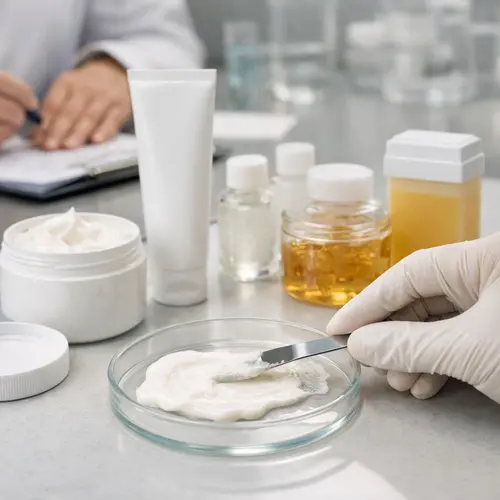
For depilatory cream, evaluate spreadability, wetness, rinse-off, odor, visible residue, and texture recovery after repeated opening. The formula should remain uniform in the intended container and should not become watery, overly stiff, or grainy during storage. Ask the supplier to define the expected viscosity range and the method used to measure it. A visually attractive cream that cannot be filled consistently is not launch-ready.
For wax, request the softening or melting range relevant to the selected format, together with application temperature guidance. A low-temperature wax may improve comfort, but it still needs enough grip to remove hair effectively. A roll-on formula should pass repeated rolling tests without clogging or depositing an uneven layer. For wax strips, review strip substrate, adhesive coating, pull strength, residue, and aging behavior. For sugar wax, confirm whether the texture changes significantly with humidity or warming.
Packaging compatibility and shipment
Packaging should be tested with the actual formula, not an unrelated base. Review tube wall stress, cap torque, liner performance, pouch seals, jar closure, roller-ball movement, and label adhesion. A package that looks premium on camera can still fail through seepage, paneling, cracked seals, or oil migration.
Ask for heat and cold storage observations, freeze-thaw review where relevant, accelerated stability results, and transport simulation. The supplier should also check filling weight, leakage after inversion, carton compression, and component availability. For a creator-led brand, packaging development should run beside formula sampling rather than after it. That enables a 7-day sample target when the components are available, while keeping the final decision based on performance rather than speed alone.
Visual texture is a useful marketing asset, but it must remain repeatable. A cream-to-film transition, a clean wax pull, or a controlled roll-on layer should look similar across samples. PZIK’s visual-first approach can support content-ready texture development, while the hair removal manufacturing process should show how sampling, filling, inspection, packaging, and shipment are connected.
When selecting a depilatory cream OEM partner, ask for the exact sample scope: formula versions, pack sizes, decoration options, documentation, revision limits, and the point at which additional charges apply. For a broader kit, post-depilation care OEM can help align the removal and aftercare experience without forcing the brand to manage separate suppliers.
Decision Framework Table
| Factor | What to Check | Why It Matters | ODM Buyer Note |
|---|---|---|---|
| Skin-positioning brief | Body area, user profile, fragrance preference, contact-time guidance, and claim boundaries | Prevents a general formula from being marketed as suitable for every sensitive-skin use case | Write the intended use on the RFQ before requesting samples |
| Formula texture | Spread, viscosity, residue, rinse behavior, wax grip, or sugar-wax consistency | Controls comfort, performance, and the quality of demonstration content | Approve a measurable texture range, not a subjective description such as creamy |
| Irritation-risk review | Fragrance, colorants, active materials, usage limits, patch-test language, and complaint process | Reduces avoidable consumer reactions and customer-service escalation | Request supporting safety and labeling documents before artwork approval |
| Pack compatibility | Tube, jar, sachet, cartridge, strip substrate, seal, cap, liner, and label adhesion | Prevents leakage, separation, drying, or component failure during storage | Test the final formula in the intended pack and closure |
| Stability and shipment | Heat, cold, humidity, vibration, inversion leakage, carton compression, and filling weight | Links laboratory performance to real warehouse and customer conditions | Define destination climate and shipping route in the project brief |
| Scale readiness | Pilot quantity, lead time, raw-material continuity, filling capacity, and change-control process | Protects the launch if social content creates a sudden demand spike | Confirm that the mass-production line will not require a new formula |
Before sending an RFQ, prepare a one-page brief covering format, target body area, pack size, fragrance direction, visual effect, market, target retail price, pilot quantity, and launch date. Then ask the supplier to return a sample plan, test plan, document list, packaging assumptions, and landed-shipment estimate. A focused brief makes comparison easier than a long list of desired claims.
For next-step sourcing, buyers can review private label depilatory cream, private label waxing products, and post hair removal serum supplier options. When the format is selected, use request a hair removal product quote to submit the brief and confirm sample timing, MOQ, packaging, documents, and production capacity.

ODM Manufacturing Considerations
For private-label buyers, the most important ODM decision is not whether a supplier can make wax or cream in general. It is whether the supplier can convert a specific product brief into a repeatable, documented item. A useful brief should define the removal area, target hair type, application thickness, contact time, fragrance direction, residue tolerance, color, pack size, sales channel, and intended market.
Begin with a written sample-confirmation process. Ask the supplier to identify which sample is the commercial reference, what changes are still allowed, and which characteristics cannot drift. For a depilatory cream, record spreadability, rinse behavior, odor, color, and the acceptable feel after removal. For wax, record working consistency, pull behavior, stringing, brittleness, and the temperature or viscosity range needed for application. A visual product intended for social media may need a distinctive color or texture, but appearance should never be approved separately from skin-contact performance.
Formula customization should be handled through a controlled change list rather than casual messages. Specify whether the priority is lower fragrance, a softer wax, stronger strip pickup, faster cream removal, a natural-ingredient story, or a particular aftercare feel. Ask for an ingredient list, allergen or fragrance disclosure where applicable, usage directions, warning language, and a clear statement of which ingredients are fixed, optional, or proprietary. Buyers should also request a small retained reference from each approved batch so future production can be compared with the signed sample.
Packaging compatibility must be reviewed at the product level. A cream that works in a tube may not dispense consistently through a narrow opening. Sugar wax may need a closure that limits contamination during repeated use. A roll-on cartridge requires a stable fit between the reservoir, roller head, cap, and outer carton. Wax strips need packaging that protects adhesive performance without creating excess heat or pressure during storage. Use the relevant hair-removal OEM/ODM service page or supplier brief to document pack dimensions, filling weight, closure type, artwork version, and approved materials.
A stability review should compare the first sample with the product after planned storage and transit conditions. Look for separation, odor change, color shift, hardening, softening, crystallization, loss of adhesion, and changes in dispensing. The buyer should receive dated observations rather than a simple pass statement. If a product is sold through a marketplace or third-party warehouse, shipment planning should also account for carton strength, orientation limits, temperature exposure, and the possibility of extended storage. Amazon sellers can compare their handling assumptions with the Amazon FBA fulfillment program guidelines.
MOQ should be separated into sample MOQ, packaging MOQ, and production MOQ. A supplier may be flexible with the formula but require a larger run for printed tubes, cartons, strips, or custom cartridges. Ask for the cost impact of standard packaging, custom packaging, and a later artwork change. A transparent BOM should show product, container, closure, label, carton, inserts, testing or inspection charges, and delivery assumptions. This helps distinguish a genuinely suitable supplier from one that appears inexpensive only because key costs are omitted.
Labeling documents should be prepared before artwork approval. Request the ingredient declaration, net contents confirmation, batch or lot coding format, shelf-life or period-after-opening guidance where applicable, directions, warnings, storage language, and origin details. The importer or brand owner remains responsible for market-specific review, but the factory should be able to provide consistent source documents. Shipment conditions should state carton quantity, gross and net weight, pallet or carton dimensions, loading orientation, recommended storage, and the documentation supplied with each lot. A buyer can also review the related manufacturing process overview before finalizing the specification.
Request an RFQ only after these points are written down. Clear inputs reduce revision rounds and make it easier for a manufacturing contact to understand a marketing idea without guessing at the technical requirement.

Common Problems or Failure Cases
Wax brittleness: A hard wax or sugar wax can crack, crumble, or break before it lifts hair. This may result from an unsuitable working range, moisture exposure, an overly rigid formula, or an incorrect application thickness. Have the supplier compare the approved sample with a retained production reference and specify the acceptable pull and flexibility range.
Loss of strip adhesion: Wax strips may look normal while picking up less hair after storage. Common warning signs include uneven coating, excessive powder transfer, poor edge pickup, or adhesive transfer to the skin. The buyer should approve both immediate performance and aged-pack performance, then confirm that the inner wrap and carton protect the strips during shipment.
Cream separation: A depilatory cream may develop liquid pooling, graininess, odor change, or uneven color. Even if it can be remixed, the product may dispense inconsistently and create an unacceptable customer experience. Ask for a defined appearance standard, fill inspection, retained samples, and a clear disposition process for out-of-specification units.
Cartridge leakage: Roll-on wax can leak around the roller head, cap, seam, or base when the cartridge is stored on its side or exposed to changing temperatures. Check the assembled pack, not only the empty component. Shipment cartons should preserve the intended orientation and prevent movement that could loosen the closure.
Fragrance sensitivity: A strong fragrance can become the main complaint even when hair removal works. Buyers targeting sensitive skin should compare scented and low-fragrance versions, review fragrance disclosure, and avoid marketing language that implies universal suitability. The NBC News summary on depilatory cream safety also emphasizes following product directions and stopping use when discomfort occurs; this is useful context for directions and warning copy.
Packaging deformation: Tubes, jars, pouches, or cartridge components may dent, warp, discolor, or lose their seal. Do not approve packaging from photographs alone. Request filled samples, closure checks, carton samples, and a written record of acceptable cosmetic defects. These details are especially important when the product will be filmed in close-up or shipped through a high-volume fulfillment network.
Supplier Checklist
- Can the supplier provide a written product brief covering removal area, application behavior, fragrance, color, contact time, and aftercare expectations?
- Is there one signed or otherwise identified reference sample for formula, texture, odor, color, and pack appearance?
- Can the factory explain which formula changes are possible and how each change affects MOQ, cost, timing, and performance?
- Will the supplier provide ingredient, warning, usage, batch-coding, net-content, and origin documents before artwork approval?
- Has the filled product been checked with the exact tube, jar, pouch, strip wrap, or roll-on cartridge proposed for production?
- Does the stability review cover cream separation, wax consistency, strip adhesion, fragrance change, leakage, and package deformation?
- Are sample MOQ, packaging MOQ, production MOQ, BOM costs, inspection charges, and freight assumptions shown separately?
- Can the supplier explain how it protects intellectual property through confidentiality terms, formula ownership language, artwork control, and restricted use of custom materials?
- Does the account team understand the launch calendar, content format, target customer, and visual requirements rather than only the unit specification?
- What capacity is reserved for repeat orders, and how will the supplier respond if a social campaign creates an unexpected demand increase?
FAQ
Could a factory copy my concept or custom formula and sell it to another brand?
No supplier can remove every commercial risk, so use written confidentiality, ownership, exclusivity, and permitted-use terms before sharing sensitive details. Keep dated briefs, approved samples, artwork files, and change records. Ask whether the formula is fully custom, based on a shared base, or assembled from standard components. The answer affects how much exclusivity is realistic.
Can the sample achieve an exaggerated visual effect on camera?
It can, but visual drama should be tested with the real fill, lighting, application thickness, and removal motion. Ask for several color or texture directions, then select the most distinctive option that still spreads, removes, rinses, or peels consistently. Approve a physical sample rather than a digital color reference, and request close-up footage only as a supplement to hands-on review.
How can I reduce the risk of customers experiencing severe irritation?
Require a clear sensitive-skin positioning review, complete directions, warning language, fragrance disclosure, and documented batch controls. Review the intended body area and contact time carefully, and do not use claims suggesting that every customer will tolerate the product. The brand should also maintain a complaint process and pause shipment when a meaningful performance or irritation pattern appears.
I do not understand ingredients. Can the supplier understand social-media marketing requirements?
A capable account team should translate phrases such as creamy reveal, clean pull, low-odor demo, or satisfying texture into measurable product requirements. Test this during the brief stage: ask the contact to restate the concept in terms of texture, color, application, removal, packaging, and filming conditions. If the response remains limited to price and MOQ, communication risk is high.
What if a video goes viral and demand suddenly exceeds the first order?
Discuss a repeat-order plan before launch. Confirm available filling capacity, packaging replenishment time, backup component options, production priorities, and the conditions for reserving a later slot. A supplier with experience supporting overseas creator brands should be able to show how it handled demand changes without promising unlimited output.
Should I choose a natural wax or a depilatory cream for sensitive-skin positioning?
Choose based on the intended use, removal behavior, fragrance tolerance, customer education, and shipment conditions. Wax may require more precise working instructions, while cream demands careful contact-time and warning communication. Compare the complete user experience, including aftercare, package stability, and complaint risk, rather than selecting from the ingredient story alone.
References
- NBC News: Is Hair Removal Cream Safe? Dermatologists Explain — background for cautious directions, contact-time communication, and user warnings.
- Amazon FBA fulfillment program guidelines — reference for marketplace storage, shipment preparation, and fulfillment considerations.