Direct Answer
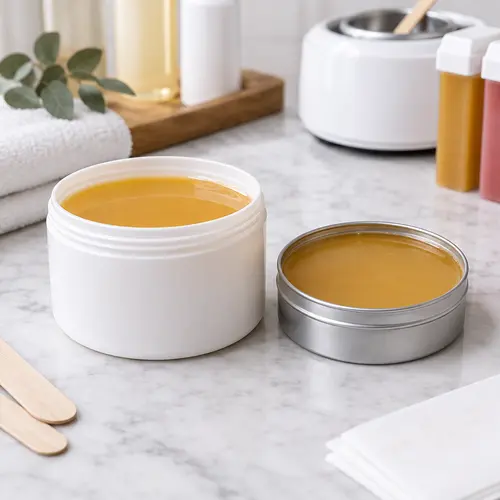
For most private-label wax products, a polypropylene plastic jar is the safer default. It is lighter, resists dents, supports threaded lids and liners, and generally handles wax oils better than an uncoated metal tin. Metal wins when premium shelf presence, compact form, or a pomade-like hard-wax concept matters more than shipping weight and reheating flexibility.
The right wax jar packaging decision still depends on the formula. Hard wax, soft wax, and sugar wax have different fill temperatures, water content, reheating instructions, and leakage risks. A metal tin can tolerate a hot fill yet transfer heat rapidly to the user’s hand. Plastic stays cooler but may warp if its resin, wall thickness, or closure is not matched to production conditions.
Choose only after filled-pack testing. Review texture, closure torque, oil migration, heat and cold storage, drop performance, label adhesion, and shipment orientation before approving mass production.
Key Takeaways for Private Label Buyers
- Start with the formula. Butter-like hard wax, fluid soft wax, and water-rich sugar wax do not place the same demands on a jar.
- Specify the plastic. PP is commonly considered for hot-filled wax. PET or other resins should not be approved from appearance alone.
- Specify the metal construction. Confirm whether the tin is aluminum or tinplate, whether the interior is coated, and whether the lid is threaded, hinged, or friction-fit.
- Test the complete pack. Jar, lid, liner, label, ink, wax, and carton must be evaluated together through storage and transit testing.
- Align packaging with use. Metal must not be positioned for microwave reheating. Plastic should only carry microwave instructions when the complete filled pack has been approved for that use.
- Lock the BOM before launch. Record resin or alloy, jar weight, decoration, closure, liner, carton, and approved suppliers so the production batch matches the sample.
Buyer Context
Wax packaging is part of product performance, not a decoration selected after development. A creator-led brand may want a reflective metal tin because it reads well on TikTok. The same tin can become uncomfortable to hold after warming, dent in parcel delivery, or develop interior discoloration when paired with a water-bearing sugar wax.
A plastic jar offers more color options, lower freight weight, and a larger decoration area. It can also show sink marks, scuffing, lid mismatch, or panel distortion when the pack is under-specified. These failures are highly visible in unboxing content, even when the hair-removal formula itself performs correctly.
Format changes the decision. Hot wax needs a wide opening and controlled heat resistance. Soft wax needs stronger leakage control. Sugar wax requires close attention to moisture loss, corrosion, and reheating directions. Roll-on wax cartridges need an entirely different leakage review, while wax strips depend more on pouch barrier and adhesion aging. Buyers comparing formats can review private label waxing products and broader hair removal product solutions.
The jar also affects the content calendar. Ask whether the ODM can provide a decorated packaging mockup and a filled sample within a seven-day sampling target, then state what that sample includes. A plain jar with substitute wax is not a launch-ready approval sample. For pilot planning, confirm whether the selected decoration remains viable from 1,000 units and whether the same specification can scale without changing texture, color, or closure performance. These points should be defined within the hair removal OEM ODM services scope.
Technical or Packaging Factors
Fill Temperature and Dimensional Stability
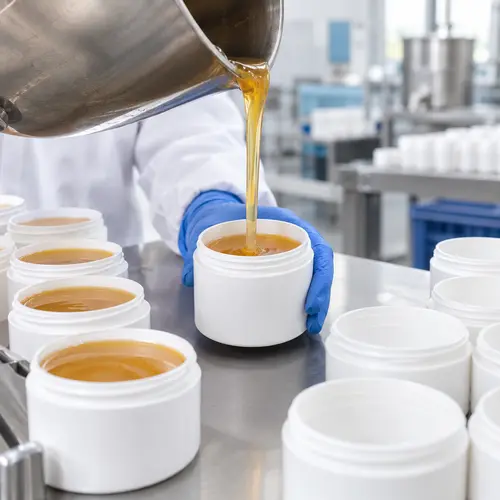
Many hard-wax formulas soften or melt within an approximate 45–65°C window, but actual ranges depend on the resin, wax, oil, and fragrance system. Filling may occur around 70–85°C for some products. These are planning ranges, not universal specifications. The supplier should record the validated formula temperature at filling and the package temperature at capping.
PP jars are often selected because they can accommodate elevated fill temperatures, provided the grade and wall design are suitable. A thin jar may ovalize or lose thread alignment. Metal is less likely to warp, but rapid heat transfer can create handling and condensation concerns. The cosmetic filling and packaging process should show where temperature, fill weight, cooling time, and closure application are checked.
Formula Contact and Barrier Performance
Wax oils and fragrance can soften liners, stain coatings, or migrate into label adhesives. Metal tins require an interior coating review, particularly for sugar wax or any formula containing meaningful water. Tinplate can corrode where coating coverage is incomplete; aluminum avoids red rust but can still react, discolor, or dent.
Plastic compatibility is resin-specific. Request filled samples from the intended packaging lot, not a visually similar stock jar. Inspect for swelling, cracking, odor transfer, oil sweating, liner lift, and changes in wax surface texture. Scientific coverage in the International Journal of Cosmetic Science can provide useful background, but the final decision must come from testing the actual formula-pack combination.
Storage, Transit, and User Safety
A practical screen can include storage at 4°C, 25°C, and 40°C for 8–12 weeks, plus three freeze-thaw cycles when cold-route exposure is plausible. Add upright, side, and inverted storage; a one-meter packaged drop; and parcel vibration appropriate to the sales channel. Record leakage, lid release, deformation, corrosion, label movement, fragrance loss, and texture change at defined checkpoints.
Packaging does not replace an irritation-risk review. For warmed wax, confirm application temperature, heating instructions, warning language, and the risk of hot spots. Metal transfers heat quickly. Plastic can retain heat differently and may deform if overheated. After-wax routines can be planned through after wax care products, while broader technical education is available in waxing and depilatory guides.
Decoration and Label Control
Plastic supports direct printing, labels, sleeves, and molded color. Metal supports direct print, embossing, labels, and premium finishes, but dents and curved surfaces can expose alignment problems. Confirm rub resistance after wax contact and warming.
Reserve space for identity, net quantity, ingredient declaration, business details, directions, warnings, and lot coding. Use the FDA Cosmetics Labeling Guide for U.S. label planning and Australia’s TGA cosmetic-therapeutic boundary guidance when reviewing Australian claims. Claims and market files should be settled before artwork release, not after printed packaging arrives.

Decision Framework Table
| Factor | What to Check | Why It Matters | ODM Buyer Note |
|---|---|---|---|
| Formula type | Hard wax, soft wax, sugar wax, water content, fragrance load | Changes corrosion, leakage, and barrier risk | Submit the exact formula for compatibility work |
| Fill conditions | Wax and jar temperature during filling and capping | Prevents distortion, loose lids, and surface defects | Approve a recorded filling window |
| Closure | Thread fit, liner material, torque, tamper evidence | Controls leaks and first-open experience | Test after hot and cold storage |
| Reheating | Approved method, maximum time, user instructions | Reduces overheating and package misuse | Never imply that a metal tin is microwave-safe |
| Transit | Drop, vibration, orientation, carton fit | Reveals dents, cracks, lid release, and oil seepage | Test the fulfillment-ready carton |
| Commercial scope | MOQ, sample inclusions, tooling, decoration, lead time | Protects the launch schedule and cost model | Request a line-item BOM through a hair removal product RFQ |
| Scale-up | Approved suppliers and component tolerances | Keeps later batches consistent with launch samples | Confirm capacity through the selected hair removal OEM manufacturer |
ODM Manufacturing Considerations
For wax jar packaging, the manufacturing decision should begin with an approved reference sample rather than a container quotation alone. The reference should define the wax color, fragrance level, surface appearance, break pattern, pickup behavior, and performance at the intended use temperature. Approval records should include dated photographs, the sample code, packaging components, and measurable limits where possible. A buyer can then distinguish an intentional formula adjustment from uncontrolled batch variation during production.
Formula customization should be linked to the target hair-removal method and market position. A hard wax may need a specific balance between flexibility and clean removal, while a soft wax must spread evenly at the planned application temperature. Sugar wax requires close control of consistency, and depilatory cream must maintain uniform appearance and dispensing behavior. Ask the supplier to document target viscosity or melt behavior, fragrance concentration, color reference, and permitted tolerances. The sample scope should state how many revisions are included and whether fragrance, color, texture, and package trials are charged separately.
Packaging compatibility remains a joint formula-and-container decision. Confirm the jar or tin specification, lid fit, seal or liner, decoration method, net contents, and headspace before approving tooling or printed inventory. The supplier should review retained samples for changes in closure fit, odor, staining, surface finish, and container shape under the expected storage profile. Buyers comparing formats can also ask whether the same approved formula behaves differently in plastic and metal because of heat transfer during warming and cooling.
A stability plan should identify the formula lot, component lot, review intervals, acceptance criteria, and person responsible for sign-off. It should cover texture, color, odor, package condition, and functional performance. For products that contact sensitive skin, request an irritation-risk assessment based on ingredients, intended use, warnings, and available finished-product evaluation. No quality system removes all risk, so approval should be based on documented controls, traceable records, and a defined process for complaints and corrective action.
MOQ discussions should separate bulk production, container decoration, labels, cartons, and assembly. A low filling MOQ may still require a larger printed-component order. Request an itemized BOM, charges for samples and tooling, expected component overage, and ownership of unused packaging. The supplier should also provide label copy inputs such as the ingredient list, lot identification format, net quantity, responsible-party details, directions, warnings, and country-of-origin information as applicable. Destination-specific claims should be reviewed before artwork approval. The OEM/ODM service process and manufacturing process should make these approval points visible.
Shipment conditions should be agreed before production scheduling. Define carton count, pallet requirements, temperature exposure concerns, acceptable transit duration, export documents, and responsibility for freight insurance. For launch planning, ask for separate dates for components received, bulk completed, filling, inspection, and cargo handoff. This provides a more useful schedule than a single estimated completion date.
Common Problems or Failure Cases
Wax brittleness often appears as cracking during removal or fragments left on the skin. Possible contributors include an unsuitable formula target, excessive cooling, or inconsistency between the approved sample and production batch. The buyer should compare batch records and removal performance against the signed reference rather than accepting appearance alone.
Strip adhesion loss can result from changes in wax pickup, strip material, storage exposure, or contamination during packing. A finished strip pack should be evaluated as a complete product, including opening, separation, application, removal, and residue. For soft wax, an otherwise acceptable bulk formula can still fail if the package dispenses too much product or allows wax around the closure.
Depilatory cream separation may show as watery discharge, uneven color, or inconsistent extrusion. These signs require investigation before shipment because remixing a sample does not establish that the retail product will remain uniform. Roll-on cartridge leakage can similarly originate from the formula, roller fit, cap fit, filling level, or transit exposure. Record where leakage appears and which component lots are affected.
Fragrance sensitivity is another preventable source of complaints. Strong scent may support a brand concept on camera but can conflict with use on sensitive areas. Buyers should review allergen-related documentation, intended-use warnings, and fragrance alternatives before confirming the production formula. Packaging deformation, meanwhile, may affect lid engagement, label presentation, or warming instructions even when no product escapes. Cosmetic appearance and functional closure performance should therefore have separate acceptance limits.
Supplier Checklist
Use the following checks when comparing a hair-removal product supplier:
- Request samples tied to unique formula, fragrance, color, and packaging codes.
- Define measurable approval criteria for texture, viscosity or melt behavior, color, odor, net contents, and removal performance.
- Confirm that the jar, tin, cartridge, strip pouch, or cream container is assessed with the actual finished formula.
- Review ingredient documents, safety data where applicable, label inputs, batch records, and finished-product inspection criteria.
- Ask how raw materials, bulk product, packaging components, and finished batches are identified and traced.
- Separate the MOQ and cost for formula production, filling, decoration, labels, cartons, and freight.
- Verify capacity by line, realistic scheduling assumptions, component lead times, and the process for urgent repeat orders.
- Confirm shipment configuration, environmental limits, inspection timing, release authority, and complaint handling.
- Put sample ownership, formula confidentiality, artwork control, and rules for subcontracting into written agreements.
FAQ
Can a Chinese OEM use my formula or product idea for another customer?
A contract cannot prevent every breach, but it creates enforceable boundaries. Use a confidentiality and development agreement that identifies your formula brief, samples, artwork, test results, and ownership of custom work. Ask who can access the files, whether development is performed in-house, and whether subcontractors are involved. Avoid relying only on a general NDA.
How can I confirm that the wax texture and color will look right on camera?
Approve samples under the lighting and filming conditions used for your content. Record warm-up state, application thickness, pull behavior, color reference, gloss, and residue. Send the supplier short reference clips with measurable comments instead of terms such as ‘more dramatic.’ The final signed sample should remain the production benchmark.
Can quality controls guarantee that customers will never experience irritation?
No responsible supplier can guarantee zero reactions. Risk can be reduced through ingredient review, intended-use limits, controlled production, traceability, appropriate warnings, and finished-product evaluation. Ask how the supplier investigates complaints and whether affected batches and material lots can be identified quickly.
What if I do not understand technical ingredient terminology?
A capable project contact should translate your marketing goal into testable product criteria. Ask for plain-English summaries covering texture, fragrance, application, removal, sensitive-area restrictions, and packaging use. Confirm every decision in a written sample brief so that social-media language does not replace manufacturing specifications.
What happens if a video creates a sudden increase in orders?
Ask for documented normal and peak monthly output for the relevant filling line, not total factory capacity. Confirm whether packaging materials can be reserved, how repeat orders are prioritized, and which lead-time assumptions change at higher volumes. A forecast with staged releases is usually more dependable than an unsupported promise of immediate expansion.
Is plastic always less expensive than a metal tin?
No. Unit price depends on resin or metal grade, weight, decoration, closure parts, order quantity, packing density, and freight. Compare complete landed BOMs at the same volume. Include rejects, component overage, labels, cartons, and any handling needed to protect decorated surfaces.
References
- FDA Cosmetics Labeling Guide provides guidance on cosmetic identity, net quantity, ingredient declarations, and other label elements for the United States.
- Australia’s TGA cosmetic-therapeutic boundary guidance explains how ingredients, presentation, and claims can affect product classification in Australia.