Direct Answer
Effective wax jar packaging should tell the user exactly how to prepare, heat, apply, remove, and store the wax—without forcing critical safety information into an insert that may be discarded. For private-label buyers, the label should combine formula-specific directions, heat and skin warnings, net weight, ingredient information, responsible-party details, batch traceability, and clear accessory notes. It must also distinguish between items included in the pack and tools the customer must purchase separately.
Do not approve generic wording before the formula, jar, heating method, and target market are fixed. Hard wax, sugar wax, microwaveable wax, and warmer-only wax require different instructions. The final copy should be reviewed on the actual curved jar, tested after heat and cold storage, and compared with the outer carton or insert. The FDA guide treats directions for safe use and warnings as information-panel content and emphasizes readable, conspicuous presentation. ([fda.gov](https://www.fda.gov/cosmetics/cosmetics-labeling-regulations/cosmetics-labeling-guide))
Key Takeaways for Private Label Buyers
- Lock the formula and heating method before approving label directions.
- Separate required accessories from spatulas, strips, or aftercare products included in the kit.
- Test label adhesion against wax residue, heat, condensation, abrasion, and shipping movement.
- Use formula-specific warnings rather than copying language from a competitor’s jar.
- Review the physical label at retail size, not only as a full-screen design file.
- Approve market-specific artwork only after the ingredient list, net weight, and responsible-party details are confirmed.
Buyer Context
A wax jar is both a product container and an operating interface. A creator-led brand may focus first on color, a butter-like texture, or a dramatic pull for short-form video. The customer, however, still needs a reliable sequence from opening the jar to removing the wax. If the heating method is unclear, a visually strong launch can quickly produce uneven melting, burns, failed hair pickup, leakage complaints, or negative reviews.
The labeling model also changes by product. Hard wax may not require removal strips, while soft wax usually does. Sugar wax may support hand or strip techniques depending on the composition. A roll-on cartridge needs separate warmer and cartridge-fit instructions. Pre-coated wax strips need hand-warming, separation, application, and residue-removal directions rather than jar-heating copy. Aftercare products should be positioned as separate steps, with buyers able to review suitable after wax care products and after hair removal serum options.
For a custom launch, treat the label as part of product development—not a graphic design task added after filling. Ask the supplier to show the wax at its intended working texture, provide a camera-ready sample, and map label milestones into the hair removal manufacturing process. A useful sample review should cover application feel, removal behavior, residue, fragrance, jar handling, and the exact accessories used during the demonstration.
Market requirements also shape the artwork. U.S. cosmetics need required information presented prominently and in terms consumers can understand. The FDA guide notes that warning statements generally use lettering no smaller than 1/16 inch unless another requirement applies, making dense decorative layouts risky. ([fda.gov](https://www.fda.gov/cosmetics/cosmetics-labeling-regulations/cosmetics-labeling-guide)) For Great Britain, product notification should be planned alongside final label data through the UK SCPN cosmetic notification process. ([gov.uk](https://www.gov.uk/guidance/submit-a-cosmetic-product-notification)) Amazon sellers should also review Amazon’s dangerous-goods classification rules for cosmetics before inventory is routed to fulfillment.
Technical and Packaging Factors
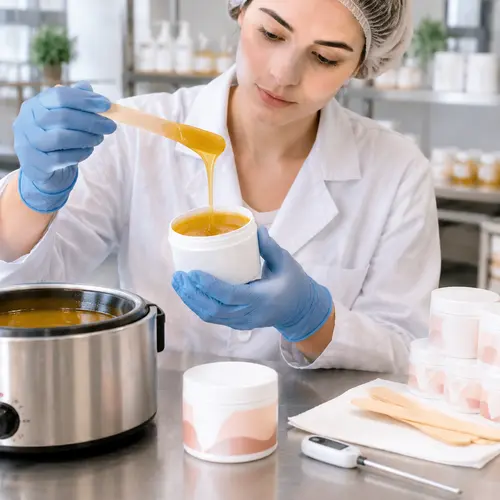
Directions should match the validated use sequence. State whether the wax is warmed in a dedicated heater, microwave, water bath, or another approved method. Include stirring, temperature checking, application direction, removal direction, and post-use closure. Avoid a universal heating time because wattage, fill weight, room temperature, and wax composition can change the result. If the jar is warmer-only, say so directly.
Accessory notes must remove ambiguity. A concise panel can state whether strips are required, whether a spatula is included, and whether a heater, gloves, pre-wax cleanser, or soothing product is sold separately. For professional bulk formats, specify whether single-use applicators are expected and whether the jar is compatible with the buyer’s warmer dimensions. Review complete kit options through private label waxing products and broader waxing product solutions.
Warnings should reflect real misuse risks. Typical review points include excessive heat, use on irritated or damaged skin, contact with eyes or mucosal areas, repeated application on the same area, child access, and discontinuation if significant irritation occurs. Patch-test directions, restricted body areas, and professional-use statements should only be added when supported by the actual product and market plan. Buyers developing mild-positioned products should compare claims and warning language with low irritation hair removal products.
The label material must survive the formula. Wax residue, fragrance components, oil migration, warm filling, condensation, and repeated lid handling can lift edges or blur print. Test the production label on the production jar—not a substitute sample. Include heat and cold storage, upright and side-position leakage review, scuff testing, cap torque checks, and shipment simulation. A transparent BOM comparison should identify the jar resin, liner, cap, label stock, adhesive, decoration, carton, and accessories before the purchase order is released.
Front-panel clarity comes before visual density. The identity statement and net quantity should remain easy to find. FDA guidance generally treats solid, semi-solid, and viscous cosmetics as weight declarations rather than fluid measure. ([fda.gov](https://www.fda.gov/cosmetics/cosmetics-labeling-regulations/cosmetics-labeling-guide)) Place detailed directions and warnings on the information panel, outer carton, or insert according to available space, but do not hide essential safe-use steps only in digital content. For broader planning, review hair removal OEM ODM services, the hair removal OEM manufacturer overview, and related waxing and depilatory guides.
Decision Framework
| Factor | What to Check | Why It Matters | ODM Buyer Note |
|---|---|---|---|
| Heating directions | Approved device, sequence, stirring, and temperature check | Reduces overheating and inconsistent texture | Approve copy using the final formula and fill weight |
| Warnings | Heat, skin condition, body-area, eye-contact, and child-safety language | Addresses predictable misuse without vague over-warning | Review separately for each target market |
| Accessories | Required, included, optional, and separately sold items | Prevents incomplete-use complaints and returns | Show the exact kit contents in the sample sign-off |
| Label durability | Adhesive lift, oil exposure, heat, cold, scuffing, and condensation | Protects readability through filling, transit, and use | Run testing on decorated production components |
| Artwork fit | Curved-surface readability, panel hierarchy, barcode, and batch area | Keeps required information legible at retail size | Request a printed mockup before bulk production |
| Launch scope | Sample timing, MOQ, BOM, cartons, inserts, and shipment conditions | Connects artwork approval to the real launch schedule | Request a hair removal product quote with comprehensive packaging details |
ODM Manufacturing Considerations
For custom wax jar packaging, the approved sample should function as a production control, not merely a color reference. Confirm the wax texture at room temperature, behavior during heating, working consistency, fragrance strength, color, hair-grip performance, cooling time, residue level, and removal experience. Record the approved jar, lid, label material, fill weight, batch code position, and any included spatula or instruction insert. A signed sample specification reduces disagreements when bulk production begins.
Formula customization should start with measurable priorities. For hard or soft wax, define the desired melting or application range, flexibility after cooling, grip, fragrance level, and whether the texture must look especially glossy, elastic, creamy, or butter-like on social media. For depilatory cream, review spreadability, odor, contact-time directions, rinse behavior, and separation risk. Sugar wax and roll-on wax cartridges need their own viscosity and flow targets. Buyers can compare mature private-label bases with a more custom OEM/ODM development route before deciding how much development work is justified.
Primary packaging must be evaluated with the actual product. Wax can soften label adhesives, distort some plastics under elevated storage temperatures, or create messy threads around the jar neck. Depilatory cream can place different demands on tubes, seals, pumps, and printed decoration. Ask for compatibility observations using production-intent components, including the jar resin, cap, liner, cartridge roller, tube laminate, label stock, and adhesive.
A stability review should track appearance, odor, color, texture, separation, container condition, closure performance, and label readability under defined storage conditions. The supplier should explain which checks are completed before production and which continue afterward. Any custom fragrance, color, botanical addition, or packaging change may require a revised review rather than reliance on results from the original base product.
MOQ should be separated into formula MOQ, filling MOQ, printed-packaging MOQ, carton MOQ, and accessory MOQ. A low product MOQ can still become expensive if custom jars, pouches, inserts, or spatulas require larger purchases. Request a transparent BOM comparison showing product, packaging, accessories, testing, freight assumptions, and expected unused material. Buyers with strict launch dates should also confirm the sample window, artwork deadline, component lead time, filling schedule, and reserve capacity for repeat orders. The supplier’s manufacturing process should make these dependencies visible.
Before shipment, confirm the label file, ingredient list, directions, warnings, responsible business details, batch coding method, carton marks, packing count, pallet requirements, and destination documents. For Great Britain, the notification process requires information including an ingredient summary, label image, and packaging photograph before a new cosmetic is placed on the market. Shipping plans should also account for summer heat exposure, cold-weather brittleness, carton compression, and whether a marketplace or carrier requires additional product classification information.

Common Problems or Failure Cases
Wax becomes brittle or cracks: A hard wax sample may perform well in a controlled room but fracture after cold storage or during removal. Confirm flexibility across expected warehouse and consumer conditions, and check whether color or fragrance adjustments altered the approved behavior.
Strip adhesion weakens: Premade wax strips can lose grip if the wax coat, release film, storage temperature, or pouch seal is inconsistent. Compare fresh samples with aged samples and verify that the consumer directions explain warming, pressing, and removal technique clearly.
Depilatory cream separates: Visible liquid release, thinning, graininess, or uneven odor can indicate that the formula or package is not stable under the selected conditions. Review retained samples and filling records before approving shipment.
Roll-on cartridges leak: Leakage can come from excessive product flow, poor roller fit, closure damage, or heat exposure. Test filled cartridges in multiple orientations and inspect the retail box for oil staining or deformation.
Fragrance creates avoidable complaints: A strong scent may support a distinctive market position but can increase sensitivity concerns or conflict with required warning space. Approve fragrance at the intended dosage and request an unscented or lower-fragrance comparison when targeting sensitive users.
Packaging deforms: Thin jars, caps, tubes, or kit trays may warp during storage or transportation. Finished-pack review should include stacked cartons and the same accessories planned for retail, not empty display components.
Directions do not match the final SKU: Reusing generic copy can leave the wrong heating method, contact time, strip instructions, body-area limitations, or aftercare steps on the label. Each format needs a dedicated copy check before printing.
Supplier Checklist
- Request batch-traceable samples made with the intended color, fragrance, texture, and product format.
- Define measurable acceptance points for melting behavior, viscosity, flexibility, adhesion, separation, odor, and visual appearance.
- Confirm that the sample package matches the planned jar, tube, pouch, cartridge, liner, label, and accessory set.
- Review irritation-risk documentation, use-area restrictions, patch-test wording when appropriate, and complaint-handling procedures.
- Ask for a complete MOQ breakdown covering bulk product, filling, decoration, cartons, inserts, spatulas, strips, and aftercare items.
- Request label-support documents, ingredient information, product specifications, batch records, and destination-specific files applicable to the project.
- Verify storage, carton configuration, shipping conditions, production lead time, repeat-order planning, and surge-capacity rules.
- Require written approval stages for the sample, formula, packaging, artwork, pre-production unit, and finished-goods release.
- Check whether technical and marketing contacts can translate social content goals into testable product attributes.
- Review relevant experience in waxing products, depilatory cream, roll-on formats, strips, and aftercare rather than general cosmetics alone.
FAQ
How can I reduce the risk that a factory will reuse my idea or formula?
Use a mutual confidentiality agreement, define ownership of custom work in the manufacturing contract, limit access to sensitive files, and document which elements are buyer-owned. Ask whether your formula is exclusive, semi-custom, or based on a shared market formula. Keep dated briefs, sample records, artwork files, and payment records.
Can a sample be optimized for dramatic appearance on camera?
Yes, but visual goals should be translated into measurable targets such as gloss, color saturation, stringiness, opacity, spread pattern, cooling behavior, or butter-like texture. Review the product under your own lighting, background, lens, and application method. Approve performance and consumer usability separately so a striking video texture does not create a difficult retail product.
How do I know quality controls are strong enough for an influencer-led launch?
No supplier can promise zero complaints. Reduce risk by confirming raw-material controls, in-process checks, retained samples, packaging inspection, batch release criteria, traceability, and a written complaint investigation process. Conduct an irritation-risk review and avoid claims or use areas unsupported by the approved product directions.
What if I do not understand technical ingredient terminology?
A capable account team should convert your market brief into a clear comparison of product format, texture, odor, use experience, packaging, cost, and testing scope. Ask for plain-English summaries and a decision table rather than accepting unexplained technical language.
What happens if a video creates a sudden sales spike?
Confirm normal monthly capacity, minimum reorder volume, material lead times, priority rules, and whether the factory can reserve jars, labels, or bulk materials. Use staged forecasts and consider holding approved packaging inventory when demand is uncertain but launch visibility is high.
Should usage directions go on the jar or the carton?
The answer depends on available space, market rules, and whether the jar is sold with an outer carton. Keep essential identity and safe-use information accessible, and ensure the jar, carton, and insert do not conflict. The FDA labeling guide identifies directions for safe use, warnings, business information, and ingredient declaration as information-panel content for cosmetics.
References
- FDA Cosmetics Labeling Guide — placement of cosmetic identity, directions, warnings, business information, and ingredient declarations.
- UK cosmetic product notification guidance — notification timing and required product, label, packaging, contact, and ingredient information for the Great Britain market.
- Amazon dangerous-goods classification guidance for cosmetics — marketplace reference for products that may require classification review before fulfillment.