Sustainable Hair Removal Packaging: A Material Selection and Review Workflow
Direct Answer
Sustainable hair removal packaging should reduce material impact without weakening formula protection, application control, shipment durability, or market compliance. Start with the product format: depilatory cream, sugar wax, hot wax, wax strips, roll-on cartridges, and aftercare each place different demands on the pack. Then build a short material hierarchy: remove unnecessary components, favor recyclable mono-material structures where practical, evaluate post-consumer recycled content, and confirm that every sustainability claim can be documented.
Do not approve packaging from a material certificate alone. Review the filled product through compatibility, leakage, storage, transport, usability, and on-screen appearance checks. A lighter tube that deforms, a roll-on cartridge that leaks when warm, or a wax-strip sachet that loses barrier performance is not a sustainable result. The correct decision is the lowest-impact pack that survives the complete product journey with an acceptable safety margin.
Key Takeaways for Private Label Buyers
- Select materials after confirming formula behavior, filling temperature, application method, and destination market.
- Prioritize component reduction and practical recyclability before decorative sustainability claims.
- Test the final formula in the final pack, including closure, liner, label, decoration, and secondary carton.
- Review warm storage, cold storage, leakage, panel distortion, odor transfer, and dispensing performance.
- Request an itemized BOM, material declarations, labeling files, sample scope, MOQ, and shipment configuration before approval.
- Keep one camera-ready prototype for texture, color, dispensing, and creator-content review.
Buyer Context
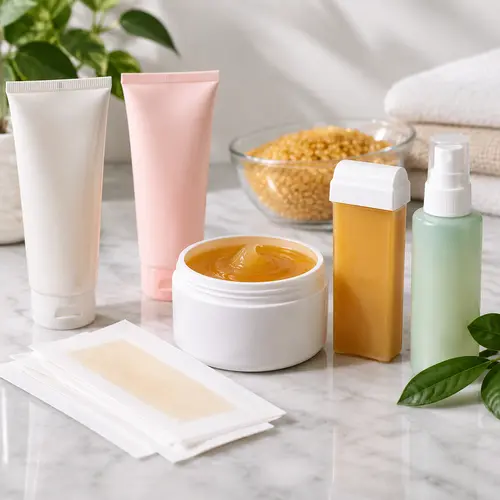
Hair-removal products expose packaging weaknesses quickly. A depilatory cream may challenge a tube, pump, liner, ink, or adhesive over time. Hot wax and sugar wax can be filled warm, creating different dimensional and sealing demands. Roll-on wax cartridges must remain tight in storage while allowing smooth roller movement during use. Wax strips depend on controlled adhesion, release liners, and sachets that limit contamination or oil migration. Aftercare products add another set of viscosity and dispensing variables.
This means a material that performs well for one removal format cannot automatically be transferred to another. Buyers comparing custom depilatory cream formulation with custom wax strips and hot wax should request separate packaging assessments. The same applies when adding post-depilation care OEM products to a kit.
Sustainability language also creates claim risk. Terms such as recyclable, recycled, natural, and organic describe different attributes and require different evidence. They should not imply that the finished product has government approval. The FDA explanation of its authority over cosmetics and its small-business cosmetics fact sheet provide useful starting points for US founders. Brands entering Australia should also review Australia’s TGA cosmetic-therapeutic boundary guidance. For UAE projects, destination checks can begin with the UAE MoIAT industrial standards.
A practical ODM brief should connect these market requirements to the physical pack from day one. That prevents a late redesign after artwork, creator content, or production slots have already been committed.
Technical and Packaging Factors
1. Material Strategy
Begin with reduction. Remove unnecessary trays, double walls, oversized caps, magnets, mixed inserts, and decorative sleeves unless they solve a verified protection or merchandising need. Next, assess whether the primary pack can use a mono-material family. A polyethylene tube with compatible polyethylene components may offer a clearer recycling pathway than a multi-layer structure, but only if it provides enough barrier and stability for the formula.
Recycled resin can reduce virgin-plastic use, yet percentage alone is not a performance guarantee. Ask where the recycled content is used, whether direct formula contact is intended, how color varies between lots, and whether odor or surface defects could appear on camera. Glass and aluminum may support premium positioning, but weight, breakage, dents, internal coatings, and shipping emissions must be assessed. Paper should be reviewed for fiber source, coatings, foil, lamination, and local recycling acceptance.
2. Product-to-Pack Fit
For depilatory cream, inspect panel swelling, brittleness, discoloration, odor transfer, seal integrity, and changes around the cap or pump pathway. Confirm that the opening delivers a controlled dose rather than a sudden surge. Projects positioned for the face or sensitive areas require especially clear use directions and an irritation-risk review. Buyers can align this work with mild hair removal formula development.
For wax jars and cartridges, define the expected filling temperature, cooling process, wax melting range, storage orientation, and reheating instructions. Roller fit is critical: excessive clearance can leak, while insufficient clearance can restrict movement as viscosity changes. Wax strips require aging checks for strip adhesion, release behavior, residue, sachet seals, and pack opening. These requirements should appear in the approved specification, not only in email threads.
The supplier should map each checkpoint within the cosmetic filling and packaging process. For broader format comparisons, review relevant hair removal product solutions before locking the container.

3. Storage, Leakage, and Launch Review
Use the actual decorated pack for testing. A label, ink, foil, soft-touch coating, or shrink sleeve can behave differently after exposure to formula residue, heat, cold, and friction. A useful screening plan can include storage at 4°C, 25°C, and 40°C; three freeze-thaw cycles when appropriate; and upright, side, and inverted leakage checks over 24 to 48 hours. These are planning conditions, not universal pass criteria. The manufacturer should define acceptance limits for each formula and market.
Record net weight, appearance, odor, viscosity trend, dispensing, seal condition, label lifting, container distortion, and visible leakage. For e-commerce, add filled-pack drop and compression checks using the intended shipper. For creator-led launches, film dispensing and application under the lighting used for content. This catches glare, color shift, messy openings, and slow product flow before thousands of units are filled.
Ask whether the ODM can supply an initial appearance sample within seven days, followed by filled compatibility units and a transparent BOM. Confirm what changes between sample and mass manufacturing. A pilot order of 1,000 units is most useful when it uses the intended formula, primary container, decoration method, and filling line. The project scope can be documented through hair removal OEM ODM services, while technical questions can be organized through established hair removal product guides.

Decision Framework
| Factor | What to Check | Why It Matters | ODM Buyer Note |
|---|---|---|---|
| Formula contact | Resin, liner, coating, seal, adhesive, and dispensing pathway | Contact can change appearance, odor, strength, or function | Approve only with the final filled formula |
| Material reduction | Component count, pack weight, headspace, carton size, and inserts | Reduction can lower material and shipment burden | Do not remove protection without transport checks |
| Recyclability | Material family, removable labels, pigments, pumps, and local collection | A recyclable resin may still be difficult to process as a complete pack | Request evidence for each target market |
| Recycled content | Percentage, location, traceability, color tolerance, and odor | Lot variation can affect premium appearance | Set visual limits using approved samples |
| Temperature | Filling heat, 4°C, 25°C, 40°C, and freeze-thaw response | Temperature affects wax viscosity, seals, panels, and rollers | Define product-specific pass criteria |
| Leakage and shipping | Upright, side, inverted, drop, compression, and closure torque | Transit failures create waste, refunds, and launch risk | Test the retail pack inside the actual shipper |
| Commercial scope | Sample stages, tooling, MOQ, BOM, lead time, artwork, and shipment terms | Hidden changes can erase sustainability or timing gains | Use a structured hair removal product RFQ |
ODM Manufacturing Considerations
A strong ODM review starts with a written sample brief, not a loose request for something similar. Define the product type, target use area, texture, color, fragrance level, removal performance, residue tolerance, and the visual effect needed for content. For wax, record spreadability, setting behavior, stringing, hardness, and the working temperature range. For depilatory cream, record viscosity, application thickness, removal time, after-feel, and acceptable color variation. For sugar wax and roll-on cartridges, include flow behavior, roller resistance, and the amount released per pass.
Confirm one approved reference sample before discussing mass production. The approved sample should cover the formula, scent, color, fill weight, container, closure, label position, and outer carton. Ask the factory to identify which parts are fixed and which can still change. A buyer should also request a small comparison set when a change is proposed, because a minor fragrance adjustment or packaging substitution can change the consumer experience.
Formula customization should be tied to measurable targets. Instead of asking for a richer cream or a softer wax, specify a viscosity range, spread thickness, removal behavior, tack level, set time, or residue limit. If your brand uses a natural or organic positioning, ask for the ingredient list, supplier documentation, color source, fragrance declaration, and any restrictions on the claim language. For a U.S. launch, FDA states that cosmetics are generally not preapproved before sale, while the responsible company remains accountable for product safety, proper labeling, and non-deceptive packaging. ([fda.gov](https://www.fda.gov/cosmetics/resources-industry-cosmetics/small-businesses-homemade-cosmetics-fact-sheet))
Packaging compatibility should be reviewed with the filled product, not with an empty component alone. Check whether wax softens the plastic, whether cream stresses a tube shoulder or pump seal, whether fragrance affects the inner liner, and whether a cartridge roller remains smooth after storage. Request filled-pack samples for appearance, dispensing, closure torque, seal integrity, and transport handling. You can also compare the supplier’s hair-removal product categories with the exact pack formats under consideration.
MOQ should be stated by finished SKU, fragrance, color, fill size, cartridge format, and artwork version. A low base MOQ may still become expensive when every scent or package variation creates a separate production run. Ask for a clear BOM, tooling charges, artwork charges, sample fees, carton costs, and estimated freight assumptions. A transparent quote helps you compare suppliers without confusing a low unit price with a lower total launch cost.
Before shipment, request the final ingredient list, batch or lot coding format, label text, warning language, carton dimensions, packing method, and shipment conditions. Heat-sensitive wax may need a different packing plan from cream or aftercare products. The factory should explain temperature limits, carton orientation, seal protection, and what happens if goods are delayed during transit.

Common Problems or Failure Cases
Wax brittleness is a common failure when a formula becomes too hard after cooling or loses workable flexibility in a cooler room. The buyer may see cracking, uneven spreading, or poor hair capture. Review hardness, pull behavior, melting range, and the actual application method together. A wax that performs well in a factory room may feel very different in a salon, bathroom, or retail warehouse.
Wax strip adhesion can decline when the adhesive layer, backing material, release liner, humidity exposure, or storage time is not controlled. Typical symptoms include strips that separate too easily, leave excess residue, or fail to lift shorter hair. Ask the supplier to compare the approved strip against retained samples after the planned storage period and to document the liner and adhesive specifications.
Depilatory cream may separate, thin out, or develop an uneven appearance after heat exposure or repeated temperature changes. This can affect dose control and make the product look inconsistent on camera. Review the target viscosity, fill process, tube or pump compatibility, odor, color, and consumer directions as one package. A cream that looks attractive in a jar may not dispense cleanly through a narrow nozzle.
Roll-on wax cartridges can leak through the roller head, cap, seam, or neck when the wax softens during transit. Check the cartridge upright and on its side, inspect the roller after use, and test the outer carton for wax staining. Packaging deformation is another warning sign. Thin walls, weak shoulders, or incompatible plastics can warp under heat and create a poor shelf impression even when the formula itself remains usable.
Fragrance sensitivity is often linked to excessive perfume load, poorly documented fragrance materials, or a mismatch between the formula and the intended use area. Keep fragrance optional where possible, request the fragrance documentation, and confirm whether the product is intended for legs, underarms, bikini areas, or facial hair removal. Do not let a strong scent mask an unpleasant base odor or become the main reason a consumer rejects the product.
Supplier Checklist
- Can the supplier provide a signed sample brief covering texture, color, scent, removal behavior, and pack format?
- Does the factory explain formula customization using measurable targets rather than vague adjectives?
- Are filled-pack compatibility checks available for tubes, pumps, jars, strips, cartons, and roll-on cartridges?
- Does the quote separate MOQ, tooling, artwork, sample, packing, and freight assumptions?
- Can the supplier provide ingredient, fragrance, label, warning, lot-code, and carton documents for the target market?
- Are retained samples, batch records, release checks, complaint handling, and change approval clearly defined?
- Can the factory explain shipment conditions for wax, cream, strips, and aftercare products during hot or cold transit?
- Does the account manager understand the brand’s content brief, launch timing, visual requirements, and consumer claims?
Use the supplier’s OEM/ODM manufacturing services page and manufacturing process information as starting points, but verify every promise against a written sample scope and quotation.
FAQ
How can I protect my concept and formula from being reused?
Use a signed confidentiality and ownership agreement before sharing the complete brief. Define ownership of the formula, artwork, mold or tooling, packaging files, sample records, and any exclusive scent or color. Ask the supplier to confirm that no ingredient substitution, factory transfer, or resale to another customer can occur without written approval.
Can the finished product really look dramatic enough for social media?
Yes, but visual performance must be specified. Set acceptance points for color, gloss, opacity, foam or stringing behavior where relevant, spread pattern, dispensing speed, and residue. Review macro photos or short videos of the filled sample, then approve a physical reference sample rather than relying on a digital color swatch.
How do I know the quality system will prevent a product that causes severe consumer complaints?
No supplier can promise zero risk, but a serious review should include raw-material checks, in-process controls, filled-pack inspection, retained samples, batch release records, clear use directions, and a documented complaint response. For cream and aftercare products, ask how the supplier reviews fragrance load, irritation-risk information, and intended use areas before approval.
What if I do not understand technical manufacturing language?
Ask the factory to convert your marketing brief into a simple product specification with measurable targets. A good contact should be able to explain viscosity, tack, set time, fill weight, packaging limits, and shipment conditions in plain American English, then confirm the points in writing.
Can the factory keep up if a video suddenly creates a large order?
Ask for monthly capacity by product type, line availability, component lead times, backup packaging options, and a written allocation plan for peak demand. Also confirm whether a larger customer can change your reserved slot. Capacity should be discussed before launch, not after a viral post.
What should I approve before releasing the first shipment?
Approve the final formula sample, filled package, label text, carton artwork, lot-code format, case pack, shipment conditions, and the list of documents included with the order. Keep a signed reference sample and photographs of the approved pack so future production can be compared against the same standard. For additional support, use the supplier’s contact and RFQ page to request a complete review package.
References