Direct Answer
Label adaptation is the step where a distributor’s brand name, language, importer details, net content, and claims get mapped onto an already-tested hair removal formula. It is also where most launches quietly slip. The version of the product that reaches a warehouse is rarely the version that left the sample room: new name, new carton, translated back panel, different fill weight. For hair removal products for distributors, the job is not designing a label. It is proving the label does not promise more than the formula, the packaging, and the destination market will actually support. Adapt the label first, print second, and hold at least three weeks of buffer between artwork approval and the first filling run. Everything below is about making that buffer real instead of hopeful.

Key Takeaways for Private Label Buyers
- Adapt the label to the formula, never the reverse. A depilatory cream validated at pH 11.8 should not carry wording that implies a mild, acid-balanced product.
- Confirm importer identity and net content units for every destination before artwork freeze. One SKU shipped to three countries can require three different cartons.
- Check that the claim set matches the evidence pack you received at sampling, including irritation review and the patch-test instruction on the finished panel.
- Match packaging to the fill line. Roll-on cartridges, 100 g tubes, and 400 g salon tubs fail in different ways and have different panel geometry.
- Lock the print date against the stability timeline. A 12-week accelerated check that begins after printing is a launch date you cannot defend.
- Ask for the label document set as a quoted deliverable, not a favor after the purchase order.
Buyer Context: Who Actually Owns the Label
The moment a distributor puts its own name on a depilatory cream, it stops being a reseller and becomes the party a retailer, a marketplace, or a customs officer will contact. In the United States, the Modernization of Cosmetics Regulation Act (MoCRA) of 2022 makes that practical reality explicit: a responsible person must be named, facility registrations must exist, and adverse event contact information must be reachable. In the EU, the distributor is typically the one holding the product information file and the Cosmetic Product Notification Portal entry. Neither obligation is solved by a well-designed carton, but both are triggered by it.
That is why label adaptation sits earlier than most operators expect. Retail buyers in the salon channel ask for the same four things every time: a claim that matches the product, a legible ingredient list, a batch code that traces to a manufacturing date, and a document set that answers a complaint within 24 hours. Distributors who treat the label as artwork discover this at the listing review. Distributors who treat it as a technical document discover it at the sample stage, which is cheaper.
The commercial pressure is real. Beauty retail moves on shelf presence and short trend windows, as the category coverage tracked by Business of Fashion (BoF) beauty intelligence shows quarter after quarter. A distributor who needs six weeks to reprint a back panel has already missed the slot. See how a parallel document track works inside our hair removal manufacturing process.
Technical and Packaging Factors That Change the Label
Formula signals the label must carry
Thioglycolate depilatory cream lives in a narrow band, usually pH 11.5 to 12.5. That single number drives most of the mandatory wording: maximum leave-on time, patch-test instruction, do-not-use warnings for broken skin, and an explicit statement that the product is not intended for eyelashes, eyebrows, or the face unless a separate formula and separate evidence exist. Irritation risk is chemistry plus contact time, which is why the published work in the Journal of Cosmetic Dermatology (Wiley) keeps returning to exposure duration as much as to actives. If the tube says 10 minutes, the process sheet, the filling record, and the label must all say 10 minutes.
Sugar wax, hot wax, and wax strips carry a different obligation. Their claims are mostly mechanical, so the label can speak about grip, set time, and clean removal, but it must also state the melt and application temperature window in the instructions. A distributor selling into a warm climate should ask for the heat-cycling record before approving that instruction block.
Packaging that decides panel geometry
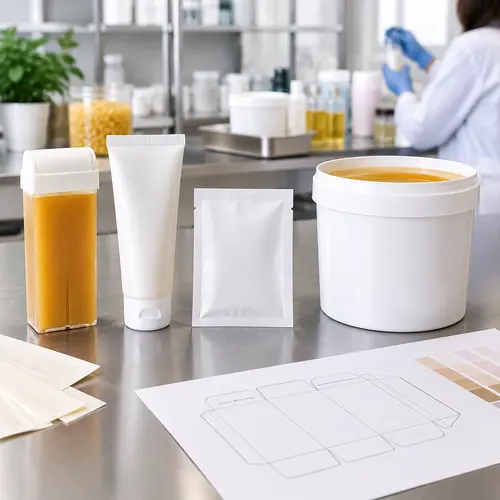
Roll-on wax cartridges, 100 g tubes, sachets, and 400 g salon tubs do not share a back panel. The cartridge forces the ingredient list into a narrow strip; the sachet loses the batch code position if the printer shifts 2 mm. Any depilatory cream OEM run should return a dieline with the artwork, not after it. For strip and bead formats, the wax strips and hot wax OEM page shows how kit cartons absorb the extra regulatory text that a single jar cannot hold.
Stability, storage, and the print date
A 12-week accelerated check at 40 C and 75% relative humidity is a printing deadline, not a formality. If the distributor approves artwork in week one and the stability check starts in week four, the cartons are already on press when the formula result lands. Roll-on wax typically sits near 40 to 45 C application temperature and hard wax nearer 55 to 60 C, so a summer shipment route is a label question too: it determines whether you print storage warnings or change the carton specification. For mild-positioned lines, the sensitive skin hair removal products route pairs a lower-irritation brief with the wording that brief can actually defend.
Decision Framework for Label Adaptation
| Factor | What to Check | Why It Matters | ODM Buyer Note |
|---|---|---|---|
| Claim-to-formula match | Every front-panel word mapped to a test result or a documented product characteristic | Unsupported wording is the fastest route to a marketplace takedown | Ask for a claim matrix signed against the sample batch |
| Ingredient list and allergens | INCI order, fragrance allergens, updated after any last-minute formula swap | A single substituted preservative invalidates the printed panel | Freeze the formula before artwork freeze |
| Net content and units | g, oz, or ml per destination; fill tolerance against declared weight | Short fills are a customs and retail compliance issue, not a rounding error | Get the fill weight range in writing from the filling line |
| Responsible party block | Importer name, address, contact route, batch and manufacturing date space | This is the first field a complaint handler looks for | Confirm the block fits the dieline before translation |
| Language variants | Per-market panels, translated warnings reviewed by a native speaker | A mistranslated warning removes the legal protection the warning exists for | Budget separate print runs per language, not stickers |
| Stability and period after opening | Accelerated result date versus press date; PAO symbol placement | Printing before the result locks you into an unsupported shelf life | Sequence stability start before artwork approval |
| Carton and label durability | Rub resistance, humidity curl on jars, adhesive behaviour on HDPE tubes | A label that lifts in a steamy bathroom reads as a counterfeit product | Request a drop and humidity check on filled units |
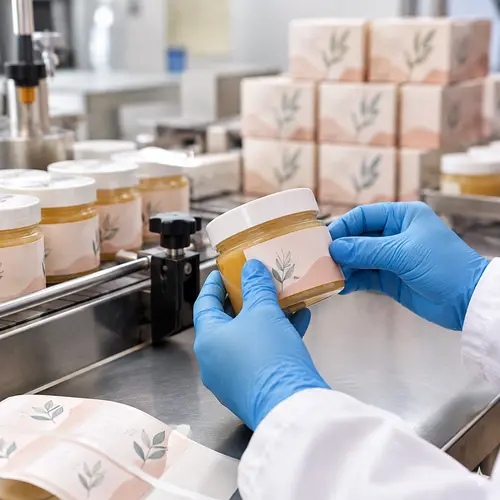
One practical shortcut: treat the label as part of the sample, and the sample as part of the label. When a distributor approves a 1,000-unit pilot through private label depilatory products with artwork attached, the pilot becomes the proof that the dieline, the fill line, and the document set agree. That is the difference between a fast launch and a fast reprint. If the line also carries an hair inhibitor serum OEM or a post-depilation care OEM item, adapt all panels in one pass so the kit carton does not need a second print run. Browse the private label hair removal blog for format-specific wording examples, review the wider hair removal product solutions set by buyer type, or request a hair removal product quote that lists the label documents as line items rather than assumptions.
ODM Manufacturing Considerations
Once a distributor stops buying stock cartons and starts commissioning an own-brand line, the manufacturing partner stops being a vendor and becomes the keeper of your label. The commitments below are the ones worth locking down in writing, stage by stage, because each one carries a document that a retail buyer or a marketplace reviewer may later ask you to produce.
Sample confirmation comes before print
Approve a filled, labeled, boxed unit, never a digital render. A render cannot show you how a cream sits in a tube shoulder, how a cartridge plunger seats, or how small text reads on a curved sachet. Sign off against the physical unit, seal one copy in an archive box, and photograph it under neutral light on the approval date. That photo becomes the reference point if a later batch drifts. Distributors working against a content calendar should also ask whether a fast sample turnaround covers the filled-and-labeled stage or only bulk material, since the second option leaves several weeks of decoration work unaccounted for. For the wider process, see the custom manufacturing program.
Formula customization inside a workable range
Customization in this category almost always means adjusting texture, fragrance, color, setting behavior, and aftercare feel within an existing base rather than inventing a new one. A sugar wax built for salon use can be softened for at-home spreading; a depilatory cream can shift in opacity or fragrance load; a hot wax can be tuned for a cleaner snap. Ask the lab what it can change without a fresh stability run and what forces one, because that answer sets your real timeline.
This is also where the communication gap shows up. If you want a texture that reads on camera as a visible ribbon or a dense matte finish, describe it in those terms and bring short reference clips. A partner who works from marketing language rather than only spec sheets will convert that into viscosity and melt-point targets instead of asking you to name a compound. That is the difference between a supplier and an OEM partner, and it is worth screening for during the first call rather than after the deposit.
Packaging compatibility
Every primary pack has its own rules: tube shoulder threads, cartridge plunger fit, the seal window on sachet film, jar lining compatibility. Request a compatibility run in which the actual formula sits in the actual pack for a defined period, then confirm the decoration method on the same substrate that will carry it. Screen print behaves differently on a soft tube than a label does, and a hot stamp on a carton edge can crack where a litho wrap would not. Confirm secondary packaging can survive the intended shipping mode before you approve the carton.
MOQ, documents, and shipment conditions
Ask for a line-item bill of materials: bulk, primary pack, secondary pack, decoration, labeling, testing, carton, and freight, with tooling or plate charges shown separately rather than folded into a unit price. A quote you can read line by line is the only one you can compare against a second supplier. Documents to collect before deposit include the safety assessment or product information file, an ingredient list in INCI form, a fragrance allergen statement, the batch coding rule, and any state-level registration your destination market requires. On shipment, confirm whether cartons travel by sea or air, whether they are palletized, and what temperature range the pallet can tolerate at the discharge port.
Common Problems and Failure Cases
Wax that snaps instead of flowing
Brittleness usually traces to a batch that cooled too quickly or a resin-to-oil ratio that drifted at the edge of tolerance. In a warm-climate market the same wax can arrive harder than the sample because the shipper sat on a dock. Add a warm-water softening instruction to the pack and check broken pieces at both the top and bottom of the shipper.
Strips that lose grip
Adhesion loss is usually age, film thickness, or storage. Pull test strips from the first and last cartons of a pallet, not the middle, because the bottom layer carries the most weight and the top layer takes the most heat.
Cream that separates
A visible water layer or a grainy texture means the emulsion has moved. Isolate whether it happened before or after a heat cycle; the two point to different fixes, and only one of them is your shipping lane.
Cartridge leakage and packaging deformation
Leakage is commonly a plunger seal mismatch or a tube wall too thin for the fill temperature. Run a short domestic shipment of loaded cartons before committing an ocean container, and open a carton at the end of it.
Fragrance sensitivity complaints
Aftercare products sit on the skin longest, so fragrance load is the usual complaint source. Keep it modest, list allergens, and print a patch-test line on the carton and the leaflet.

Supplier Checklist for Hair Removal OEM/ODM
- Filled, labeled sample approved in writing, with an archived reference unit.
- Written list of what the lab can change without a new stability run.
- Compatibility run data tying your formula to your specific pack and closure.
- MOQ stated per SKU and per pack format, not only per formula.
- Texture, melt behavior, and color tolerance ranges defined numerically.
- Irritation-risk review on the finished formula, plus patch-test copy on pack.
- Batch traceability from fill date to shipper, with retained samples held.
- Document pack: safety assessment, INCI list, allergen statement, coding rule.
- Heat and cold storage limits stated for both product and shipper.
- Named account contact who answers technical and marketing questions in the same thread.
- Capacity statement in units per week, with the buffer you can reserve ahead of a launch.
FAQ
Will the factory take my formula and sell it to a competitor?
Ask for three things before you send anything: a signed exclusivity clause tied to your formula or color-and-fragrance combination, confirmation that any custom tooling is invoiced to you and owned by you, and a statement of which stock formulas the factory already sells to others. Anything it sells openly is not exclusive, so your protection has to come from a customization the factory cannot resell without your consent.
Can the texture and color look as dramatic on camera as I need?
Often yes, within limits the lab will tell you honestly. Ask for a short video of the actual production batch being worked, not a studio shot of a prototype, and test how the color reads under ring light rather than daylight. A cream that looks dense in a jar can turn translucent on a spreader, so film it the way your audience will see it.
What happens if a customer reacts badly and my audience turns on me?
You cannot buy a guarantee, but you can buy traceability. Retained samples per batch, a documented irritation-risk review, a patch-test instruction on pack, an ingredient list the buyer can read, and a named complaints contact with a stated response window give you a defensible answer if a complaint surfaces. No supplier should tell you the risk is zero; treat that claim as a warning sign.
If a video goes viral, can production keep up?
Raise it before the first order. Ask for weekly output in units, how much buffer stock they can hold for you, and how much notice they need to reserve a line slot ahead of a scheduled launch. A factory that also serves large accounts should be able to say plainly when your reorder would be pushed.
How do I explain a marketing requirement to a factory that thinks in specs?
Bring references instead of adjectives: two short clips, one photo of the finish you want, and the words your audience uses. Then ask the lab to translate it back into measurable targets so both sides agree on what was promised.
Can I see a quote without hidden costs?
Yes, and you should insist on it. Request the bill of materials with decoration, labeling, testing, and freight shown as separate lines, plus any tooling charge stated once rather than amortized invisibly. Compare two suppliers on that sheet and the real difference usually appears in the secondary packaging line.
References
- the Modernization of Cosmetics Regulation Act (MoCRA) of 2022 for facility registration and adverse-event recordkeeping duties that affect a label holder.
- FDA Authority Over Cosmetics for the distinction between FDA oversight and product approval, useful when writing marketing copy.
- Business of Fashion (BoF) beauty intelligence for how independent beauty labels position texture and format in the current market.