Direct Answer
A defensible hair removal product quality control checklist should function as a release system, not a generic inspection form. It must connect five control layers: approved raw materials, formula-specific critical quality attributes, packaging compatibility, stability and safety evidence, and finished-goods release criteria. Each requirement should state the test method, specification, sampling plan, responsible party, record location, and escalation rule.
For depilatory cream, the checklist should control pH, active concentration, viscosity, odor, removal performance, contact time, and irritation risk. Wax, sugar wax, strips, and roll-on cartridges require different controls, including melting behavior, adhesion, residue, peel consistency, leakage, and temperature resilience. Aftercare requires preservation, compatibility, and skin-tolerance review. Effective hair removal product quality control also extends beyond the formula: labels, batch coding, transport cartons, regulatory files, and change control must be verified before release. The central principle is simple: no shipment should depend on undocumented judgment.
Key Takeaways for Private Label Buyers
- Build separate specifications for each format; a depilatory cream checklist cannot govern wax strips or roll-on wax.
- Freeze the approved formula, raw-material grades, process parameters, packaging components, and test methods before mass production.
- Test the formula inside the final commercial pack under heat, cold, ambient storage, and transport simulation.
- Define measurable release limits for texture, performance, leakage, labeling, and microbiological quality rather than relying on visual approval.
- Review claims and regulatory classification market by market before artwork approval, especially where cosmetic and therapeutic boundaries differ.
- Require deviation, out-of-specification, complaint, traceability, and recall procedures before approving the manufacturing facility.

Buyer Context
Hair-removal products concentrate several risks that can become visible only after distribution. Depilatory formulas often combine reactive reducing agents with high alkalinity. Wax performance shifts with resin, oil, polymer, fabric, coating weight, and storage temperature. Sugar wax can lose consistency through water migration. Roll-on cartridges may pass filling inspection but leak after heat exposure or vibration. An aftercare lotion can remain visually acceptable while its preservative system or pump compatibility deteriorates.
These are not isolated laboratory concerns. A failure can trigger skin complaints, marketplace suspension, retailer chargebacks, or a multinational recall. The risk increases when a brand introduces China-based capacity following a disruption at an established supplier, or expands into waxing without internal process expertise. Procurement may see equivalent unit specifications while QA sees materially different exposure.
The first governance decision is therefore product classification. The US Food and Drug Administration explains its authority over cosmetics and clarifies that cosmetics are regulated but generally not preapproved in its FDA cosmetics regulatory guidance. UK market access requires the responsible person to follow the UK SCPN cosmetic notification protocol. Australia requires buyers to assess claims and intended use against Australia’s TGA cosmetic-therapeutic boundary guidance. The checklist should capture the target country, responsible entity, approved claims, notification status, ingredient review, safety assessment, and artwork version.
A capable hair removal OEM ODM services provider should translate those market requirements into controlled manufacturing records. Buyers should still retain approval authority over specifications, deviations, and changes. Outsourcing production does not transfer brand-owner accountability.

Technical and Packaging Factors
Formula identity and process control
Begin with a signed master specification and manufacturing instruction. Record INCI identity, supplier and grade, approved alternatives, addition sequence, mixing speed, processing temperature, hold time, bulk appearance, and filling window. The batch record should reconcile theoretical yield against actual bulk, filled quantity, rejects, and retained samples. Any substitution should enter formal change control rather than being treated as a purchasing decision.
For custom depilatory cream formulation, establish limits for pH, active assay where applicable, viscosity at a defined spindle, speed, and temperature, density, odor, color, microbial quality, removal efficacy, and maximum labeled contact time. Irritation review must consider alkaline exposure, fragrance, application thickness, anatomical use, and foreseeable overexposure. A mild hair removal formula should not be released on marketing language alone; the project file needs supporting safety and performance evidence.
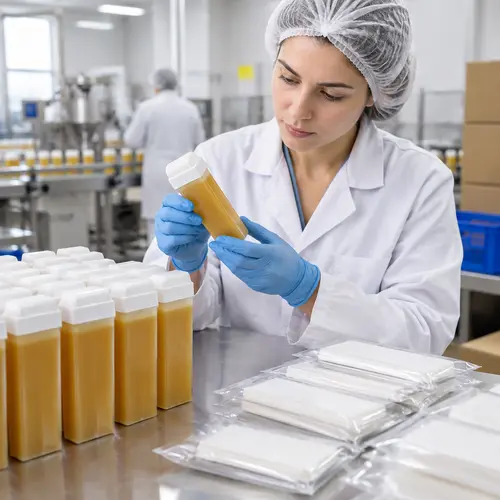
Wax specifications should cover softening or melting range, application temperature, spreadability, hair pickup, skin residue, and removal behavior. Wax strips require coating-weight consistency, strip dimensions, adhesion after aging, liner release, and pouch seal integrity. Sugar wax requires texture, heating instructions, water-loss control, and microbial assessment. These criteria should be aligned with the relevant custom wax strips and hot wax development scope.
Packaging compatibility and distribution stress
Compatibility testing must use production-intent components, including resin, closure, liner, applicator, adhesive, decoration, and secondary pack. Review swelling, cracking, discoloration, odor transfer, corrosion, paneling, seal loss, pump output, cartridge rotation, and leakage. For roll-on wax, test the assembled cartridge upright, inverted, and on its side after thermal exposure. Cartons should be assessed for compression, abrasion, barcode readability, batch-code permanence, and tamper-evidence performance.
A practical stability matrix may include 4°C, 25°C, and 40°C storage, plus at least three freeze-thaw cycles where the formulation and distribution route justify them. These are protocol design points, not universal acceptance limits. The buyer and ODM must define duration, orientation, test intervals, sample quantity, and failure rules. Shipment conditions should reflect the actual lanes, including hot warehouses, cold transit, vibration, and parcel-network handling.
Aftercare products require their own controls for viscosity, pH, preservation, dispensing, and formula-pack interaction. An integrated post-depilation care OEM program should not allow an acceptable wax result to compensate for an unstable soothing product.

Decision Framework Table
| Factor | What to Check | Why It Matters | ODM Buyer Note |
|---|---|---|---|
| Formula specification | Identity, pH or melting range, viscosity, appearance, odor, assay, and microbiology | Converts the approved sample into measurable release criteria | Confirm that sampling and mass production use the same formula and process |
| Performance | Removal efficacy, contact time, wax pickup, residue, peel behavior, and after-feel | A technically stable product may still fail consumer use | Approve a documented test method and reference standard |
| Safety review | Exposure instructions, irritation risk, warnings, patch-test language, and complaint signals | Hair-removal misuse can produce rapid and visible harm | Align the review with target markets and anatomical-use claims |
| Packaging | Leakage, seal integrity, applicator function, compatibility, coding, and artwork | Pack failure can alter formula quality and interrupt launch | Use final components rather than generic laboratory containers |
| Stability and transit | Heat, cold, ambient aging, cycling, vibration, orientation, and carton compression | Distribution exposure may exceed factory conditions | Map testing to actual shipment lanes and seasonal demand |
| Supplier controls | ISO 22716 scope, calibration, training, traceability, deviations, CAPA, and change control | System maturity determines long-term batch consistency | Review evidence on site and compare at least three commercial-scale lots when available |
| Launch authorization | Safety file, notification, approved artwork, certificate of analysis, and retain samples | Prevents release with incomplete technical or legal records | Set a cross-functional release gate before shipment approval |
Buyers comparing broader depilatory product development solutions should weight evidence quality above presentation quality. The final RFQ should request the proposed control plan, sample scope, pilot-batch conditions, packaging bill of materials, stability protocol, documentation matrix, production lead time, and capacity assumptions. These requirements can be consolidated through a formal hair removal product RFQ so procurement, R&D, regulatory, QA, and legal evaluate the same baseline.
ODM Manufacturing Considerations
A sound ODM program converts a product concept into measurable release requirements before production begins. This is especially important when a qualification project follows a serious quality event or capacity interruption at an incumbent supplier. Hair removal product quality control should start with a written development brief covering target users, product format, performance expectations, destination markets, pack size, forecast demand, and intended claims.
Sample Confirmation and Formula Customization
Approve samples in stages rather than treating the first laboratory submission as the production standard. The development sample establishes direction; a pilot sample confirms that the formula can be processed with production equipment; and a signed master sample becomes the sensory reference. Record the formula revision, batch code, texture, color, fragrance profile, application behavior, removal result, and pack configuration. Both buyer and factory should retain sealed units.
For a custom cream, wax, sugar wax, strip, or aftercare project, define which attributes may be adjusted and which are fixed. A fragrance or color change can affect user tolerance, raw-material declarations, or formula behavior. Require written review of substitutions, including the reason, specification comparison, regulatory status, and impact on existing evidence. Relevant category capabilities and formats should also be confirmed against the supplier’s hair removal product range.
Compatibility, Stability, and Commercial Scope
Compatibility work should use the final contact materials, including tube liners, caps, cartridge seals, strip release films, and printed pouches. Review staining, swelling, seal relaxation, formula pickup, dispensing consistency, and closure performance over the planned evaluation period. Stability records should identify the protocol, acceptance limits, observations, deviations, and person authorizing the conclusion. If long-term work is incomplete, the buyer should know which shelf-life statement is provisional and when supporting data will mature.
MOQ must be separated into bulk-production quantity, filling quantity, printed-component quantity, and outer-carton quantity. Ask how unused printed materials, normal production variance, and repeat-order component inventory are handled. The sample scope should state the number of free revisions, chargeable pilot work, packaging prototypes, and retained samples.
Before artwork release, obtain the ingredient list, product specification, batch coding format, safety support, claim substantiation summary, and destination-market labeling review. UK listings follow the SCPN cosmetic notification protocol, while Australian classification can depend on presentation and claims under TGA cosmetic and therapeutic boundary guidance. Shipment instructions should specify case count, pallet pattern, cartridge orientation where applicable, route exposure limits, lot traceability, container condition, and release records. Further responsibilities can be mapped through the supplier’s OEM and ODM process.

Common Problems or Failure Cases
- Wax becomes brittle: Cracking can result from raw-material variation, an unsuitable oil-to-resin balance, or uncontrolled cooling. Compare the failed lot with the approved master and review ingredient lot records and processing temperatures.
- Strip adhesion declines: Adhesive migration, release-film variation, or poor pouch sealing can leave strips difficult to separate or unable to grip hair consistently. Inspect stored units from different manufacturing dates, not only fresh samples.
- Depilatory cream separates: Layering, liquid release, or graininess may indicate incorrect addition sequence, insufficient mixing, or prolonged bulk holding. Quarantine the lot and investigate processing records before considering rework.
- Roll-on cartridges leak: Leakage may originate at the neck, roller housing, cap, or seal interface. Check component dimensions, assembly force, fill level, and evidence from units taken across the run.
- Fragrance causes complaints: A technically compliant fragrance can still be unsuitable for a sensitive-use product. Review allergen declarations, exposure directions, consumer warnings, and results against an unfragranced comparator.
- Packaging deforms: Tubes, pouches, or cartridges may swell, crease, or lose closure integrity during seasonal distribution. Investigate formula interaction, headspace, case loading, and actual shipment history.
Corrective action should identify the confirmed root cause, affected lots, containment decision, retest plan, and preventive change. Replacing failed units without this record does not demonstrate process control.
Supplier Checklist
Use the following checks when comparing a China, Guangzhou, or other regional facility. Evidence should relate to the proposed product and production line rather than a general factory presentation.
- Confirm legal manufacturer identity, site address, relevant cosmetics licenses, audit history, and production-line capabilities.
- Review an anonymized batch record, incoming-material specification, in-process checks, deviation form, release form, and traceability exercise.
- Define the signed master sample, measurable acceptance limits, retained-sample period, and approval authority.
- Verify controls for texture, application behavior, thermal or flow profile where relevant, removal performance, and irritation-risk review.
- Confirm final-component evaluation, print durability, coding legibility, seal integrity, and leakage acceptance criteria.
- Request the stability plan, current data status, expiry rationale, and rules for extending or restarting studies after a change.
- Separate formula MOQ from packaging MOQ and document sampling, pilot, tooling, and excess-component responsibilities.
- Check ingredient, labeling, claim, safety, and destination-market documentation before artwork approval.
- Review complaint escalation, recall support, insurance evidence, business-continuity arrangements, and shipment-release controls.
- If headquarters has introduced a carbon-reduction requirement, verify that energy, emissions, and environmental records are traceable to the actual facility and reporting period.
FAQ
When is an ODM sample considered approved?
Approval occurs only when the formula revision, final pack, acceptance sheet, and signed master sample match. Email approval of appearance alone is insufficient. Any later change to fragrance, color, contact material, or processing method should trigger a documented impact review.
Which labeling documents should the supplier provide?
Request the ingredient declaration, net-content basis, responsible-party details, directions, warnings, batch-code format, shelf-life basis, country-of-origin information, and support for product claims. In the United States, cosmetics are generally not preapproved by FDA, but responsible companies remain accountable for safety and compliance, as explained in the FDA authority overview.
Can a factory guarantee that a core formula will never be leaked?
No supplier can credibly promise absolute immunity. Buyers should instead verify role-based system access, separated development and production permissions, encrypted backups, physical sample controls, visitor restrictions, confidentiality agreements, access logs, employee exit procedures, and incident-response obligations.
How can a strategic buyer obtain priority during raw-material shortages?
Priority should be contractual and operational, not verbal. Use rolling forecasts, committed order windows, reserved safety stock, allocation rules, approved secondary sources, and a named escalation process. Audit whether the supplier’s purchase commitments and inventory reports support the promised allocation.
What insurance evidence is needed for a major quality complaint?
Review the insurer, policy period, covered products, territories, exclusions, per-event limit, aggregate limit, deductible, recall coverage, and whether the policy is occurrence-based or claims-made. Ask for a current certificate and a written explanation of how overseas defense, testing, withdrawal, and compensation costs are handled.
How should buyers qualify a backup supplier after an incumbent disruption?
Run document review, sample matching, pilot production, component verification, and commercial-line approval in parallel. Do not rely solely on laboratory samples or an established facility’s general reputation. Define transfer ownership, comparison criteria, supply timing, and the evidence required before volume is divided between suppliers.