Direct Answer
The right hair removal product sourcing checklist should test more than a supplier’s catalog or unit price. Ask whether the partner can hold formula performance from sample to commercial batch, document MoCRA and CPNP requirements, validate packaging compatibility, and support a realistic launch quantity. For depilatory cream, wax strips, sugar wax, roll-on cartridges, or aftercare, the critical questions are practical: What is the formula’s viscosity or melting behavior? How is irritation risk reviewed? What happens after heat and cold exposure? Can the supplier provide batch records, stability data, ingredient documentation, artwork review, and shipment conditions before production begins?
A capable ODM partner should make these answers visible early. The goal is not simply to find a product that looks good in a sample jar. It is to build a repeatable, compliant SKU that survives storage, shipping, customer use, and the pressure of a fast-moving market.
Key Takeaways for Private Label Buyers
- Source for evidence, not promises. Request representative samples, technical data, certifications, and a clear approval workflow before discussing scale.
- Match the formula to the use case. Wax hardness, cream viscosity, strip adhesion, and aftercare feel should reflect the target body area, climate, and customer routine.
- Review packaging as part of the formula. Test jars, tubes, sachets, cartridges, lids, seals, and labels for leakage, migration, heat tolerance, and user control.
- Put testing into the launch calendar. Stability, compatibility, microbial quality where applicable, and transport checks should run before final artwork and shipment planning.
- Clarify the small-batch path. Confirm minimum pilot quantity, sample scope, lead time, batch consistency, and how the same formula will scale.
- Make compliance ownership explicit. Agree who prepares ingredient declarations, safety files, product information, claims support, MoCRA records, and CPNP notification inputs.
Hair removal product supplier selection becomes easier when every answer can be tied to a document, a test, or an approved sample.
Buyer Context
Hair removal products are deceptively sensitive. A consumer may judge a depilatory cream within minutes by its spread, scent, removal result, and post-use comfort. A wax customer notices whether sugar wax drags, whether hot wax breaks cleanly, or whether a strip lifts evenly without leaving excessive residue. A salon or subscription-box buyer also evaluates dispensing, shelf appearance, shipping reliability, and the consistency of every batch.
That combination creates a wider sourcing risk than a simple formula comparison. A cream may perform well in a laboratory sample but separate after temperature cycling. A roll-on wax cartridge may look premium yet leak around the roller head during shipment. Wax strips can lose adhesion when the backing paper, wax layer, or pouch seal is changed. Aftercare products can feel excellent in a pump bottle but become difficult to dispense when the viscosity shifts in a colder market.
For emerging DTC brands, these problems arrive at the worst possible moment: after packaging artwork, influencer seeding, or a paid launch campaign has already been scheduled. A supplier should therefore be evaluated as part of the brand’s operating system. The questions cover formulation, sampling, manufacturing, compliance, packaging, quality control, and shipment conditions together.
Start by reviewing the supplier’s hair removal manufacturing process, including formulation approval, filling, packaging, QC release, and shipment preparation. Then compare the available hair removal OEM ODM services against your actual needs: private label packaging, custom texture adjustments, documentation, pilot quantities, and repeat production.
Compliance should be discussed before a label is designed. For the United States, ask how the supplier supports MoCRA-related facility and product records and how responsible-person information is handled. For the European Union, clarify the documentation needed for CPNP notification and the product information file. Environmental or natural-positioning claims should be substantiated rather than implied; buyers can review the requirements behind Ecocert organic and natural cosmetic certification when evaluating certification language.
Useful references also include the FDA’s guidance document library and relevant technical literature such as the Journal of Cosmetic Dermatology. These sources do not replace a supplier’s product-specific file, but they help buyers ask more precise questions.
For category planning, review the supplier’s hair removal product solutions and compare whether the partner can support a focused range: depilatory cream, wax strips, hot wax, sugar wax, post-depilation care, or a coordinated aftercare kit. A narrower, technically experienced partner may be more useful than a broad catalog with limited evidence behind each SKU.
Hair removal product guides can help structure internal questions, but the final decision should rest on documents and samples that match your exact formula and packaging configuration.

Technical or Packaging Factors
Formula behavior and user control
Ask for the target viscosity range of a depilatory cream and the test method used to measure it. The relevant question is not whether the cream is simply thick or thin, but whether it spreads in a controlled layer, remains stable in the intended tube or jar, and rinses cleanly within the product’s instructions. Request an irritation-risk review for the intended use area, including fragrance, alkalinity, active depilatory ingredients, and contact-time instructions. Avoid unsupported claims such as suitable for every sensitive skin type.
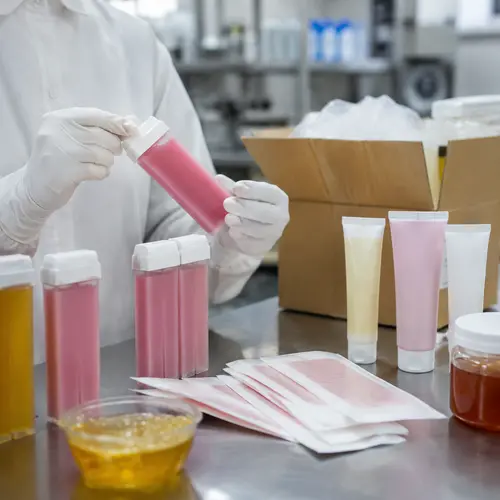
For wax, request softening or melting behavior, application temperature guidance, stringing characteristics, setting time, residue, and removal performance. A roll-on cartridge needs special attention to roller resistance, orifice control, cap seal, and leakage after vibration and temperature exposure. For wax strips, ask how wax coat weight, strip substrate, pouch seal, and adhesion are controlled between batches. Sugar wax should be checked for crystallization, viscosity drift, and performance across expected storage temperatures.
Packaging compatibility and storage
Packaging is a functional component, not a final decoration. Request compatibility results for the exact formula, container, closure, liner, adhesive, and label combination. Check for swelling, softening, discoloration, odor transfer, leakage, cap loosening, and changes in dispensing. A tube, jar, sachet, cartridge, or pump may require a different fill process and sealing inspection.
Ask what heat and cold conditions were used in stability and transport reviews. The test plan should reflect the markets you serve, shipping routes, warehouse conditions, and the time between filling and first customer use. Confirm whether samples were tested in final packaging rather than only in laboratory containers. For a launch dependent on social traffic, a delayed shipment or leaking sample can create more than a quality complaint; it can damage the first customer experience.
Review the supplier’s depilatory cream formulation options and, where appropriate, pair them with sensitive skin hair removal products positioning only after the formula’s evidence supports the claim. For complementary products, assess post-depilation care products and an after hair removal serum as separate formulations with their own stability and packaging checks.
Decision Framework Table
| Factor | What to Check | Why It Matters | ODM Buyer Note |
|---|---|---|---|
| Formula performance | Viscosity, spreading, setting time, melting behavior, residue, and removal result | Determines user control, comfort, and repeat purchase potential | Approve a documented golden sample and define acceptable variation before the pilot batch |
| Irritation-risk review | Ingredient profile, use-area guidance, contact time, fragrance, and warning language | Reduces avoidable complaints and unsupported claims | Request the review in writing and align it with final label instructions |
| Packaging compatibility | Container, closure, liner, seal, label adhesive, leakage, and dispensing | Prevents formula-package interaction and shipment failures | Test the exact commercial configuration, including artwork and seal components |
| Storage and transport | Heat, cold, vibration, orientation, and expected warehouse conditions | Shows whether the product can reach customers in usable condition | Share destination markets and shipping lanes before finalizing packaging |
| Compliance file | Ingredient declaration, batch records, safety documents, claims support, MoCRA and CPNP inputs | Supports legal sale and retailer or marketplace review | Assign document ownership, deadlines, and approval gates in the project brief |
| Sampling and scale | Sample quantity, revision rounds, pilot quantity, lead time, and batch controls | Connects product testing with a realistic launch plan | Confirm that the approved sample can move to repeatable production without formula re-engineering |

Finally, ask how changes are controlled. Any change to wax supplier, cream thickener, fragrance, tube resin, strip substrate, cartridge component, or filling line can affect the finished product. A dependable partner records the change, assesses its impact, and communicates whether renewed sampling or stability work is required. For buyers comparing wax strips and hot wax formats, this change-control discipline is as important as the initial sample.
Once the technical questions are answered, prepare a concise project brief covering target market, product format, body area, claims, packaging, forecast, pilot quantity, storage conditions, and launch date. You can then request a hair removal product quote with enough context for a meaningful response rather than a generic price.
ODM Manufacturing Considerations
A useful hair removal product sourcing checklist should separate sample approval from commercial readiness. A pleasant laboratory sample does not prove that the same cream, wax, strip, or cartridge will remain consistent after scaling, filling, storage, and shipment. Buyers should therefore define what is being approved and which measurable specifications must accompany that approval.
Confirm a controlled reference sample
Keep an approved reference sample, sometimes called a golden sample, with a signed specification sheet. For depilatory cream, record appearance, odor, application texture, pH, and an acceptable viscosity range. For hard or sugar wax, document softening or melting range, spreadability, cooling behavior, and brittleness. Wax strips should have agreed dimensions, coating weight, release behavior, and removal performance.
Ask whether subsequent samples represent a laboratory preparation, a trial made on commercial equipment, or the final filling configuration. The sample scope should also identify included fragrances, colorants, imported botanical oils, and aftercare items. If a supplier promotes unusual ingredient sourcing as part of the brand story, request origin records, supplier specifications, and continuity plans rather than relying on a marketing description.
Control formula customization
Customization should begin with a written brief covering target users, removal area, use time, fragrance direction, desired texture, prohibited ingredients, price target, and intended markets. Every revision should receive a code and change summary. This prevents confusion when several samples are circulating at the same time.
A turnkey base does not have to remain generic. Differentiation can come from texture targets, fragrance architecture, application time, wax flexibility, strip format, aftercare pairing, or a documented specialty ingredient. However, each change can alter performance or irritation risk. Ask which modifications require another stability review, consumer-use assessment, or updated supporting documents.
Match the product to its package
Compatibility should be evaluated using the actual container, closure, liner, pouch film, cartridge, cap, and label stock intended for launch. Cream formulas may interact with seals or dispensing openings. Heated wax can soften containers, while oil-rich aftercare formulas may affect labels or closure fit. For roll-on formats, buyers should define acceptable fill weight, roller movement, cap retention, and leakage criteria.
Confirm the test duration, temperatures, sample orientation, inspection intervals, and pass or fail limits. Elevated and low-temperature exposures should reflect likely warehouse and delivery conditions. Any accelerated study should be supported by ongoing observation under normal conditions rather than treated as a guarantee of shelf life.

Clarify MOQ, documents, and shipment assumptions
MOQ should be broken down by formula batch, fragrance, container color, printed component, carton, and finished SKU. A low finished-goods MOQ may still require the buyer to purchase excess custom packaging. Ask who owns unused components and how long they can be stored.
Before artwork approval, request the ingredient declaration, product specification, batch certificate format, safety data where applicable, claims support, use instructions, warnings, lot-coding format, and country-of-origin information. Review the supplier’s broader manufacturing process and OEM/ODM development workflow to identify document ownership and approval points.
Shipment planning should specify pallet pattern, carton strength, temperature limitations, container loading, route risks, and inspection responsibility at dispatch. This is especially important for summer routes, long customs holds, or distribution into the Middle East. Buyers replacing a failed supplier or resolving a capacity bottleneck should also ask whether packaging molds, artwork files, specifications, and approved raw materials can be transferred without restarting development.
Common Problems or Failure Cases
- Wax becomes brittle: The approved sample bends cleanly, but later batches crack during handling or removal. Investigate raw-material variation, temperature history, coating thickness, and the agreed softening range.
- Strip adhesion declines: Strips may grip poorly after warm storage or may leave excessive residue. Compare coating weight, nonwoven or film substrate, pouch barrier, aging conditions, and opening instructions.
- Depilatory cream separates: Oiling, watery release, odor change, or uneven dispensing may indicate emulsion stress, unsuitable filling conditions, or package interaction. Establish objective appearance and viscosity limits instead of approving by photographs alone.
- Cartridges leak: Leakage can originate from roller tolerances, cap fit, fill temperature, headspace, orientation, or prolonged heat exposure. A passed upright sample does not represent cartons stored on their sides.
- Fragrance increases sensitivity complaints: A scent accepted during sampling may become stronger during use or may not suit sensitive application areas. Review fragrance level, allergen disclosure, intended-use warnings, and irritation-risk assessment before approval.
- Packaging deforms: Wax containers or cartridge parts may warp in hot transit, affecting closure fit or roller operation. Confirm material grade and define shipment temperature precautions.

Supplier Checklist
- Define each product category, target market, intended user, application area, and benchmark.
- Request coded samples with formula status, preparation method, and revision history.
- Approve measurable limits for cream viscosity, wax melting or softening range, texture, odor, color, fill weight, and removal performance.
- Review irritation risks, fragrance allergens, warnings, directions, and evidence supporting performance claims.
- Test the final formula with the exact container, closure, pouch, cartridge, label, and secondary packaging.
- Confirm stability protocol, inspection schedule, acceptance limits, and responsibility for failures.
- Break MOQ down by batch, component, decoration, fragrance, and SKU; identify ownership of surplus materials.
- Verify labeling documents, ingredient nomenclature, specifications, batch records, certificates of analysis, traceability, and change notification.
- Audit cruelty-free and natural-origin claims through policies, supplier declarations, and recognized certification where relevant.
- Agree on pre-shipment inspection, retain samples, carton configuration, temperature precautions, and complaint investigation procedures.
- Document confidentiality, formula ownership, artwork control, tooling ownership, and restrictions on sharing brand plans.
- Assess contingency capacity and qualified material alternatives before relying on the supplier as an emergency replacement.
FAQ
Can an Asian facility genuinely meet Western clean beauty and cruelty-free expectations?
Yes, but location alone proves nothing. Clean beauty has no single universal definition, so provide a written restricted-substance policy for the target market. Verify ingredient traceability, animal-testing policies, supplier declarations, audit records, and claim wording. For certified natural or organic positioning, confirm the exact scope through a recognized program such as Ecocert rather than implying that every ingredient or finished product is certified.
Will a low MOQ make the unit cost incompatible with customer acquisition costs?
It can. Model landed cost at several volume tiers, including testing, setup, decoration, excess packaging, freight, duties, fulfillment, and expected rejects. Compare contribution margin after CAC, not only the quoted unit price. A simpler package or fewer initial variants may protect margin better than forcing a highly customized launch.
Will a turnkey formula make the product indistinguishable from competing brands?
Not necessarily. Ask how many buyers use the same base and which elements can be exclusive. Meaningful differentiation may involve wax flexibility, cream application time, fragrance, strip dimensions, use protocol, aftercare pairing, or traceable ingredients. Put approved customizations and exclusivity limits in writing.
How many samples should be evaluated before approval?
There is no universal number. Evaluate enough coded samples to confirm the chosen formula, final fragrance, package function, and repeatability. At least one approval stage should use commercial-intent ingredients and packaging rather than substitute components.
Which labeling documents should be available before printing?
Buyers should have the complete ingredient list, net-content basis, directions, warnings, responsible-party details, origin statement where required, lot-code plan, and substantiation for visible claims. Requirements vary by market, so local regulatory review remains necessary.
What should be checked before shipping wax or cream through hot climates?
Review route temperatures, transit duration, pallet exposure, container orientation, and customs-delay risk. Inspect representative packed cartons after relevant temperature conditioning, and define what happens if deformation, separation, or leakage appears before release.
References
- Ecocert organic and natural cosmetic certification — certification scope and standards for substantiating relevant environmental or natural-origin claims.
- FDA guidance document search — current regulatory guidance should be checked for the intended US product and claims.
- The Journal of Cosmetic Dermatology — peer-reviewed research that may inform ingredient, tolerability, and cosmetic performance reviews.