Direct Answer
A sensitive skin depilatory cream sample should be approved through a controlled sequence: define the target user and use area, review the formula brief, test application and removal under fixed conditions, inspect the skin response, verify packaging compatibility, and convert every observation into a measurable revision request. Do not approve a sample from texture, fragrance, or a single founder trial alone. The decision should combine immediate performance, delayed-response feedback, stability evidence, label instructions, and production readiness.
For a creator-led brand, speed still matters. A first prototype can be targeted within seven days, but fast sampling is only the opening gate. Stability work, package testing, safety review, and market-specific documentation continue in parallel. The goal is a camera-ready cream that performs consistently without changing between the approved sample and the first 1,000-unit pilot run. Start with a documented brief and a supplier experienced in sensitive skin hair removal products.
Key Takeaways for Private Label Buyers
- Source for repeatability. Ask whether the pilot and scaled batches use the same formula, raw-material specifications, filling method, and primary package.
- Define performance before testing. Set the intended body area, hair type, contact time, removal method, odor tolerance, and acceptable post-use skin feel.
- Test the complete pack. A stable bulk cream can still fail through cap leakage, seal damage, panel deformation, blocked dispensing, or formula-package interaction.
- Separate preferences from defects. Record scent and visual opinions separately from burning, persistent redness, incomplete removal, phase separation, or leakage.
- Lock launch decisions to evidence. Approve only after the formula version, packaging components, instructions, claims, and retained reference sample are aligned.
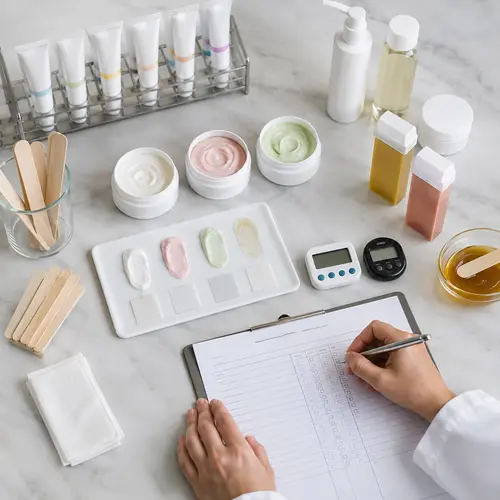
Buyer Context
Hair-removal products create a narrow operating window. The formula must weaken or capture hair effectively while remaining manageable on skin and easy to remove. For depilatory creams, a softer positioning does not excuse weak performance. For sugar wax, hot wax, wax strips, or roll-on wax cartridges, the equivalent risks include poor pickup, excessive tack, temperature sensitivity, residue, and inconsistent removal.
This matters more for creator-led brands because launch feedback arrives publicly and quickly. A dramatic texture demonstration may win attention, but viewers will also report odor, redness, missed hair, messy cleanup, or leaking packs. The product brief therefore needs two connected standards: what looks clear on camera and what remains dependable during normal consumer use. Reviewing hair removal product guides can help a founder distinguish a visual preference from a production-critical requirement.
Claims and market classification must also be settled early. The FDA guidance on personal care product classification explains why intended use and product claims matter in the United States. For European ingredient screening, buyers can consult the European Commission’s CosIng ingredient database, while recognizing that a database entry is not automatic product approval. Brands considering Australia should review Australia’s TGA cosmetic-therapeutic boundary guidance. Commercial trend context from Business of Fashion beauty intelligence can inform timing, but it should not replace product testing.
A capable hair removal OEM ODM services partner should translate the content concept into a testable brief. That includes sample quantity, version control, target cost, pack format, market, expected shipment conditions, and feedback deadlines. It also makes the tradeoff visible: a faster first sample can validate texture and visual impact, while longer-running stability and compatibility checks protect the launch decision.
Technical or Packaging Factors
Formula Behavior and Skin-Response Review
Start by recording the formula code, batch code, manufacture date, appearance, odor, measured pH, and viscosity range supplied by the manufacturer. Depilatory performance depends on alkaline conditions and reducing ingredients, so a sensitive positioning should be evaluated through controlled exposure and clear stop rules, not by assuming that botanical additions neutralize irritation risk.
Use the intended application thickness and timed contact window. Record spread, cling, drying at the edges, hair release, removal effort, residue, odor during use, and skin feel after rinsing. Feedback should identify the body area and hair characteristics because a cream that works on fine arm hair may perform differently on coarse leg hair. Any burning, swelling, blistering, or persistent redness should stop the test and trigger formal review. Consumer-facing instructions should retain the required pre-use skin test, maximum contact time, prohibited areas, rinse method, and discontinuation language.
For development options, compare the sample against the documented scope of the custom depilatory cream formulation rather than against an unnamed market product. If the launch includes recovery products, test the cream and soothing gel after hair removal as a routine, while keeping claims for each product distinct. A post hair removal serum supplier should likewise provide separate specifications and labeling support.
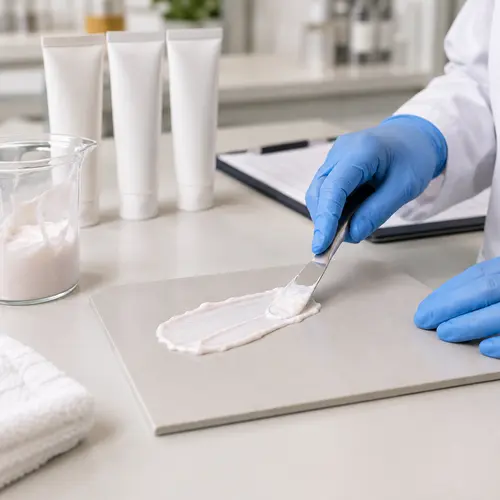
Packaging, Storage, and Shipment Conditions
The approved cream must be tested in the actual tube, bottle, cap, seal, label stock, and secondary carton. Check upright, inverted, and side storage; repeated opening; dispensing after storage; closure torque or crimp quality; panel distortion; staining; odor transfer; and leakage. Heat and cold exposure should be followed by a return-to-room-condition review for separation, viscosity shift, color change, gas formation, blocked flow, and label lifting.
Packaging choices should support both use and content production. A wide opening may create a strong texture shot but dispense too much product. A small orifice may improve control yet struggle with a high-viscosity cream. Ask the hair removal manufacturing process team to show how bulk handling, filling, sealing, coding, and inspection affect the approved texture. For adjacent wax concepts, the same discipline applies to cartridge leakage, wax-strip adhesion aging, sugar-wax consistency, and jar seal integrity. Broader depilatory product development solutions should still be assessed product by product.
Feedback That a Lab Can Act On
Avoid comments such as ‘make it gentler’ or ‘make it more premium.’ Use one feedback sheet per tester and sample code. Capture application amount, contact time, use area, hair result, removal method, immediate sensation, later observations, fragrance response, and package behavior. Photograph the product before application, at removal, and after rinsing under consistent lighting. Aggregate patterns without hiding outliers.
Then classify requests as required, preferred, or exploratory. Required changes address safety signals, leakage, instability, instructions, or failed removal. Preferred changes cover scent strength, color, glide, and finish. Exploratory changes belong in a separate sample version so they do not destabilize an otherwise acceptable formula. Before authorizing production, use a hair removal product RFQ to confirm sample scope, 1,000-unit pilot assumptions, component costs, testing responsibilities, documentation, lead time, and shipment terms.

Decision Framework Table
| Factor | What to Check | Why It Matters | ODM Buyer Note |
|---|---|---|---|
| Removal performance | Coverage, contact time, hair release, residue, and rinse effort | Shows whether mild positioning still delivers a usable result | Test on the intended body area and defined hair profile |
| Skin response | Immediate sensation and delayed redness, dryness, or discomfort | Reveals patterns that a texture review cannot detect | Set stop rules and document every adverse observation |
| Texture and odor | Spread, cling, edge drying, viscosity, fragrance, and use odor | Affects application control, camera presentation, and repeat use | Approve against a coded reference sample |
| Package compatibility | Seal, closure, dispensing, leakage, deformation, and label condition | Prevents stable bulk from failing in the finished SKU | Test production-intent components, not generic sample jars |
| Storage resilience | Heat, cold, orientation, recovery, separation, color, and flow | Models warehouse and shipment stress | Agree on acceptance criteria before testing begins |
| Scale readiness | Formula code, raw materials, fill method, QC limits, and retained sample | Reduces differences between prototype and market batch | Confirm the same manufacturing route can scale beyond the pilot |
Use this table as the approval gate for each coded version. A qualified hair removal OEM manufacturer should be able to connect every approved attribute to a written specification, test record, and production control rather than relying on an informal sample sign-off.
ODM Manufacturing Considerations
ODM development should begin with a written sample brief that separates essential requirements from preferences. For a sensitive skin depilatory cream, essential points may include the intended body area, target contact time, acceptable odor profile, texture, removal performance, rinse behavior, and limits on visible redness or discomfort during supervised user evaluation. Preferences may include color, fragrance direction, gloss, and how the cream appears when dispensed on camera. Each sample should have a unique code, manufacture date, and specification sheet so buyer comments can be connected to the correct batch.
Formula customization requires tradeoffs. A thicker cream may remain in place more effectively, but it can be harder to spread or dispense through a narrow opening. A stronger fragrance can mask the characteristic odor of hair-removal ingredients, yet it may be unsuitable for fragrance-sensitive users. Buyers should ask the supplier to define the expected viscosity range, appearance, odor, and application weight rather than approving a sample only by feel. Ingredient names should also be checked against the destination market. The European Commission’s CosIng ingredient database is a useful reference for ingredient functions and naming in the European market.
Packaging must be assessed with the actual formula and expected fill weight. The supplier should confirm whether the tube, cap, liner, label stock, printing, and outer carton remain functional after filling and distribution. Ask whether the dispensing opening gives a controlled dose, whether residue builds up around the cap, and whether the container can be emptied without excessive force. For wax strips, sugar wax, or roll-on wax cartridges, the review should also consider seal performance, material distortion, and whether the pack protects the product from temperature-related changes.
Stability work should use written acceptance criteria. Relevant observations include color drift, odor change, loss of uniformity, viscosity movement, wax texture, package distortion, seal failure, and net-weight loss. Confirm the evaluation duration, storage temperatures, inspection intervals, and procedure when a result falls outside specification. A commercial batch should not be treated as equivalent to an approved sample unless the supplier can show that the same formula version, raw-material standards, process settings, and packaging components were used.
MOQ discussions should distinguish among the formula MOQ, packaging MOQ, printed-component MOQ, and finished-goods MOQ. These figures may differ substantially. Request an itemized bill of materials covering bulk product, primary pack, printing, cartons, testing, assembly, and freight assumptions. This makes custom decisions easier to price and reduces the risk of late charges. Buyers should also establish who owns unused printed packaging and how obsolete components will be handled after an artwork change.
Before production, request the ingredient list, product specifications, batch records available to the buyer, safety documentation, test summaries, and label files. Claims must match the product’s demonstrated use and market classification. The FDA explains that personal-care products are not automatically treated alike in the United States, particularly when intended use changes the product category, in its guidance on whether personal-care products are regulated as cosmetics. For Australia, consult Australia’s TGA cosmetic-therapeutic boundary guidance when reviewing label language.
Shipment planning should record carton configuration, pallet requirements, temperature exposure assumptions, destination, transport mode, and responsibility for export documents. For heat-sensitive wax or creams, obtain the supplier’s recommended storage range and discuss seasonal routing before approving freight. Brands with launch-driven demand should also ask for realistic reorder lead times, monthly available capacity, component replenishment times, and the conditions for reserving production space.

Common Problems or Failure Cases
Wax becomes brittle: Wax strips can crack or fail to conform after cool storage when the wax blend, coating weight, or backing material is unsuitable. Compare application behavior after the pack returns to normal room conditions and define acceptable flexibility before production.
Strip adhesion declines: Adhesion can weaken because of wax migration, backing interaction, poor pouch sealing, or prolonged warm exposure. A sample that works immediately after manufacture may not represent performance later in its shelf life.
Cream separates: Oil release, watery discharge, graininess, or uneven color may indicate that the formula or manufacturing process is not sufficiently robust. Buyers should reject simple remixing as a commercial remedy and request an investigated cause, corrective sample, and updated specification.
Cartridges leak: Roll-on packs may leak around the roller, neck, or cap when tolerances change under transport temperatures. Leakage can damage labels and retail cartons even when the product itself remains usable. Filled-pack transit simulation and carton inspection should therefore be included in approval criteria.
Fragrance causes complaints: A fragrance selected to improve odor perception may create discomfort for part of the intended audience. Evaluate both fragranced and low-fragrance options with suitable participants, document the exposure area and duration, and avoid broad sensitive-skin claims based only on internal preference.
Packaging deforms: Tubes or wax containers can soften, panel, swell, or become difficult to close after temperature exposure. Confirm that the final decoration, adhesive, and container material are included in the evaluation because unprinted samples may behave differently from finished packs.

Supplier Checklist
- Confirm experience with depilatory creams, wax strips, sugar wax, roll-on cartridges, and relevant aftercare products.
- Require coded samples, version history, manufacture dates, and written approval criteria.
- Define target texture, color, odor, application behavior, viscosity or melting range where relevant, and removal performance.
- Review irritation risks, intended application areas, contact instructions, warnings, and the evidence supporting sensitive-skin claims.
- Test the sale-ready formula in the sale-ready container, closure, decoration, and carton.
- Obtain a stability plan with conditions, checkpoints, acceptance limits, and out-of-specification handling.
- Separate formula, component, printing, and finished-product MOQs in the quotation.
- Request a transparent bill of materials plus tooling, testing, freight, and artwork-related charges.
- Verify ingredient lists, specifications, safety documents, label support, batch identification, and document retention periods.
- Confirm shipment temperature guidance, carton strength, pallet pattern, loading method, and leakage controls.
- Ask for normal and surge capacity, reorder lead time, component constraints, and production-slot reservation terms.
- Record confidentiality, formula ownership, sample ownership, and restrictions on selling custom work to third parties.
FAQ
How can I reduce the risk of a factory reusing my idea or formula?
Use a confidentiality and development agreement that identifies pre-existing supplier formulas, buyer-funded modifications, ownership of test data, permitted subcontractors, and restrictions on disclosure or resale. Keep dated briefs and sample records. Absolute secrecy cannot be guaranteed, so commercial protection should combine contracts, controlled information sharing, distinctive branding, and documented ownership.
Can the sample texture and color deliver a strong visual effect on camera?
Ask for short videos and physical samples under agreed lighting, background, dispensing, and application conditions. Evaluate spread, opacity, color accuracy, stringiness, gloss, and removal footage. Camera impact must remain secondary to stable performance, suitable ingredients, and safe directions for use.
Can quality controls guarantee that no customer will experience irritation?
No supplier can guarantee zero reactions. Risk can be reduced through ingredient review, controlled user evaluation, clear application limits, batch specifications, traceability, and complaint procedures. Claims such as suitable for sensitive skin should be narrow, documented, and consistent with actual test conditions.
How do I communicate requirements without understanding technical ingredients?
Describe the user, application area, desired result, unacceptable outcomes, content format, target price, and market. A capable account team should convert that marketing brief into measurable sample criteria and explain tradeoffs in plain English without expecting the buyer to design the formula.
What should I approve before paying for mass production?
Approve the final formula code, specification, sale-ready pack, artwork, fill weight, label text, quality limits, test plan, production sample process, quotation, lead time, shipment terms, and rules for handling deviations. Verbal approval or approval from an early sample leaves avoidable ambiguity.
How can I assess whether capacity will support a sudden increase in orders?
Request documented line capacity, current utilization ranges, component lead times, backup filling options, and reorder scenarios at several volumes. Confirm whether capacity can be reserved and whether larger customers receive contractual priority. Forecast sharing helps, but the agreement should state what the supplier can actually commit to.