Direct Answer
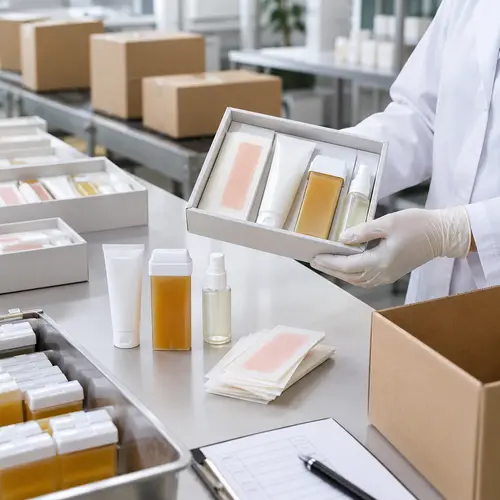
Hair removal product bundles work best when they are designed as one user journey rather than a collection of unrelated SKUs. For a private-label brand, the practical sequence is to define the target body area, hair type, skin sensitivity, usage method, and target retail price before choosing the formula or packaging. A strong bundle may combine wax strips with post-depilation care, a depilatory cream with a soothing gel, or sugar wax with an applicator and aftercare lotion. The key is to validate formula performance, packaging compatibility, labeling documents, stability, and shipment conditions as a complete kit. An experienced ODM partner should be able to provide a clear assortment brief, controlled samples, pilot quantities from 1,000 units, and parallel compliance support. This reduces late-stage substitutions and keeps the sample formula consistent with the production formula.
For United States launches, review the Modernization of Cosmetics Regulation Act of 2022 requirements early. A bundle is still a compliance project at SKU level, even when the consumer sees one box.
Key Takeaways for Private Label Buyers
- Start with an occasion-based assortment: facial touch-up, body waxing, sensitive-skin depilation, travel use, or post-wax recovery.
- Match each formula to a measurable performance target, such as cream spreadability, wax melting behavior, strip adhesion, or serum absorption.
- Approve the primary container, closure, applicator, and carton together. Leakage and compatibility issues often appear at the kit level.
- Request stability, irritation-risk, microbiological, and packaging compatibility evidence before approving artwork or a launch date.
- Use a controlled pilot to evaluate fill weight, texture, scent, labeling, shipment damage, and customer instructions before increasing volume.
- Build MoCRA or CPNP documentation into the development schedule instead of treating it as a final administrative step.
Buyer Context
The commercial appeal of a hair removal bundle is straightforward: it increases perceived value while giving the customer a more complete routine. The operational challenge is that each format has different technical constraints. Wax strips depend on adhesive behavior and release strength. Sugar wax requires a predictable texture and workable application temperature. Roll-on wax cartridges need reliable flow through the roller head without leakage during storage or transit. Depilatory cream requires controlled alkalinity, uniform active distribution, and clear exposure-time instructions. Aftercare products must support a comfortable post-removal experience without making unsupported medical claims.
For DTC brands, these differences affect more than product quality. They influence returns, reviews, paid-media claims, shipping restrictions, and customer support workload. A bundle that looks elegant on a product page may still fail if the cream separates in heat, the wax hardens during cold shipment, or the aftercare tube contaminates the carton. That is why buyers should treat assortment planning as a manufacturing and compliance decision, not only a merchandising exercise.
The right brief should identify the intended market, body area, customer profile, formula preferences, fragrance position, ingredient exclusions, packaging expectations, target cost, and launch quantity. It should also distinguish between a ready baseline formula and a genuinely custom adjustment. A pre-validated base can shorten development, while changes to fragrance, active level, viscosity, or preservative system may require additional review.
For category research, buyers can use hair removal product guides and hair removal product solutions to compare wax, cream, and aftercare applications before writing the final assortment brief.

Technical or Packaging Factors
Formula behavior and user control
Formula selection should begin with the consumer action the product must support. A depilatory cream should spread in a consistent layer, remain workable for the stated application window, and rinse without excessive residue. The buyer should review viscosity across normal storage conditions, color and odor drift, active uniformity, and irritation-risk documentation. For sensitive-skin positioning, request a documented ingredient review and clear usage restrictions rather than relying on a gentle-sounding name.
Wax products require different checks. Hot wax and sugar wax should be assessed for melting behavior, application flow, stringing, set time, and removal performance. Roll-on wax should be evaluated through the complete cartridge and roller assembly, including flow after storage and repeated use. Wax strips need an adhesion review after aging, because substrate, adhesive, release paper, and heat exposure can change pull strength. These checks should be performed on the final packaging configuration, not only on a laboratory beaker sample.
Aftercare formulas should complement the removal format. A light soothing gel may suit a wax strip kit, while a richer lotion may be appropriate for larger body areas. Packaging should protect the product from contamination and should not imply that the product treats a medical condition. The FDA eye-area cosmetic safety framework is especially relevant when a brand proposes facial or brow-area use. Claims and directions need a separate review because facial application has a narrower tolerance for irritation and user error.
Packaging compatibility and shipment conditions
Packaging decisions should follow formula behavior. A depilatory cream may require a laminate tube or compatible plastic that resists active ingredients and prevents odor transfer. A roll-on wax cartridge needs a closure and roller system that limits leakage while preserving controlled dispensing. Wax jars must be checked for lid fit, thread integrity, headspace, and surface residue after heat exposure. Wax strips should be tested inside the final carton and shipping configuration to confirm that strips do not curl, adhere to one another, or shift during transit.
Request heat and cold storage checks that reflect the intended distribution route. Examine leakage, separation, deformation, label adhesion, carton scuffing, and fill-weight changes after conditioning. If a bundle includes multiple formulas, test the entire assembled kit because one leaking tube can damage paper components and create a customer-facing quality failure. Shipment conditions should be documented by market, including expected transit duration, temperature exposure, pallet or parcel handling, and any restrictions affecting the formula.
For a step-by-step view of sampling, filling, packaging, quality review, and shipment preparation, see the hair removal manufacturing process. Buyers comparing cream formats can also review custom depilatory cream formulation, while aftercare planning may benefit from post-depilation care OEM.

Decision Framework Table
| Factor | What to Check | Why It Matters | ODM Buyer Note |
|---|---|---|---|
| Assortment logic | Use occasion, body area, skin profile, and target retail price | Prevents a bundle from becoming a mismatched collection of products | Ask for two or three assortment routes with clear SKU roles |
| Formula performance | Spreadability, viscosity, wax flow, melting behavior, adhesion, scent, and residue | Performance drives reviews, repeat purchase, and customer support volume | Approve retained samples against written acceptance criteria |
| Skin and claim review | Ingredient exclusions, irritation-risk review, directions, warnings, and claim substantiation | Reduces regulatory and reputational exposure | Separate cosmetic claims from medical or treatment language |
| Packaging compatibility | Container material, closure, roller assembly, tube seam, jar lid, label, and carton | Prevents leakage, deformation, contamination, and artwork failure | Test the filled final pack, not an empty component |
| Stability and shipment | Heat, cold, aging, leakage, separation, fill weight, and parcel handling | Shows whether the kit can survive its actual distribution route | Define storage and shipment conditions before the pilot run |
| Launch readiness | Samples, pilot quantity, batch records, labeling file, compliance documents, and inspection plan | Turns a concept into a repeatable SKU launch | Use one approval gate for formula, pack, artwork, and documentation |
Buyers evaluating wax formats can compare private label waxing products, while brands planning a recovery step can assess an after hair removal serum. The development team should record every approved change so the production batch does not drift from the sampled kit.

ODM Manufacturing Considerations
A practical project handoff includes the assortment brief, formula references, target pack sizes, artwork requirements, market destinations, testing scope, and approval owners. The manufacturing partner should clarify which items use an existing baseline, which require custom development, and which documents will be supplied for the United States or European Union. For the EU, confirm the responsible-person workflow and CPNP support. For the United States, confirm facility and product information required under MoCRA and review the FDA position that cosmetics are regulated but generally not pre-approved; the agency explains this distinction in its cosmetics regulatory authority guidance.
A low-MOQ pilot should have a defined purpose: verify demand, collect user feedback, test the fulfillment experience, or validate a creator-led launch. It should not be treated as an informal sample batch with different raw materials or packaging. Ask whether the same formula specification, supplier controls, filling line, and inspection criteria will be used when the order scales. This is the point where a documented hair removal formulation service and a clear hair removal product RFQ can prevent avoidable rework.
ODM Manufacturing Considerations
A reliable hair removal product bundle is confirmed in stages, because the formula, primary pack, accessories, and shipping carton affect one another. The first approval should be a documented sample confirmation. For wax strips, review strip cut, wax coverage, release behavior, residue, and skin feel. For sugar wax or jar wax, record texture at room temperature, melting behavior, spreadability, and the usable temperature range. For depilatory cream, confirm viscosity, active uniformity, odor, application thickness, and the defined contact-time directions. Aftercare gel or lotion should be checked for absorption, fragrance level, and compatibility with the complete kit concept.
Customization should be separated into formula changes, sensory changes, and presentation changes. A buyer may request a different fragrance, lower residue, a softer wax, a more controlled roll-on flow, or a cream suitable for a specific body area. Each change needs a written target and a comparison sample. This prevents a vague request such as premium texture from becoming an approval dispute. A custom manufacturing brief should state the intended market, product format, user area, fragrance position, prohibited ingredients, claims, pack size, and expected retail use.
Packaging compatibility is a product requirement, not a final artwork task. Check whether wax contacts the liner, pouch seal, jar wall, cartridge body, roller head, tube, or cap during storage. Confirm that oils, solvents, fragrance components, and depilatory actives do not weaken seals, soften plastic, stain labels, or alter the wax surface. Bundle components should also fit without pressure on strip sachets, cream tubes, spatulas, or aftercare containers. A packaging compatibility matrix with formula, material, closure, fill level, and observed condition gives procurement teams a useful approval record.
Stability review should represent actual distribution conditions. Inspect the individual product and assembled kit after heat exposure, cold exposure, temperature cycling, and normal warehouse holding. Look for wax brittleness, oil separation, cream phase change, cap distortion, label lifting, carton compression, and odor migration. The shipment plan should define pallet configuration, outer-carton strength, moisture protection, temperature limits, and whether the cargo requires seasonal routing. These details belong in the production specification and the manufacturing process record, not only in informal messages.
MOQ should be evaluated against the full bundle, not just the formula. A low initial quantity may still require minimum purchases for printed pouches, custom cartons, molded accessories, or special fragrance materials. Ask for separate quantities for sampling, formula production, primary packaging, printed components, and finished kits. Compare the resulting unit economics with expected customer acquisition cost, returns, fulfillment labor, and damaged-kit allowance. A phased launch using standard pack components with custom labels may provide better learning economics than commissioning every component at once.
Before approval, request the labeling and shipment file: ingredient declaration, net contents, batch or lot identification method, shelf-life or period-after-opening basis, usage directions, warnings, allergen or fragrance disclosure where applicable, carton artwork, packing list, and commercial documents. For United States distribution, review the supplier documentation against the Modernization of Cosmetics Regulation Act (MoCRA) of 2022. The supplier should explain what it provides, what the brand or responsible party must complete, and which claims require additional substantiation.
Related planning pages: hair removal product categories and project and RFQ information.

Common Problems or Failure Cases
Wax brittleness: A strip or sugar wax can become difficult to bend, spread, or remove cleanly when the formula, substrate, temperature, and storage time are not balanced. Ask for observations at low, normal, and elevated storage temperatures. The corrective action may involve wax composition, coating weight, liner selection, or clearer application directions. Do not approve a sample based only on appearance.
Strip adhesion loss: Adhesion can decline after prolonged heat, humidity, compression, or contact with a poorly matched liner. Review peel consistency across the batch and inspect whether wax remains on the skin or transfers unevenly to the backing. The supplier should identify the suspected cause and repeat the relevant conditioning review before changing artwork or increasing fill weight.
Cream separation or odor drift: Depilatory cream may separate, thin, thicken, or develop a stronger odor when the active system and emulsion are not stable together. Compare samples from the beginning, middle, and end of a fill run. Confirm the recommended storage range and test the actual tube or sachet rather than relying only on a laboratory container.
Roll-on cartridge leakage: Leakage can occur around the roller head, cap, seam, or closure after vibration and temperature changes. Inspect upright and inverted samples, the inside of the cap, and the outer carton. A cartridge that works during hand testing may still fail in parcel shipment if the closure tolerances or secondary packaging are weak.
Fragrance sensitivity and claim risk: A strong fragrance may conflict with a sensitive-skin positioning, while an unsupported low-irritation claim can create regulatory and customer-service exposure. Review the fragrance composition, warning language, patch-test direction, and intended body area with the compliance team. Keep claims limited to evidence that can be retained in the product file.
Packaging deformation: Heat can warp a tube, soften a pouch seal, distort a lid, or cause a carton to buckle around a heavy jar. Test the finished bundle in its actual shipper and inspect both product protection and shelf presentation. Repeated deformation is usually a specification problem, not a cosmetic defect to be accepted after launch.
Supplier Checklist
- Can the supplier provide controlled samples for wax strips, sugar wax, roll-on cartridges, cream, and aftercare components relevant to the proposed bundle?
- Are formula targets documented for texture, melting behavior, viscosity, odor, application area, residue, and user removal experience?
- Does the supplier record formula revisions, sample approvals, batch identification, and retained-sample handling?
- Has each formula been reviewed with its actual tube, pouch, jar, cartridge, liner, closure, label, and carton?
- Are heat, cold, vibration, compression, leakage, seal, and label-adhesion observations available for the finished kit?
- Are MOQ and pricing separated for formula, primary packaging, printed components, accessories, and assembled bundles?
- Can the supplier provide ingredient, warning, usage, lot, shelf-life, artwork, and shipment documentation before production approval?
- Is there a written process for fragrance sensitivity review, claim substantiation, complaint handling, and corrective action?
- Can the buyer sign a meaningful NDA covering formulas, artwork, packaging concepts, samples, and commercial plans before technical exchange?
- Are environmental packaging claims supported by material specifications, recycled-content evidence, supplier traceability, and recognized certification where claimed?
FAQ
Can an Asian supplier meet European and United States clean beauty and cruelty-free expectations?
Yes, but location is not evidence of compliance. Request ingredient restrictions, supplier declarations, animal-testing policy, fragrance documentation, batch records, and claim support. Define clean beauty as a written buyer standard rather than an undefined marketing label, and verify the finished formula against that standard.
Will a low MOQ make the bundle too expensive to acquire customers profitably?
It can, especially when custom cartons, pouches, accessories, and small print runs are included. Model the landed cost together with fulfillment, returns, samples, and expected CAC. A staged launch with adaptable components can reduce packaging exposure while the market validates the assortment.
Will a turnkey base formula make the products look identical to competing brands?
Not necessarily. Differentiation can come from formula texture, fragrance profile, wax format, application instructions, aftercare pairing, pack architecture, and documented user testing. Ask which elements are genuinely customizable and require written approval before the supplier offers the same specification to another brand.
Can the supplier sign a strict NDA before receiving the full brand plan?
That should be a normal procurement step for confidential formula targets, artwork, launch timing, and channel strategy. The NDA should identify confidential information, permitted recipients, duration, exclusions, ownership of buyer-created work, and remedies. Share technical details in stages until the agreement is executed.
How can a buyer avoid greenwashing in packaging claims?
Ask for the exact material composition, recycled or renewable content basis, supplier chain documentation, disposal instructions, and certification scope. Claims should describe the verified component and market qualification, not imply that an entire kit is universally recyclable. For halal-related market plans, consult the MUI World Halal Council mutual-recognition guide and confirm the applicable certification route.
What should be approved before releasing the first commercial bundle?
Approve the formula sample, primary pack, artwork, assembled kit, labeling file, shipment specification, acceptable quality limits, and corrective-action process. Retain signed samples and photographs of approved packaging so later production can be compared against a clear reference.