Direct Answer
Post depilatory care products should be developed as part of the hair-removal system, not added after the wax, strip, or cream is finished. The strongest concept usually combines three priorities: immediate soothing feel, lightweight moisture, and a routine that is simple enough for repeat use. For private-label buyers, this means matching the aftercare formula to the removal method, the target body area, and the packaging format from the first sample round.
A gel may suit a fast, cooling post-wax ritual, while a lotion or serum can support a more moisturized positioning after depilatory cream or sugar wax. The formulation must also be reviewed for irritation risk, fragrance sensitivity, preservative compatibility, packaging leakage, and claims substantiation. A reliable development brief should therefore include the removal product, the aftercare product, the intended market, storage conditions, and the exact consumer routine. This integrated approach helps a brand build a coherent product concept while reducing late-stage reformulation and compliance uncertainty.
Key Takeaways for Private Label Buyers
- Source the routine, not only the SKU: Evaluate the depilatory product and aftercare product as one consumer experience, including texture, scent, absorption, and pack size.
- Match formula to removal method: Post-wax skin may prefer a light soothing gel, while cream or sugar-wax users may expect more moisture and comfort after rinsing or removal.
- Test packaging with the real formula: Check pump performance, cap closure, leakage, label adhesion, and compatibility with oils, botanical extracts, and preservatives.
- Document irritation and claims risk: Review fragrance, essential oils, alcohol content, exfoliating ingredients, and any claim that could imply treatment rather than cosmetic care.
- Define storage and shipment conditions early: Heat, cold, vibration, and extended warehouse storage can affect viscosity, separation, odor, and package integrity.
- Use sampling to validate launch economics: Confirm sample scope, pilot quantity, component availability, and scale-up consistency before committing to a full launch plan.
Buyer Context
Hair removal temporarily changes the feel and appearance of the skin surface. Wax strips, hot wax, roll-on wax cartridges, sugar wax, and depilatory cream each create a different aftercare need. Wax and sugar wax rely on adhesion and removal force. Creams rely on chemical action and rinsing. A roll-on format also introduces direct contact between the cartridge, applicator, product, and skin. These differences make a generic moisturizer an incomplete solution.
For a DTC brand, the post-removal moment is also where the routine becomes visible. Consumers may evaluate whether the skin feels tight, sticky, greasy, hot, or comfortable within minutes. That sensory response influences reviews, repeat purchase, subscription retention, and the perceived quality of the entire hair-removal line. A simple aftercare product can therefore carry disproportionate brand value.
Buyers should first decide what the product is expected to do in the routine. Is it a cooling step after waxing, a daily moisture product between removal sessions, or a coordinated companion to a depilatory cream? These are different positioning choices. The formula, packaging, directions, and claims should follow that choice rather than trying to cover every use case.
For brands entering multiple markets, the documentation pathway matters as much as the consumer story. Ingredient lists, product specifications, stability records, packaging declarations, and claim support should be organized before artwork is finalized. A transparent compliance workflow is particularly useful for operators managing MoCRA or CPNP requirements across a fast launch cycle. The post-depilation care OEM page can help buyers compare soothing gels, recovery lotions, and after-wax concepts, while the depilatory cream formulation page provides useful context for coordinating the primary removal SKU.
Product architecture can also create a stronger market concept. A brand might pair a low-residue wax with a calming gel, or a depilatory cream with a more moisturizing lotion for areas that feel dry after rinsing. This is where hair removal product solutions and custom hair removal product development become relevant: the buyer is selecting a connected routine rather than isolated formulations.

Technical or Packaging Factors
Formula texture and after-feel. A soothing gel should spread quickly and avoid excessive tack. A lotion should absorb without leaving a heavy film that transfers to clothing. A serum may offer a premium visual and sensory concept, but its dropper or pump must deliver consistently and protect the formula from unnecessary exposure. During sampling, review glide, absorption time, residue, odor, and the appearance of the skin immediately after use.
Ingredient and irritation review. The aftercare product should be screened for fragrance, essential oils, alcohol, exfoliating acids, and other ingredients that may be poorly tolerated immediately after hair removal. Natural positioning does not automatically mean low irritation. Buyers should request an ingredient rationale, intended-use guidance, safety documentation, and a clear review of any sensitive-skin positioning. The sensitive skin hair removal products resource is relevant when the removal and aftercare products are being developed for a lower-irritation concept.
Compatibility with the primary product. Wax residue, oils, botanical extracts, alkaline cream systems, and surfactants can affect how an aftercare formula feels or how its package performs. A roll-on wax cartridge requires a separate leakage and applicator review. Wax strips require attention to adhesive aging, pouch sealing, and the interaction between the strip surface and storage temperature. Depilatory cream requires viscosity consistency, tube compatibility, odor control, and stability after repeated opening.
Storage and transport. Ask for heat and cold storage checks, freeze-thaw observations where relevant, centrifuge or separation observations, odor changes, color changes, and viscosity tracking. Packaging should be tested under vibration and shipment conditions, not only on a stable laboratory bench. For a gel or lotion, confirm that the pump primes correctly after storage and that the cap or closure does not allow leakage. The hair removal manufacturing process page outlines the broader sampling, filling, packaging, and quality-control workflow buyers should expect.
Claims and documentation. Words such as soothing, calming, hydrating, cooling, and comfort-focused should be matched to the formula and available evidence. Claims should not imply that the product treats a medical condition or guarantees a specific physiological result. Buyers can compare proposed advertising language with the FTC advertising substantiation guidelines. For broader cosmetic classification questions, the FDA explanation of personal care products regulated as cosmetics is a useful reference point.
Routine fit and pack design. A travel-size tube may suit waxing kits or subscription boxes, while a pump bottle may communicate a repeated body-care ritual. The pack should make dosage intuitive and keep the directions legible. Avoid pairing a premium claim with a closure that feels fragile, leaks in transit, or requires consumers to touch the formula unnecessarily. For coordinated launches, compare the visual proportions, component finishes, and label hierarchy across the wax, cream, and aftercare products.
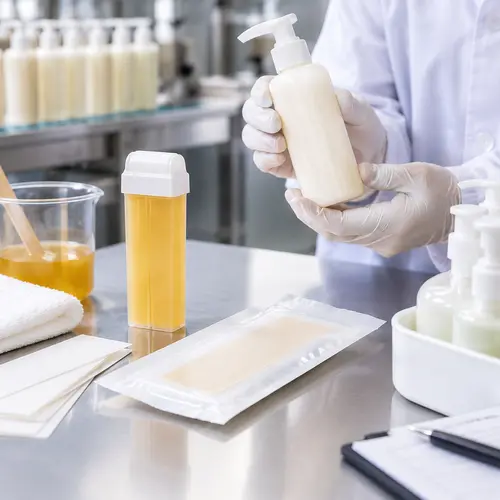
Decision Framework Table
| Factor | What to Check | Why It Matters | ODM Buyer Note |
|---|---|---|---|
| Texture | Spread, absorption, tack, residue, scent, and skin feel after use | Determines whether the product feels like a useful recovery step or an extra layer | Review at least one gel, lotion, or serum direction before locking the concept |
| Formula compatibility | Interaction with wax residue, cream systems, oils, extracts, and preservatives | Prevents inconsistent feel, separation, odor change, or unexpected irritation concerns | Provide the primary removal formula during aftercare development |
| Packaging | Pump prime, tube squeeze, closure fit, leakage, label adhesion, and component availability | Protects shipment quality and keeps the routine easy to use | Test the filled package, not only an empty component |
| Stability and shipment | Heat, cold, vibration, separation, viscosity, color, odor, and closure integrity | Shows whether the product can tolerate real distribution conditions | Define target markets and warehouse conditions before testing begins |
| Claims and documents | Ingredient list, specifications, safety file, stability records, directions, and claim support | Reduces artwork revisions and market-entry uncertainty | Run compliance review in parallel with formulation and packaging work |
| Pilot and scale-up | Sample scope, pilot quantity, component MOQ, lead time, and batch consistency | Connects product quality with launch economics and replenishment planning | Ask how the approved sample will be transferred to the production line |
For buyers comparing suppliers, the most useful next step is a written development brief. Include the removal method, target body area, skin-feel preference, fragrance direction, ingredient exclusions, package format, target markets, intended claims, storage conditions, and launch quantity. A supplier should be able to respond with a sample plan, testing scope, documentation list, and clear boundaries around what can be customized.

Brands exploring a coordinated range can also review post hair removal serum concepts, wax strips and hot wax formats, and the hair removal product RFQ process. The goal is not to add unnecessary products. It is to ensure that every selected SKU supports the same consumer routine, quality standard, and launch calendar.
ODM Manufacturing Considerations
Developing post depilatory care products requires alignment among the hair-removal format, aftercare formula, packaging, claims, and intended routine. A light gel paired with wax strips may need rapid spread and minimal residue, while an aftercare cream for depilatory cream users may prioritize moisture retention and fragrance restraint. Buyers should evaluate these combinations as one concept rather than approving each SKU in isolation.
Confirm Samples Against a Written Brief
Sample approval should be based on measurable criteria, not only whether the product feels pleasant. The brief should define appearance, odor, color, viscosity target, spread, absorption time, residue, and the acceptable degree of variation between samples. Evaluation should include use after the relevant hair-removal method on appropriate test substrates or through a properly designed consumer-use study. Keep an approved control sample and signed specification as the reference for future batches.
Clarify what the sample fee and MOQ cover. Thresholds may differ by formula, fragrance, package color, decoration method, and carton configuration. A low quantity using stock components can have a different cost structure from the same quantity with custom-colored bottles or printed components. Compare total landed cost, testing, component setup, and expected sell-through rather than unit price alone.
Control Customization Without Losing Formula Robustness
Changing a base formula can affect more than the ingredient list. Adding an imported botanical oil for a natural sourcing story may alter odor, color, oxidation behavior, or emulsion structure. Ask for the ingredient origin, specification, allergen information, and lot traceability before building claims around it. Customization can also come from sensory profile, fragrance level, format, routine instructions, or package presentation without unnecessarily destabilizing the base.
Review compatibility using filled components from the intended supplier. Observe cap fit, liner interaction, paneling, label lift, discoloration, and formula contact with seals or internal surfaces. Stability protocols should reflect expected market and distribution conditions, including ambient storage, elevated-temperature exposure, temperature cycling, light exposure when relevant, and post-test sensory assessment. Agree in writing on test duration, acceptance criteria, and responsibility if the commercial package changes after approval.

Prepare Labeling and Shipment Files Early
The documentation pack should include the ingredient declaration, product specification, batch coding format, safety support, claims evidence, packaging specifications, and market-specific label copy. Intended use matters because regulators may classify products according to their claims, not their marketing category. The FDA explains that not every item described as a personal care product is regulated identically, so US label review should reflect the formula and stated purpose.
Shipment planning should document case count, pallet pattern, component orientation, container conditions, and handling limits. Confirm whether shipment testing represents parcel delivery, pallet freight, or ocean transport. Buyers reviewing the manufacturing process should also identify where incoming component inspection, in-process controls, release testing, and retention samples are recorded.
Common Problems or Failure Cases
- Wax becomes brittle: A hard or sugar wax can crack or lose workable spread when its composition, fill conditions, or storage environment is unsuitable. Confirm the application temperature window and evaluate product from the final container.
- Wax strips lose adhesion: Low tack may result from adhesive migration, unsuitable backing, prolonged storage, or contamination. Test removal performance across the intended shelf-life program and inspect whether individual strips separate cleanly.
- Depilatory cream separates: Visible liquid, graininess, or uneven texture can signal emulsion stress or raw-material interaction. Record viscosity and appearance at defined intervals, then verify dispensing and application remain consistent.
- Roll-on cartridges leak: Leakage can originate from dimensional variation, roller fit, closure torque, or wax behavior during transit. Inspect multiple component lots rather than relying on one hand-selected prototype.
- Fragrance causes avoidable sensitivity concerns: Recently depilated skin may be less tolerant of strong perfume. Review fragrance concentration, allergen disclosure, and whether an unscented option better fits the routine and target market.
- Packaging deforms: Bottles, jars, caps, or cartridges may distort because of formula interaction, temperature exposure, or stacking pressure. Cosmetic appearance is not the only issue; deformation can affect closure integrity and dosing.
When a failure appears, request a documented root-cause review that separates formula, component, filling, storage, and transport variables. Replacing several variables at once may hide the real cause and make the result difficult to reproduce.

Supplier Checklist
- Define experience with wax, sugar wax, strips, cartridges, depilatory cream, and aftercare rather than general cosmetics alone.
- Request valid certificates and verify the legal entity, site address, scope, issuer, and expiration date.
- Compare the supplier’s hair-removal product categories with the exact format and market being developed.
- Ask for sample stages, revision limits, approval records, reference retention, and scale-up controls.
- Obtain formula specifications covering appearance, odor, pH where applicable, viscosity or workable temperature range, and microbiological limits.
- Review irritation-risk assessment, fragrance allergens, use directions, warnings, and evidence supporting visible claims.
- Confirm component specifications, decoration tolerances, closure controls, and compatibility responsibilities.
- Separate MOQ requirements for formula filling, primary packaging, decoration, and cartons.
- Request ingredient, label, claims, batch, testing, and traceability documents before artwork approval.
- Define shipment configuration, release criteria, nonconformance handling, and retained-sample access in the quality agreement.
A structured technical RFQ brief makes comparison more reliable because each candidate responds to the same formula, package, market, and documentation scope.
FAQ
Can an Asian manufacturing site genuinely meet Western clean beauty and cruelty-free expectations?
Location alone does not prove or disprove compliance. Treat clean beauty as a buyer-defined restricted-substance standard because it has no single universal definition. Audit ingredient screening, supplier declarations, animal-testing policies, quality records, and market-specific requirements. For certifications such as ISO 22716, GMPC, or BSCI, verify the issuing body, covered site, scope, and validity rather than accepting a logo.
Will a low MOQ make the unit cost incompatible with customer acquisition cost?
It can, particularly when custom decoration, unique components, or several fragrances divide the volume. Model landed margin after testing, setup, freight, fulfillment, and expected CAC. A stock package with differentiated artwork and a focused formula modification may protect early-stage economics better than changing every element at launch.
Does using a turnkey or established formula make the product identical to competitors?
Not necessarily. Ask which elements are exclusive and which remain shared. Differentiation can come from a controlled sensory profile, selected botanical oil source, fragrance strategy, routine pairing, package format, instructions, or substantiated claims. Review custom development pathways and document ownership of each modification.
Can we require a strict NDA before sharing the concept?
Yes. The NDA should define confidential information, permitted recipients, exclusions, duration, handling of samples and formulas, and remedies. It should also distinguish confidentiality from formula ownership and market exclusivity, which usually require separate contractual terms.
How can we verify that environmental packaging claims are not greenwashing?
Request material specifications, recycled-content evidence, chain-of-custody records where relevant, supplier identities, and certification numbers that can be checked with the issuer. Ensure the final claim accurately describes the component and region. Broad environmental statements require support under the FTC’s advertising substantiation guidelines.
What should be approved before the first commercial shipment?
Approve the signed formula and component specifications, finished sample, artwork, claims support, coding format, test summary, case configuration, release criteria, and deviation procedure. Confirm that the shipped product matches the approved formula-package combination rather than a visually similar substitute.