Direct Answer: Compliance Sequencing Decides the Launch Date, Not the Formula
For a depilatory cream, hot wax, wax strip, sugar paste, or roll-on cartridge, hair removal products US EU compliance is a two-track documentation architecture that has to be built in parallel with the formula, not after it. The US track now rests on MoCRA facility registration and product listing, layered on the FDA position that cosmetics are not FDA-approved and that the manufacturer and marketer carry the safety substantiation burden. The EU track rests on Regulation (EC) No 1223/2009: an in-market Responsible Person, a Product Information File, a Cosmetic Product Safety Report, and a CPNP notification completed before the first unit is placed on the market. Where launches slip, the cause is rarely the emulsion. It is a safety report that cannot be signed because a 12-week accelerated stability dataset was started four weeks before the ship date, or an aerosol and roll-on format that was never checked for compatibility with an alkaline thioglycolate system. Treat compliance as the critical path and the launch date becomes predictable.
Key Takeaways for Private Label Buyers
- Build the regulatory dossier and the formula on the same clock. A CPNP notification cannot be filed without a signed safety report, and a safety report cannot be signed without stability and compatibility data.
- Fix the pH and active concentration before sampling. Depilatory systems live or die on the thioglycolate concentration and the pH ceiling, and reformulating after artwork approval resets both testing and label review.
- Qualify packaging as a technical component, not a purchasing line item. Alkaline creams attack tube lacquers, and roll-on cartridges fail at the ball seat rather than the body.
- Run claims substantiation early. Anti-irritation, sensitive-skin, and slow-regrowth positioning all require evidence generated before copy is locked.
- Confirm the contract manufacturer holds ISO 22716 and can hand over the full technical file, not just a certificate of analysis.
Buyer Context: Why This Question Surfaces Before the Formula Does
Procurement teams do not usually open a hair removal program because they want a new texture. They open it because the group has mandated a second qualified source in the depilatory and waxing category, because an incumbent supplier has just failed a capacity or quality audit, or because the brand is moving beyond skin care into aerosol foams and hot wax systems that the existing line cannot fill. In each case the brief arrives with a fixed retail window and a compliance committee that will not accept a provisional file.
That timing pressure collides with a category-specific reality: depilatory products are among the more awkward cosmetic formats to document. The chemistry is alkaline and reactive, the irritation profile is under scrutiny by both the FDA and EU authorities, and the formats are mechanically varied. A wax strip and a bag-on-valve depilatory foam share a shelf but not a manufacturing line, a stability protocol, or a packaging qualification route. Buyers who want to compress the timeline should therefore expect the supplier to run regulatory, safety, and stability work as parallel tracks and to show the schedule that proves it.

One further consideration sits outside the product file but inside the board pack: the group ESG disclosure. Solvent handling, wastewater from wax kettles, energy source, and labour standards at the filling site are now audited alongside the certificate of analysis. A supplier that cannot produce a traceable environmental record is a supply chain risk even when the cosmetic file is flawless. The same discipline applies to intellectual property — segregated data environments and physical separation of client batches are reasonable preconditions for sharing a proprietary depilatory base.
Technical and Packaging Factors That Determine Approvability
Depilatory chemistry and the pH ceiling
Thioglycolate-based depilatory creams typically sit between pH 10.5 and 12.5, and the EU framework caps the use of thioglycolic acid and its salts at 5 percent calculated as thioglycolic acid with a pH not above 12.7 in depilatory applications. That leaves a narrow operating corridor: high enough to cleave the disulfide bonds in keratin within the claimed three to ten minutes, low enough to stay inside the regulatory ceiling after any drift across shelf life. Buyers should request the pH specification, the drift data at end of shelf life, and the irritation-risk assessment, and should note that an anti-irritation or sensitive-skin claim requires its own substantiation file rather than a formula tweak. Ingredient naming must reconcile with the European Commission’s CosIng ingredient database before the safety report is drafted, otherwise the label and the notification diverge.
Wax melting point and strip adhesion aging
Hot wax and cosmewax-type synthetic blends are specified by melting point and viscosity, commonly in the 40 to 45 degree Celsius band for strip and film formats. Two checks matter commercially. First, melting point stability across storage: a wax that softens in a hot container in transit will not release cleanly in the salon. Second, adhesion aging of pre-coated strips — the adhesive bond between wax and substrate relaxes over time, and a 12-month aged strip can behave measurably differently from a freshly coated one. Ask for aged-strip pull data, not just fresh-coat data.
Packaging compatibility and leakage
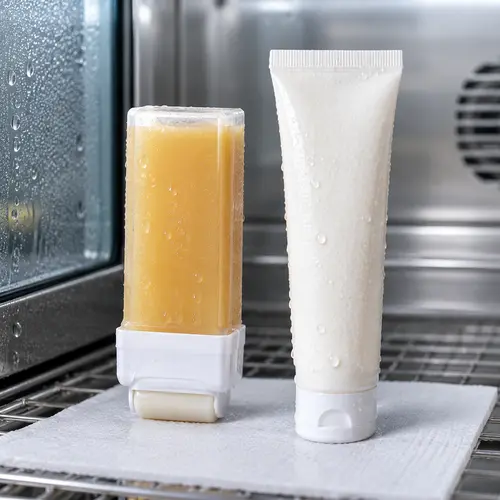
Alkaline cream in a laminate tube is a compatibility test, not an assumption; the inner lacquer must resist the formula for the full shelf life or the tube delaminates and the batch is lost. Roll-on cartridges should be qualified at the ball seat and the crimp, with a documented leakage check after inverted storage. Aerosol depilatory foams require valve and bag-on-valve qualification, pressure testing, and transport classification documentation. Secondary packaging matters too: labelling durability under humid bathroom conditions is a routine consumer complaint source.
Stability protocol and storage claims
A defensible programme runs 12 weeks of accelerated stability at 40 degrees Celsius and 75 percent relative humidity, with three freeze-thaw cycles and a real-time arm started in parallel. For wax and sugar paste the parameters extend to phase separation, crystallisation, and colour shift; for aftercare and post-depilation serum formats the indicators are viscosity, pH, and preservative efficacy. Claims written on the website and on pack must stay inside what the data supports; micro-claims about regrowth inhibition are the most frequent area where copy outruns the file.
Decision Framework: A Compliance-First Sourcing Matrix
| Factor | What to Check | Why It Matters | ODM Buyer Note |
|---|---|---|---|
| Active system and pH | Thioglycolate concentration, pH specification, end-of-life pH drift | Determines both efficacy and regulatory headroom | Request drift data, not a single batch reading |
| Safety documentation | CPSR sign-off, PIF completeness, Responsible Person for the EU | CPNP notification is blocked without them | Confirm who owns the file after handover |
| Stability dataset | 12-week accelerated at 40C and 75 percent RH, freeze-thaw, real-time arm | Shelf life claim and transport tolerances rest on it | Start before artwork approval, not after |
| Primary packaging | Tube lacquer compatibility, roll-on ball-seat leakage, valve and BOV pressure | Failure shows up at retail, not at release | Qualify inverted storage and transit vibration |
| Wax rheology | Melting point band, viscosity, aged-strip adhesion | Drives salon handling and container stability in heat | Hot and cold storage simulation is mandatory |
| Scale and continuity | Pilot volume, ISO 22716 scope, capacity ceiling per SKU | Prevents a second qualification cycle at peak demand | Ask whether the pilot line and mass line are the same line |
The practical consequence is that the sourcing decision should be evaluated on documentation depth and format range rather than on quoted unit price alone. Buyers moving a portfolio across regions will find the FDA’s published guidance on cosmetic regulation and the CosIng database more useful as reference anchors than any supplier brochure.

ODM Manufacturing Considerations
A capable ODM partner turns a brand brief into a batch record you can audit. The stages below are what separate a supplier that can ship one pilot run from one that can carry a category rollout, which becomes the deciding factor when a brand extends beyond its current line into depilatory wax, sugar paste, or roll-on formats the incumbent factory cannot produce.
Sample confirmation
Request three distinct rounds: bench sample, pilot sample, and a production-representative sample drawn from the actual filling line. Each round should travel with the same specification sheet, the same bulk batch code, and the same component lot. Approve texture by hand-spread at application temperature rather than by photograph, and record the melt point of the approved sample so the production batch can be held within a defined tolerance of it. If the supplier cannot tell you which round you signed, the approval is not traceable and the first commercial batch becomes the real sample.
Formula customization
Customization in hair removal is narrower than in skin care, and that is a feature, not a limitation. Fragrance, color, wax blend ratio, and aftercare actives are movable. Active concentration and pH are not, because changing either reopens the safety assessment and, in the EU, the product information file. Ask the ODM to classify every requested change in writing as cosmetic or regulatory, and to quote the second category separately so the cost of re-documentation is visible before you commit rather than after the purchase order.
Packaging compatibility
Compatibility work runs on filled units, never on a bare component. A roll-on cartridge needs inverted storage with the ball seat under load; a cream tube needs contact time against its inner lacquer at fill temperature; a wax jar needs a lid gasket checked after hot filling. Pair each compatibility arm with the stability arm so leakage, panel deformation, and formula drift are read off the same units instead of being argued about later from separate reports.

MOQ, tooling, and scale
Quote MOQ per SKU and per component, because the carton and cap usually set the floor before the bulk does. Ask what the MOQ becomes on the second order, whether tooling is amortized into unit price or retained by the factory, and at which batch size the process itself changes. A supplier that cannot describe that step-up in concrete terms has not yet run the format at scale.
Labeling documents
The document pack should arrive before artwork lock, not after. Expect the ingredient list reconciled against the European Commission’s CosIng ingredient database, the allergen declaration for the fragrance, the batch coding and PAO convention, and the responsible person details for the EU. For the US, confirm the label reflects that cosmetics are not FDA-approved and that the firm making the claim is identifiable, consistent with the Cosmetics and U.S. Law framework.
Shipment conditions
Wax and cream are temperature-sensitive cargo. Specify the container type, the transit temperature band, and what happens to a container held on a dock in August. Ask whether the supplier has shipped the same format through the same lane before, and request the loading record for the last comparable shipment. Insurance terms and Incoterms belong in the same conversation, since a melted pallet of wax strips is a commercial loss, not a manufacturing defect.
Common Problems and Failure Cases
Most launch failures in this category repeat. Each has a cause you can check at sampling and a fix that costs far less before the first container than after.
Wax brittleness. Usually a blend ratio or cooling-rate problem, not a storage problem. A strip that cracks on the second peel at room temperature will crack in a customer’s bathroom in winter. Ask for a cold-storage peel check, not only a warm-weather one.
Strip adhesion loss. Adhesion depends on the wax-to-substrate bond and on how the coated roll was aged. Test strips from the oldest inventory the supplier holds, not from the sample made for you that week.
Cream separation. Water loss at the tube shoulder or an unstable emulsion shows up as a watery ring at the crimp. Cut open a tube that has sat on a warm shelf for a month and look at the interface before you accept the batch.
Cartridge leakage. The ball seat and the crimp are separate failure points. Store cartridges inverted for the full test period, then weigh each unit; a few grams of loss across a carton is a pattern, not a coincidence.
Fragrance sensitivity. A fragrance that performs in a rinse-off cream can irritate in a leave-on aftercare serum. If you intend an anti-irritation or sensitive-skin claim, the substantiation must exist before the label copy is drafted, not after the first review appears online.
Packaging deformation. Hot-filled jars and thin-wall tubes distort at the base or the shoulder. Check panel flatness and lid fit on units filled at the top of the fill-temperature range.

Supplier Evaluation Checklist
- Written specification per SKU, with melt point, viscosity, and fill weight tolerances stated numerically.
- Traceable sample rounds, each with its own batch code and retained reference unit.
- Compatibility and stability data from filled units, with raw data available on request rather than summary tables only.
- Documented change-control procedure covering bulk, fragrance, and component substitutions.
- Component supplier list, including the tube or cartridge molder, and evidence of incoming inspection.
- Document pack delivered before artwork lock: ingredient reconciliation, allergen list, responsible person, batch coding.
- Shipment plan naming container type, temperature band, and lane history for the same format.
- Labor and facility audit records you can review directly, with the last social compliance audit date and corrective actions.
- Clear commercial terms on MOQ step-down, tooling ownership, and defect liability.
Frequently Asked Questions
How do we protect our formula if we do not own the factory?
Contract first, then system. A confidentiality and non-use agreement that survives termination is the baseline, but ask how the plant separates your formula record from shared project files, who can open the batch record, and whether the mixing area is physically segregated by project. A supplier that answers with a document rather than a description of access rights is telling you something useful. Our OEM/ODM service page outlines how project records and retained samples are handled.
What happens if a defective batch reaches a customer?
Establish the recall and liability sequence before the first order: who funds retrieval, who owns the customer communication, and what product liability cover the factory carries, at what limit, with which territory named. Ask for the certificate, not the claim. A supplier unable to state a coverage limit in writing is a supplier you should not place a launch behind.
Can we verify labor conditions ourselves?
Yes, and you should. Request the most recent social compliance audit, the audit body, and the corrective action log, then walk the filling line during a scheduled visit and speak with operators without managers selecting who you meet. Excessive overtime and wage deductions are visible in payroll samples. If a supplier resists a payroll sample, treat that as a finding.
How long does a format change take?
Adding a new format to an existing relationship typically runs through tooling, compatibility, and a pilot, which is a matter of months rather than weeks. Budget the time as a project gate and do not allow artwork to be released against an unapproved component.
Do we need separate US and EU artwork?
Usually yes, because ingredient naming, allergen formatting, and responsible person details differ. Build one master label with two regional variants rather than two independent documents, so a formula change updates both.
What should be in the retained sample set?
One unit per batch held at ambient, plus the aged units used in your stability arm. Retention should cover the shelf life plus a margin, and the set should be stored where you can inspect it.
Buyers planning a launch can review the manufacturing process and RFQ process to see where each of these gates sits before committing to a specification.
References
- European Commission, CosIng cosmetic ingredients database. https://ec.europa.eu/growth/tools-databases/cosing/
- US Food and Drug Administration, Cosmetics and U.S. Law. https://www.fda.gov/cosmetics/cosmetics-laws-regulations/cosmetics-us-law
- US Food and Drug Administration, FDA Authority Over Cosmetics. https://www.fda.gov/cosmetics/cosmetics-laws-regulations/fda-authority-over-cosmetics-how-cosmetics-are-not-fda-approved-are-fda-regulated