Direct Answer
When comparing hair inhibitor serum vs post depilatory care, choose soothing aftercare if you need a broadly relevant, lower-friction companion SKU for wax, strips, sugar wax, or depilatory cream. Choose a hair inhibitor serum if your range needs a differentiated regimen step, stronger repeat-purchase logic, and a longer-term ingredient story.
The tradeoff is claims complexity. A calming gel or lotion can focus on moisturization, cooling sensory effects, and the visible appearance of post-removal redness. An inhibitor-positioned serum must avoid implying permanent removal or altering a biological growth process unless its classification, substantiation, and market-specific wording support that claim. For most first launches, aftercare is the simpler route. For brands with strong education content and disciplined claims review, serum offers more narrative depth and kit-building potential.
The decision should ultimately follow your removal format, customer routine, evidence package, packaging compatibility, and target market rather than whichever concept sounds more novel.
Key Takeaways for Private Label Buyers
- Start with use occasion: soothing aftercare addresses the minutes and hours after removal; an inhibitor serum is positioned as a repeated regimen between sessions.
- Review claims before ingredients: terms suggesting inhibition, delayed growth, or permanent results can change regulatory risk and the level of evidence expected.
- Match texture to the removal method: lightweight gels complement wax and strips, while fast-absorbing serums can suit routine-based bundles without leaving a greasy film.
- Test the final pack, not only the formula: pumps, droppers, airless bottles, and spray systems can behave differently during heat storage, cold storage, transit, and repeated consumer use.
- Validate irritation risk: freshly depilated skin may be more reactive to fragrance, alcohol, acids, botanical extracts, and high active loads.
- Launch according to evidence readiness: a cosmetic aftercare message is usually easier to support quickly, while inhibitor positioning may require additional instrumental or consumer-perception work.
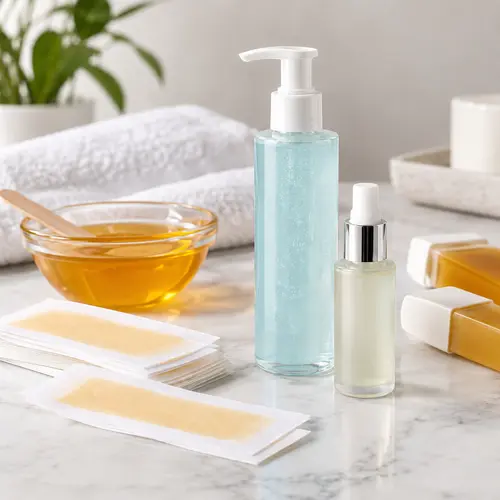
Buyer Context
Hair-removal brands rarely sell a single isolated formula. A depilatory cream needs a credible next step. Wax strips and sugar wax create an obvious after-use moment. Roll-on wax cartridges are often sold as part of a routine that includes cleansing and calming products. Aftercare therefore influences perceived completeness, average order value, and whether the customer sees the brand as a system rather than a one-product listing.
Soothing aftercare has the wider compatibility map. It can sit beside custom depilatory cream formulation, private label waxing products, or salon-oriented roll-on formats. Its role is immediately understandable, which reduces the educational burden on a Shopify page or short TikTok demonstration.
A hair inhibitor serum asks more from the buyer and the customer. The brand must explain when to apply it, how often to use it, what realistic change to expect, and how long evaluation may take. That additional education can support retention, but vague promises can create chargebacks, negative reviews, and regulatory attention. The FDA explains that intended use and product claims help determine whether a personal-care product is regulated as a cosmetic or another product category under personal-care product classification principles. Its overview of cosmetics under United States law is a useful starting point for claim review.
For a founder testing demand, the practical sequence is often an aftercare SKU first, followed by a more evidence-intensive serum once customer behavior is visible. PZIK supports pilot runs from 1,000 units under ISO 22716 protocols, using the same validated formulation and line architecture intended for scaling. Buyers can review the broader custom hair removal product development scope and the documented hair removal manufacturing process before approving samples.
Technical or Packaging Factors
Formula Architecture and Sensory Fit
Aftercare formulas commonly use a gel, gel-cream, lotion, or fine spray format. The critical sensory checks are spreadability, cooling perception, tack after drying, fragrance intensity, and residue around hair follicles. A clear gel photographs well and pairs naturally with wax, but excessive polymer or humectant loading may create pilling or stickiness. A lotion offers more emollience, although it can feel too occlusive immediately after hot wax.
An inhibitor-positioned serum usually benefits from rapid absorption and precise dosing. Ingredient selection should begin with an irritation-risk review rather than a trend list. Botanical extracts, exfoliating components, alcohol, and fragrance may be acceptable individually yet uncomfortable on recently treated skin. Ask for the quantitative ingredient list, allergen information where applicable, safety assessment inputs, and rationale for every performance claim. Published research in the International Journal of Cosmetic Science can inform study design, but a journal link does not substitute for evidence on the finished formulation.
Brands targeting reactive users should also compare the concept against low irritation hair removal products. Compatibility with the preceding removal step matters: residues from depilatory creams, wax oils, or pre-wax cleansers can alter slip, absorption, and perceived sting.

Packaging Compatibility and Stability
A serum in a dropper bottle may look premium but exposes the contents to repeated air contact and possible applicator contamination. An airless pump offers more controlled dosing, while a treatment pump may be easier for travel kits. For soothing gel, verify whether the pump can handle the target viscosity without sputtering, delayed recovery, or product left inaccessible at the base. Spray aftercare requires an additional check for nozzle clogging and spray-pattern consistency.
Request compatibility testing in the final decorated pack. A practical protocol should cover ambient storage, elevated heat, cold exposure, and freeze-thaw cycling where shipment lanes justify it. At minimum, buyers should review odor, color, pH, viscosity, separation, weight loss, pump output, leakage, label lifting, and decoration transfer at agreed checkpoints. The test conditions and acceptance ranges should be written into the specification rather than inferred from a sample that looked stable for one week.
Regulatory wording also needs market-specific review. Australia’s TGA cosmetic-therapeutic boundary guidance illustrates why presentation and claims can matter as much as formula composition. For United States and European launches, request the applicable MoCRA and CPNP documentation track, label review inputs, safety support, and substantiation file before artwork is locked.
Decision Framework Table
| Factor | What to Check | Why It Matters | ODM Buyer Note |
|---|---|---|---|
| Primary consumer need | Immediate comfort or repeated between-session use | Defines education burden and purchase frequency | Choose aftercare for broad utility; choose serum for regimen depth |
| Claims | Exact website, label, creator, and marketplace wording | Claims influence classification and evidence requirements | Do not approve growth-related language before regulatory review |
| Texture | Absorption, tack, slip, residue, and pilling | Freshly treated skin makes sensory flaws more noticeable | Evaluate on skin after the intended removal format |
| Irritation profile | Fragrance, alcohol, acids, extracts, and total active load | Post-depilatory skin may have reduced tolerance | Request a documented irritation-risk review for the finished formula |
| Packaging | Pump output, dropper hygiene, nozzle function, and leakage | Pack failure can erase formula quality | Test the final component, decoration, label, and closure together |
| Stability and shipment | Heat, cold, freeze-thaw, separation, pH, viscosity, and weight loss | Cross-border routes expose products to variable conditions | Approve written acceptance criteria before the pilot run |
| Launch architecture | Standalone SKU, removal bundle, travel kit, or subscription refill | Format affects fill size, BOM, and reorder logic | Compare post-depilation care ODM with private label hair inhibitor serum options |

The cleanest sourcing decision is the one your team can verify. Review representative samples, finalized claims, stability scope, pack compatibility, labeling documents, shipment conditions, and scale-up controls together. Additional depilatory product development articles can support the internal brief before formula selection begins.
ODM Manufacturing Considerations
Once the hair inhibitor serum vs post depilatory care decision is made, development should move through controlled sample confirmation rather than a single approval based on appearance. The buyer should receive a documented sample showing the formula version, ingredient list, color, fragrance, viscosity or texture target, fill weight, packaging components, and intended hair-removal use. Approval criteria should be agreed before the formula enters production planning.
Customization can range from changing fragrance and color to adjusting the full formulation. For a hair inhibitor serum, buyers may prioritize fast spreading, low residue, and cosmetic language concerning the appearance of hair growth. For soothing aftercare, the target may be slip, cooling perception, or compatibility with routines involving wax, strips, sugar wax, roll-on cartridges, or depilatory creams. Ingredient substitutions should trigger a new irritation-risk review because botanical extracts, fragrance materials, and preservatives can change tolerance and stability.
A turnkey base does not have to produce a generic SKU. Differentiation can come from a selected imported botanical source, fragrance direction, texture target, application format, pack size, and evidence-supported positioning. However, customization should remain technically meaningful. Adding a decorative ingredient at a negligible level rarely creates a defensible market difference.
Packaging should be evaluated as a complete component set. Confirm resin type, closure fit, cap torque, dip-tube length where applicable, decoration method, and the formula’s contact with seals or liners. For roll-on wax cartridges, verify that the housing remains dimensionally stable and that wax does not migrate around the roller assembly. For depilatory cream, check whether the formula alters tube panels, seams, or cap fit over time.
The stability review should cover appearance, odor, pH where relevant, viscosity, weight change, microbial control, and dispensing behavior at defined checkpoints. Samples should also be examined after realistic warehouse and transport exposure. A stable formula in a laboratory container may still fail when placed in the selected commercial pack.
MOQ discussions should separate formula minimums, component minimums, decoration minimums, and finished-unit minimums. A lower finished quantity may still require the buyer to fund excess printed components. Request a tiered cost model showing setup charges, testing, samples, packaging inventory, and reorder assumptions. This gives a more useful CAC and margin view than comparing unit price alone.
Before artwork approval, request the INCI list, specification, directions, warnings, batch coding format, country-of-origin information, and available safety or claim-support documents. U.S. positioning should be checked against FDA cosmetic law, while Australian launches require attention to the cosmetic-therapeutic boundary. Halal-targeted distribution may require ingredient, cleaning, and supply-chain documentation aligned with the intended certification route.
Shipment planning should define carton configuration, unit orientation, pallet limits, acceptable transit duration, and temperature-excursion expectations. Wax products are especially sensitive to route conditions: excessive warmth can encourage migration, while low temperatures can affect flexibility. Retain pre-shipment samples from the approved lot and document the release inspection.
Buyers can review related hair-removal product categories, ODM development options, and the manufacturing process when comparing development scopes.

Common Problems or Failure Cases
Wax Becomes Brittle
Hard or sugar wax may crack instead of flexing if the formulation, melting behavior, fill process, or transport conditions are poorly matched. Confirm the working texture and temperature range using the actual removal method. A visually acceptable room-temperature sample is not enough.
Wax Strip Adhesion Declines
Pre-coated strips can lose effective grip because of wax migration, unsuitable backing material, excessive fragrance or oil, or prolonged warehouse exposure. Compare fresh and aged samples on representative hair and skin conditions, recording pull behavior, residue, and strip integrity.
Depilatory Cream Separates
Separation may appear as surface liquid, graininess, uneven color, or a viscosity drop. Potential causes include emulsifier imbalance, raw-material variation, processing sequence, or component interaction. Do not accept remixing as the only corrective action; request root-cause findings and a revised specification.
Roll-On Cartridge Leaks or Deforms
Wax can escape around the roller or closure when component tolerances, filling temperature, headspace, or transit orientation are not controlled. Cartridge deformation may also prevent smooth rolling. Inspect random finished units after simulated distribution handling, not only empty packaging.
Fragrance Causes Avoidable Sensitivity
After hair removal, skin may be more reactive to fragrance or certain botanical blends. Review allergen declarations, dosage, intended application area, and warning language. A fragrance-free option may be commercially useful for professional salons or buyers serving sensitivity-conscious consumers.
Claims Exceed Cosmetic Positioning
Statements that a serum permanently stops growth or changes a biological function can create regulatory risk. Keep claims tied to cosmetic appearance and the documented evidence. Market language should be reviewed for each destination rather than copied across regions.

Supplier Checklist
- Hair-removal experience: Request examples covering the specific format, such as depilatory cream, wax strips, sugar wax, cartridges, serum, or soothing aftercare.
- Sample controls: Confirm version numbers, approval records, retained samples, and rules for changes after approval.
- Formula specification: Review texture, viscosity or melting behavior, pH where relevant, color, odor, fill weight, and microbiological limits.
- Irritation-risk review: Ask how fragrance allergens, depilatory actives, botanical ingredients, and application timing are assessed.
- Packaging evidence: Verify component materials, dimensions, closure performance, dispensing consistency, and deformation risk.
- Production controls: Review incoming-material checks, batch traceability, in-process testing, release criteria, and deviation handling.
- Regulatory documents: Confirm the availability of INCI data, specifications, safety documentation, claims support, and destination-specific label review.
- Commercial transparency: Separate formula, packaging, decoration, testing, freight, and unused-component liabilities.
- Shipment readiness: Define carton tests, transit assumptions, lot release records, and the process for investigating damaged or leaking goods.
FAQ
Can an Asian manufacturing site genuinely follow Western clean beauty and cruelty-free requirements?
Yes, but location alone proves nothing. Clean beauty has no single universal legal definition, so provide a written restricted-substance standard. For cruelty-free positioning, request supplier declarations, raw-material statements, audit rights, and destination-specific regulatory review. Certifications should be verified with the issuing body rather than accepted as marketing artwork.
Will a low MOQ make the unit cost impossible to support against CAC?
It can, particularly with custom components or complex decoration. Compare contribution margin at several quantity tiers and include testing, setup, freight, packaging inventory, fulfillment, and expected reorder frequency. A simpler stock component with a differentiated formula may offer better economics than an elaborate custom pack.
Will a turnkey or existing formula make my product identical to competing brands?
Not necessarily. Ask which elements are exclusive and which are shared. Meaningful differentiation may include texture, fragrance-free positioning, a traceable specialty ingredient, pack format, directions, and the role of the SKU within a complete removal routine. Record all approved changes in the formula and product specifications.
Can we sign a strict NDA before disclosing our formula brief and launch plan?
Yes. The NDA should identify confidential materials, permitted recipients, subcontractor controls, disclosure exceptions, term, return or destruction obligations, and governing law. Also clarify who owns custom formulas, artwork, test results, and modifications developed during sampling.
What evidence should support an eco-conscious packaging claim?
Request material specifications, recycled-content evidence where claimed, supplier chain-of-custody records, and certificates that can be validated. Confirm whether the complete pack is recyclable in the target market, not merely one component. Avoid broad terms such as environmentally friendly unless the claim is specific and substantiated.
How quickly can a replacement supplier take over after a previous supplier failure?
Timing depends on whether the existing formula, specifications, components, and regulatory files are transferable. Begin with a gap assessment covering formula ownership, raw materials, packaging availability, approved artwork, quality history, and shipment deadlines. Do not compress safety, stability, or compatibility work solely to recover a launch date.