Direct Answer
For most bikini hair removal products private label programs, depilatory cream is the better choice when the brand promise centers on painless, quick, at-home removal. Body wax is stronger when longer-lasting smoothness, visible technique, and salon-inspired ritual are central to the offer. Neither format is inherently easier to launch. Cream requires tighter control of alkalinity, odor, skin-contact instructions, and packaging compatibility. Wax demands precise control of working temperature, adhesion, residue, strip performance, and leakage during warm-weather shipment.
A DTC brand should therefore choose by consumer behavior and operational risk, not by trend volume alone. Cream generally supports an accessible first-use experience, while wax can create a more demonstrable social-media moment but introduces a steeper learning curve. Brands still validating demand may begin with one hero format, one aftercare SKU, and packaging tested under realistic storage and delivery conditions.
Key Takeaways for Private Label Buyers
- Define the treatment area first. A body formula is not automatically appropriate for the external bikini area or face.
- For cream, review pH, viscosity, thioglycolate stability, odor control, removal time, and pack dispensing.
- For wax, verify working temperature, hair capture, skin pull, residue, reheating behavior, and strip compatibility.
- Test the filled product, closure, label, and secondary packaging together under heat, cold, vibration, and leakage conditions.
- Request substantiation, ingredient records, safety support, and market-specific labeling documents before approving artwork.
- Keep the first launch focused enough to support a pilot run, but confirm that the same formula and components can scale without reformulation.
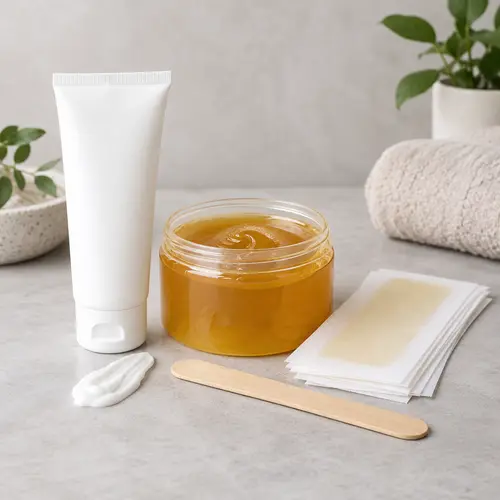
Buyer Context
Hair removal sits at an unusual intersection of cosmetics, technique, and consumer trust. The product has to work visibly, yet it is used on skin where discomfort, redness, residue, or an unclear warning can quickly become a public review. For a founder launching through Shopify, Amazon, or TikTok Shop, one inconsistent batch can erase the margin saved through a lower component cost.
The comparison also extends beyond a jar of wax and a tube of cream. A coherent range may include ready-to-use strips, sugar wax, roll-on cartridges, spatulas, nonwoven strips, and post-depilation care OEM options. Each format changes the consumer instructions, carton contents, fulfillment profile, and customer-support burden. Reviewing established hair removal product solutions can help a buyer map these dependencies before requesting samples.
Claims require equal discipline. Terms such as natural, vegan, cruelty-free, and sensitive skin must be defined through ingredient selection, supplier declarations, testing strategy, and market-specific claim review. They are not substitutes for a documented safety assessment. For the United States, buyers should understand the Modernization of Cosmetics Regulation Act of 2022 and the FDA Cosmetics Labeling Guide. Product classification and transport inputs should also be reviewed against the selling channel, including Amazon dangerous-goods classification rules for cosmetics where applicable.
For teams replacing an unreliable supplier or trying to catch a short trend window, the useful question is not simply how fast a sample can arrive. It is whether the sample, stability protocol, compatibility pack, and approved production specification describe the same product. A vertically specialized partner can use prevalidated formula platforms to shorten development, but customization still needs controlled change records and a clear approval gate.
Technical and Packaging Factors
Depilatory Cream: Chemistry, Contact, and Dispensing
Depilatory cream commonly uses thioglycolate chemistry in an alkaline system to weaken hair so it can be wiped away. Typical development targets may sit around pH 11.0 to 12.5, but the correct specification depends on the complete formula, intended area, exposure instructions, and safety assessment. Buyers should never approve performance from pH alone. Ask for results covering removal efficacy, maximum labeled contact time, rinse-off behavior, odor after rinsing, and irritation-risk review on the intended user population.
Viscosity must be evaluated during application and aging. A cream that looks dense in a laboratory jar can become difficult to spread after cold storage or separate near the tube shoulder after heat exposure. For a custom depilatory cream formulation, request numerical viscosity specifications with the test temperature, spindle, and speed recorded. Those details make batch comparisons meaningful.
Packaging contact surfaces matter because high-pH formulas and reducing agents can challenge pumps, seals, springs, inks, and unprotected metals. Candidate tubes, airless packs, or bottles should be filled with the actual formula and assessed upright, inverted, and on their side. Review paneling, discoloration, odor migration, cap stress, dispensing force, and seal integrity rather than approving an empty component from appearance alone. Buyers developing mild positioning should also compare the testing scope for sensitive skin hair removal products.
Wax: Adhesion, Temperature, and Delivery Format
Wax performance is a balance between gripping hair and releasing from skin with manageable residue. Soft wax may be designed for a working range around 40 to 45 degrees Celsius, while some hard wax systems operate around 50 to 60 degrees Celsius. These are development examples, not universal consumer instructions. The approved range must come from the selected formula, heater configuration, application thickness, and safety review.
During sampling, test short and coarse hair capture, film breakage, brittleness after cooling, stringing, fragrance stability, and cleanup. Ready-made strips add adhesive coat weight, nonwoven or film substrate, release liner, and pouch seal integrity to the review. Sugar wax introduces its own sensitivity to water activity, crystallization, and texture shift. Buyers comparing custom wax strips and hot wax should request application trials at both the beginning and end of the stated shelf-life study.
Roll-on cartridges need a focused leakage protocol. Evaluate the roller fit, cap retention, flow after repeated heating, formula migration around the neck, and deformation in warm transit. A useful initial screen may include storage at 4, 25, and 40 degrees Celsius, at least three freeze-thaw cycles where relevant, and an 8-to-12-week accelerated compatibility review. Final shelf-life support should follow the approved protocol rather than relying on accelerated results alone. The full hair removal manufacturing process should connect these test outcomes to filling controls, retained samples, and release inspection.

Decision Framework
| Factor | What to Check | Why It Matters | ODM Buyer Note |
|---|---|---|---|
| Consumer experience | Pain expectation, application steps, removal time, residue, and cleanup | These factors shape repeat purchase and support tickets | Test with target users, not only trained evaluators |
| Formula control | Cream pH and viscosity; wax working range, adhesion, and cooling behavior | Small shifts can change safety, spread, or removal performance | Require numerical release specifications and approved methods |
| Pack compatibility | Seal integrity, dispensing, leakage, corrosion, label lift, and odor migration | The filled pack may fail even when formula and component pass separately | Approve aged filled units in the final decoration system |
| Storage and shipment | Heat, cold, cycling, vibration, orientation, and carton protection | DTC parcels experience uncontrolled delivery conditions | Include roll-on leakage and wax softening checks for summer routes |
| Compliance file | INCI, specifications, safety support, claims evidence, label review, and traceability | Missing records can delay listings or market entry | Align responsibilities through documented hair removal OEM ODM services |
| Launch scope | Sample variants, component lead time, pilot quantity, and scale pathway | Too many early variants consume cash and slow validation | Use a structured hair removal product RFQ covering formula, pack, tests, and destination markets |

ODM Manufacturing Considerations
For bikini hair removal products private label programs, development should begin with a written product brief rather than a generic request for cream, strips, or wax. Define the target body area, removal format, desired texture, fragrance position, pack size, market, retail channel, and expected consumer technique. A salon-oriented hard wax and a first-time home-use wax strip require different performance limits, instructions, and sampling plans.
Sample Confirmation and Formula Customization
Ask the supplier to document what each sample represents: an existing base, a modified base, or a new custom formula. Sample approval should cover appearance, odor, spread, removal performance, residue, rinse-off behavior where applicable, and the condition of the skin immediately after normal use. Record the approved sample code and retain sealed control units. The final specification and production batch should be compared with this reference.
Customization does not have to mean rebuilding the entire formula. Useful differentiation can come from wax flexibility, cream spreadability, fragrance level, application time, strip dimensions, imported botanical oil sourcing, aftercare pairing, or pack architecture. Buyers should confirm which changes may affect testing time, ingredient declarations, cost, or MOQ. Review relevant custom manufacturing options before deciding whether a base formula or deeper ODM route fits the launch schedule.
Packaging, Stability, and Scale-Up
Evaluate the formula in the intended consumer pack, not only in a laboratory jar. Check whether cream dispensing remains consistent through the expected use period, whether wax-strip sachets protect the coated strips, and whether roll-on components remain secure after transport vibration and repeated handling. Decoration should also tolerate oily residue, bathroom humidity, and ordinary consumer cleaning.
A stability review should establish acceptance criteria for color, odor, texture, net content, closure function, and removal performance. Any change in fragrance, colorant, oil source, strip backing, tube material, or cartridge component may justify targeted confirmation work. Ask how pilot samples are translated into routine manufacturing controls, including mixing sequence, filling conditions, in-process checks, and release records.
MOQ discussions should separate formula MOQ, printed-component MOQ, filling MOQ, and carton MOQ. A low filling quantity may still require a larger purchase of decorated tubes or strip sachets. Request a cost model showing one-time development charges, component inventory exposure, testing, and reorder assumptions. This is more useful for CAC planning than comparing unit prices alone.
Before artwork approval, obtain the ingredient list, product identity, net-content format, warnings, directions, responsible-party details, batch coding approach, and available substantiation files. US-bound brands should allocate responsibilities under the Modernization of Cosmetics Regulation Act of 2022. Shipment planning should state case configuration, pallet requirements, temperature precautions, lot traceability, and whether the carrier or marketplace requests additional product classification information.

Common Problems or Failure Cases
- Wax becomes brittle: Hard wax may crack during removal if its flexibility, layer thickness, application temperature, or cooling behavior does not match the intended technique. Confirm performance across multiple operators and realistic room conditions.
- Wax strips lose adhesion: Poor sealing, backing incompatibility, oil migration, or prolonged storage can leave strips unable to grip hair consistently. Inspect unopened and opened sachets and compare early samples with aged units.
- Depilatory cream separates: Visible liquid release, graininess, or inconsistent dispensing may appear after ingredient or processing changes. Quarantine affected samples and compare them with the approved reference before altering the formula or pack.
- Roll-on cartridges leak: Leakage can originate at the roller fit, cap, seam, or seal and may worsen during parcel handling. Review filled units after vibration, inversion, and expected shipping exposure.
- Fragrance causes complaints: A strong masking fragrance can create discomfort or conflict with a sensitive-skin position. Evaluate fragrance-free and lower-fragrance options while recognizing that odor perception is part of depilatory product acceptance.
- Packaging deforms: Warm warehouses or product contact may distort a cartridge, closure, sachet, or cream tube. Confirm component resin, wall thickness, seal quality, and transport limits before committing to printed inventory.
Failure investigations should identify the affected lot, component batch, processing record, storage history, and retained sample. Replacing a supplier during a capacity shortage is faster when specifications, artwork files, test reports, and component drawings are controlled by the brand rather than scattered across email threads.
Supplier Checklist
- Confirm experience with the exact format: depilatory cream, sugar wax, hard or soft wax, strips, or roll-on cartridges.
- Request a sample plan identifying the base formula, custom variables, pack components, quantity, timing, and approval criteria.
- Define measurable specifications for appearance, odor, texture, viscosity or melting behavior where relevant, fill weight, and removal performance.
- Review irritation-risk evaluation, intended-use warnings, consumer directions, and complaint-escalation procedures.
- Check packaging drawings, material declarations, sealing method, coding location, and evidence from filled-pack assessments.
- Separate MOQs and lead times for formula, filling, printed components, cartons, and replacement parts.
- Verify ingredient, allergen, safety, quality, traceability, labeling, and market-support documents before artwork release.
- Ask for current certification scope and site address; do not rely on an undated logo sheet. ISO 22716, GMPC, or BSCI documents should match the facility involved in the contract.
- Define shipment configuration, storage instructions, release process, retained samples, and continuity arrangements for constrained ingredients or packaging.

FAQ
Can an Asian manufacturing site genuinely meet Western clean beauty and cruelty-free requirements?
Location alone does not establish compliance. Provide the exact retailer or certification standard because clean beauty has no single universal definition. Audit restricted-ingredient screening, supplier declarations, animal-testing policy, quality-system scope, and traceability records. Cruelty-free claims should be supported across the formula and relevant raw-material supply chain, not merely stated in a presentation.
Will a low MOQ make the unit cost too high to support customer acquisition costs?
It can, especially when custom-printed packaging has a higher minimum than filling. Compare contribution margin using landed cost, testing, freight, duties, fulfillment, leakage allowance, and unused component inventory. A simpler pack or staged decoration approach may protect launch economics better than forcing a highly custom package into a small first run.
Will a turnkey or existing base formula make the product indistinguishable from competing brands?
Not necessarily. Request disclosure of which attributes are fixed and which can be exclusive or modified. Differentiation can be built through application behavior, fragrance strategy, strip size, wax format, sourced oils, directions, aftercare combinations, and packaging. Put any formula exclusivity, ownership, or market restrictions into the contract rather than assuming them.
What should be approved before placing the first production order?
Approve the coded reference sample, formula specification, finished-product criteria, packaging components, artwork, labeling text, testing scope, batch-code format, case pack, shipment conditions, and change-control process. The commercial order should reference the same controlled documents.
What labeling support should a supplier provide for US sales?
The supplier should provide accurate formula and technical information, while the responsible brand should complete a market-specific legal review. The FDA Cosmetics Labeling Guide explains core US cosmetic labeling principles. Claims, warnings, directions, and responsible-party information must match the actual product and route to market.
Do hair-removal products require special marketplace shipment review?
Requirements depend on formula composition, pack size, and marketplace classification. Provide complete product and transport information when requested rather than assuming every cream, wax, or spray is treated identically. Sellers using Amazon should review Amazon’s dangerous-goods classification rules for cosmetics before inventory is shipped to fulfillment centers.