Direct Answer: What Should the Hair Removal OEM Process Include?
A reliable hair removal OEM process should move through four controlled gates: inquiry qualification, sample development, written approval, and commercial production. At inquiry, the supplier should confirm product type, target market, claims, formula preferences, packaging format, forecast, and compliance route. Sampling should then test the actual product-package system—not formula texture in an anonymous lab jar. Approval must freeze the formula, fragrance, color, packaging components, artwork, quality specifications, and retained reference sample. Only after that freeze should purchasing, filling, assembly, and release begin.
For a DTC launch, speed is useful only when these gates remain traceable. A baseline formula may support a 3–5-day first sample, while a program using stocked packaging can target an under-30-day path. Neither timeline should be promised before ingredient availability, compatibility testing, label documents, and shipment conditions are reviewed. The practical goal is fewer uncontrolled revisions, not simply a faster calendar.

Key Takeaways for Private Label Buyers
- Submit a precise brief. Define whether the SKU is a depilatory cream, sugar wax, strip, roll-on cartridge, hot wax, or aftercare product, plus the intended body area and market.
- Sample the complete system. Review formula, applicator, primary pack, closure, label stock, and user instructions together.
- Approve measurable specifications. Texture descriptions such as silky or strong are not enough; agree on viscosity, melting or softening behavior, appearance, odor, fill weight, and application time where relevant.
- Run packaging and stability checks early. Heat, cold, leakage, seal integrity, and formula-contact compatibility can expose problems before printed components are committed.
- Freeze compliance inputs before artwork. Ingredient lists, warnings, responsible-party details, claims, and market-specific notifications should match the approved formula.
Buyer Context: Why Process Discipline Matters in Hair Removal
Hair-removal products sit at an unusually sensitive intersection of chemistry, user technique, and packaging. A depilatory cream must remove hair within its instructed contact time without encouraging unsafe overexposure. Wax strips need consistent adhesion after storage, yet must release cleanly from their liners. Sugar wax can shift in tack and handling as temperature changes. Roll-on wax must flow through the head while warm but remain secure during transport. Aftercare has to feel calming without making unsupported treatment claims.
These differences make a generic cosmetics brief inadequate. Buyers should begin with the intended use case and select the appropriate route through hair removal product solutions. A cream-led concept may require a dedicated custom depilatory cream formulation, while a salon or at-home waxing kit should be reviewed through custom wax strips and hot wax. Sensitive-positioned launches need an explicit irritation-risk review rather than relying on a gentle fragrance or pastel design; the development considerations for sensitive skin hair removal products provide a more useful starting point.
Process discipline also protects the trend window. A 1,000-unit pilot under ISO 22716 can let a young brand test demand without changing the approved formula before scaling. But low quantity does not remove the need for batch records, incoming-material checks, retained samples, filling controls, and release criteria. Buyers should compare the documented hair removal manufacturing process, not only the sample appearance or unit price.
Technical and Packaging Factors to Review Before Approval
Formula Performance and User Safety
For depilatory cream, record the approved appearance, odor, spreadability, pH specification, viscosity range, application thickness, contact-time instructions, and rinse behavior. Confirm that the irritation-risk review considers the alkaline system, hair-removal active, fragrance, intended body area, and foreseeable misuse. A face claim should never be inferred from a body formula. The buyer should also receive the ingredient declaration and warning text needed for the destination market.
For wax and sugar wax, ask for the working-temperature or softening window, tack, pull behavior, residue profile, and performance on representative hair. Roll-on formats add flow consistency and cartridge-to-head fit. Wax strips require adhesion aging, liner release, strip separation, and pouch-seal review. A companion product can be developed through post-depilation care OEM or positioned as an after hair removal serum, but cosmetic claims should remain supportable.
If an aftercare formula contains salicylic acid, ingredient level, use area, warnings, and regional restrictions require review; the CIR final report on salicylic acid in cosmetics is one relevant safety resource. Cruelty-free and halal positioning should likewise be mapped against recognized programs such as the Leaping Bunny cruelty-free certification standard and the JAKIM Halal certification framework. Supplier declarations alone do not automatically establish certification.
Packaging Compatibility and Storage
The approved sample should use the intended tube, jar, pouch, strip liner, roll-on cartridge, or wax container whenever possible. Review swelling, paneling, discoloration, odor transfer, closure torque, seal integrity, label lifting, and leakage in upright, inverted, and side storage. An illustrative screen may include 5°C cold storage and 40°C at 75% relative humidity, but the final protocol should reflect the formula, package, route, and market.
Ask whether heat or cold exposure changes cream separation, wax flow, sugar-wax crystallization, strip adhesion, or aftercare viscosity. Shipment testing should account for carton compression and the orientation of liquid or molten-prone formats. The broader custom hair removal product development scope should identify which checks are included in sampling and which require additional time.

Decision Framework: What to Freeze at Each Gate
| Factor | What to Check | Why It Matters | ODM Buyer Note |
|---|---|---|---|
| Product brief | Format, body area, target user, market, claims, forecast, and launch date | These inputs determine formula, warnings, pack, and testing | Use a structured hair removal product RFQ rather than a one-line request |
| Formula sample | Texture, odor, color, pH or melting behavior, application, removal, and residue | Sensory approval without specifications is difficult to reproduce | Record revision codes and approve one retained reference |
| Packaging | Material, dimensions, closure, seal, applicator, decoration, and compatibility | A stable formula can still fail in an unsuitable package | Test the actual contact materials before artwork commitment |
| Stability and transport | Heat, cold, leakage, separation, adhesion, label condition, and carton protection | Storage and shipping can change performance before the customer opens the product | Define conditions, duration, acceptance criteria, and who signs the report |
| Compliance file | Ingredient list, warnings, claims support, market documents, and responsible-party data | Artwork and notifications must reflect the final formula | Confirm MoCRA and CPNP responsibilities in the manufacturing contract |
| Production release | Approved specification, signed sample, batch documents, QC plan, and shipment terms | Prevents informal changes between sample and commercial run | Review capabilities through a qualified hair removal OEM manufacturer before issuing the purchase order |

ODM Manufacturing Considerations
A controlled hair removal OEM process should move through written decisions rather than informal sample approval. For each depilatory cream, wax, strip, sugar wax, roll-on cartridge, or aftercare product, the buyer should receive a sample identification code, formula version, packaging specification, and review deadline. Approval should record the exact texture, color, fragrance level, application behavior, removal performance, and user instructions. A sample that performs well but has no traceable version can create avoidable disputes during production.
Sample Confirmation and Formula Customization
Begin with a product brief that defines the target body area, hair type, use temperature, application thickness, removal method, fragrance position, ingredient restrictions, and intended market. Customization may involve fragrance intensity, color, wax flexibility, cream viscosity, strip dimensions, or aftercare texture. Every requested change should generate a revised sample record. Do not approve a verbal description such as smooth or strong; document observable criteria, including spreadability, set time, residue, breakage, skin feel, and removal completeness.
Packaging Compatibility and Stability Review
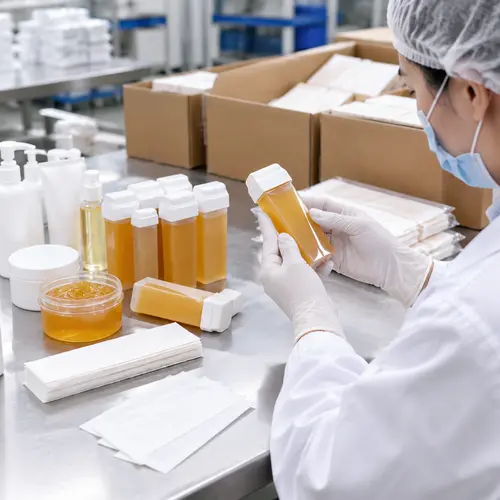
Packaging approval must cover the actual formula and the actual closure. For cream, inspect tube or jar dispensing, cap fit, odor retention, and migration or softening of plastic. For wax, review pot or cartridge filling, melting behavior, nozzle flow, leakage, and deformation during storage. For strips, verify liner release, adhesive consistency, folded-pack protection, and resistance to humidity. For aftercare products, check pump or tube output and whether the formula separates after transport.
Stability review should reflect the markets and shipping routes involved. Ask for a written test plan covering appearance, odor, viscosity or texture, separation, package integrity, and label adhesion at relevant heat and cold conditions. Shipment simulation should consider carton compression, vibration, orientation, and likely warehouse exposure. A retained production reference and defined acceptance limits make later complaint investigations more objective.
MOQ, Labeling Documents, and Shipment Conditions
MOQ should be evaluated as a cost structure, not only as a unit number. Ask which costs are fixed, including formula setup, artwork preparation, mold or tooling, testing, and packaging print runs. A smaller run may carry a higher unit cost because these charges are spread across fewer pieces, but the buyer should receive a clear comparison between pilot, repeat, and customized packaging scenarios. This helps protect gross margin and customer acquisition economics.
Before approval, request the ingredient list using the required regional naming convention, product specification, batch coding format, net contents, shelf-life or period-after-opening guidance where applicable, warnings, directions, responsible-party information, and supporting safety documents. For European distribution, clarify the information needed for CPNP-related work. For United States distribution, define the documents and product data needed for the brand’s MoCRA responsibilities. The supplier should also confirm carton marks, pallet configuration, temperature instructions, dangerous-goods considerations if relevant to the formula, and the inspection point before shipment.
Use the supplier’s OEM/ODM product development process and manufacturing process information as supporting records, but make the purchase specification and approval matrix the controlling documents.

Common Problems or Failure Cases
Wax brittleness: A hard wax or sugar wax may crack during spreading or removal when the formula balance, cooling behavior, or storage exposure is unsuitable. Check flexibility across the expected temperature range and review whether the wax pulls cleanly without excessive breakage or residue.
Strip adhesion loss: Wax strips can lose pickup performance when the adhesive layer ages, the liner releases inconsistently, or the package allows humidity exposure. Compare adhesion before and after storage, inspect folded edges, and verify that the consumer can separate the strip without damaging the product surface.
Cream separation: A depilatory cream may show oiling, watery leakage, graininess, or uneven active distribution after heat exposure or transport. Review appearance, viscosity, odor, and application behavior from samples taken at different points in the test. A visually acceptable sample is not enough if the product no longer spreads evenly.
Cartridge leakage: Roll-on wax cartridges can leak through the roller head, cap, seam, or closure when filled too high, stored on their side, or exposed to heat. Test upright and horizontal storage, inspect cartons after shipment simulation, and define the acceptable leakage limit before production.
Fragrance sensitivity: A fragrance that seems mild in a laboratory sample may feel too strong during intimate or facial use. Request an unscented or lower-fragrance option where appropriate, review allergen labeling requirements, and test the aftercare product separately from the removal formula so irritation feedback can be traced.
Packaging deformation: Tubes, jars, liners, caps, and cartridge bodies can warp, soften, or lose their seal during storage. Confirm material specifications, fill weight, closure torque where relevant, and carton protection. Photographs of a damaged shipment should be supported by batch, carton, orientation, and storage records.
Supplier Checklist
- Can the supplier provide a written product brief and version-controlled sample approval record?
- Are formula changes documented with ingredient, texture, fragrance, color, and performance differences?
- Can the supplier explain compatibility checks for cream tubes, wax pots, strips, cartridges, and aftercare closures?
- Are stability criteria defined for appearance, odor, viscosity, separation, package integrity, and label adhesion?
- Does the quotation separate unit cost from setup, testing, artwork, tooling, and packaging-print charges?
- Is the MOQ stated separately for stock packaging, custom packaging, and customized formulation work?
- Are ingredient lists, specifications, warnings, directions, batch coding, and regional labeling documents available before approval?
- Can the supplier document shipment orientation, carton protection, storage limits, and inspection procedures?
- Will the parties sign an NDA that covers formulas, artwork, samples, customer information, and product plans?
- Can environmental packaging claims be supported by material specifications, chain-of-custody records, or recognized certification rather than broad marketing language?
- Is there a defined process for nonconforming goods, retained samples, complaint investigation, and corrective action?
FAQ
Can an Asian supplier meet European and North American clean beauty and cruelty-free expectations?
Location alone does not answer the question. Request the restricted-substance policy, ingredient documentation, animal-testing position, supplier declarations, and audit evidence. If a cruelty-free claim is important, compare the documentation with the Leaping Bunny cruelty-free certification standard and confirm exactly which products and supply-chain entities are covered. Treat clean beauty as a defined brand standard with an ingredient exclusion list, not as an unsupported badge.
Will a low MOQ make the unit price too high to support customer acquisition costs?
It can, especially when custom packaging, testing, and artwork charges are allocated across a small run. Ask for a cost model with fixed and variable items, then compare a stock-package pilot, a lightly customized version, and a fully customized version. Evaluate landed cost, expected wastage, shelf-life risk, and repeat-run economics together rather than judging the unit price alone.
Will a turnkey formula make my product look identical to competing brands?
A baseline formula can create similarity if the brand changes only the label. Differentiation can come from documented texture targets, fragrance strategy, wax flexibility, strip format, aftercare pairing, packaging usability, and a defined ingredient story. Ask whether the formula can be modified under an exclusive brief and whether the supplier will disclose any restrictions on market or customer exclusivity.
Can I sign a strict NDA before sharing my product concept?
Yes, this should be negotiated before detailed formula, artwork, forecast, or launch information is shared. The NDA should identify confidential materials, permitted recipients, security duties, exclusions, return or destruction obligations, duration, and remedies. It should also clarify ownership of buyer-funded custom work and whether samples may be shown to other customers.
How can I verify that an environmental packaging claim is not greenwashing?
Ask for the exact material composition, recycled or renewable content calculation, supplier traceability, disposal conditions, and applicable certification. Separate claims about material origin from claims about recyclability, because local collection systems may differ. Avoid wording that suggests the entire package is environmentally harmless when only one component has supporting evidence.
What documents should be complete before the first commercial shipment?
At minimum, confirm the approved formula and packaging version, ingredient list, product specification, batch and expiry coding, label artwork, warnings, directions, test or safety documentation, packing list, carton details, and shipment instructions. The responsible brand should also confirm market-specific notification or registration responsibilities, including whether CPNP or MoCRA-related information is required for its route to market.
References
The Leaping Bunny cruelty-free certification standard provides a reference point for evaluating animal-testing policies and supply-chain declarations.
The JAKIM Halal certification framework can support buyers assessing Halal documentation for hair-removal products intended for relevant markets.
The CIR final report on salicylic acid in cosmetics is a useful example of an ingredient safety reference that should be reviewed alongside the finished product’s intended use and regional requirements.