Direct Answer
Effective hair removal product range planning should treat the annual portfolio review as a supply-chain risk decision, not simply a SKU performance exercise. Procurement teams should classify depilatory cream, wax strips, hot wax, sugar wax, roll-on cartridges, and aftercare products by strategic role, formulation risk, packaging dependency, regulatory exposure, and manufacturing substitutability. Retain products that have defensible consumer demand and stable quality performance; reformulate or repackage products with recurring irritation, leakage, texture, or transport failures; and remove SKUs that create complexity without protecting revenue or channel access.
The output should be a controlled portfolio architecture with approved backup formulas, qualified packaging alternatives, documented testing standards, and at least one credible secondary manufacturing route for priority products. For mature brands, the objective is not maximum assortment. It is a smaller, auditable product range capable of surviving an incumbent supplier quality event, capacity interruption, or new group-level ESG requirement without compromising launch timing.

Key Takeaways for Private Label Buyers
- Segment by risk: Separate core revenue SKUs, channel-specific products, innovation projects, and rationalization candidates before comparing supplier capabilities.
- Lock the formula-package system: Approving a bulk cream or wax without validating its final container leaves leakage, corrosion, evaporation, and dispensing risks unresolved.
- Define measurable specifications: Texture, viscosity, melting behavior, strip adhesion, application weight, removal performance, odor, and skin-comfort criteria require agreed tolerances.
- Test realistic distribution conditions: Stability and compatibility protocols should reflect heat, cold, vibration, orientation, warehousing duration, and shipment routes.
- Qualify operational evidence: Review ISO 22716 controls, batch records, change management, traceability, labor practices, environmental records, and business-continuity procedures.
- Preserve launch options: Use pilot production and controlled sampling to verify scale-up behavior before assigning a strategic SKU to a new ODM.
Buyer Context
Hair-removal portfolios contain several technically different manufacturing systems. Depilatory cream depends on controlled chemical activity, emulsion stability, odor management, and precise use instructions. Wax strips require consistent coating weight, backing compatibility, adhesion aging, and clean separation. Hot wax and sugar wax require defined melting or softening behavior, application consistency, and resistance to crystallization or phase change. Roll-on wax cartridges add heater fit, roller movement, closure integrity, and elevated-temperature leakage to the qualification scope. Aftercare products introduce a further comparison around compatibility with freshly treated skin and kit packaging.
This diversity creates hidden concentration risk. A brand may show six product families on its commercial range while depending on one filling line, one adhesive system, one cartridge supplier, or one critical raw material. The annual review should therefore map each SKU to its formula platform, primary packaging, production equipment, qualified raw materials, manufacturing site, and alternate source. The assessment can draw on the supplier’s documented hair removal manufacturing process and broader hair removal OEM ODM services, but evidence should be verified through records, samples, audits, and line-level capacity data.
Regulatory governance must also follow intended use and market. In the United States, cosmetics are generally regulated rather than approved before marketing, while the responsible business remains accountable for safety and labeling. MoCRA adds requirements involving facility registration, product listing, safety substantiation records, adverse-event processes, and FDA access or recall authority under specified conditions. ([fda.gov](https://www.fda.gov/cosmetics/cosmetics-laws-regulations/modernization-cosmetics-regulation-act-2022-mocra)) Buyers should validate these responsibilities against the Modernization of Cosmetics Regulation Act of 2022 and FDA guidance on how cosmetics are regulated.
For portfolios carrying natural or organic positioning, claims should be reviewed against the applicable certification scheme rather than assumed from ingredient marketing. Ecocert organic and natural cosmetic certification provides one external framework that procurement and regulatory teams may evaluate. Portfolio teams can also use Mintel global beauty market reports as an input to category review, while keeping manufacturing feasibility and verified consumer evidence separate from market trends. ([ecocert.com](https://www.ecocert.com/en))

Technical and Packaging Factors
Formula performance: Each project should begin with a signed product specification rather than a visual sample alone. For a custom depilatory cream formulation, verify viscosity range, spreadability, active-system control, odor profile, removal time, rinse behavior, and performance on the intended hair types. A mild hair removal formula also requires an irritation-risk review covering directions, exposure time, prohibited use areas, patch-testing language, and claim substantiation. A smoother texture does not compensate for weak safety documentation.
Wax behavior: For custom wax strips and hot wax, establish measurable limits for coating consistency, tack, residue, pull characteristics, melting or softening window, reheating behavior, and storage aging. Sugar wax should be checked for crystallization, water loss, stringing, and temperature sensitivity. Roll-on systems require testing with the selected heater and cartridge geometry; bulk wax approval does not establish dispensing performance.
Packaging compatibility: Tubes, pumps, jars, sachets, strip pouches, cartridge closures, labels, inks, and secondary cartons should be assessed as one system. Practical checks include paneling, seal integrity, product migration, discoloration, odor transfer, roller blockage, cap loosening, label lift, pouch delamination, and leakage after storage in different orientations. Buyers should compare these controls with the proposed hair removal OEM manufacturer capabilities and available hair removal product solutions.
Stability and shipment: A defensible protocol typically combines real-time storage with agreed accelerated, cold-storage, and freeze-thaw conditions based on the formula and destination. Common project conditions may include 40°C at 75% relative humidity, 5°C storage, and three freeze-thaw cycles, but the final design must be justified rather than applied mechanically. Record appearance, odor, viscosity, weight change, seal condition, dispensing, and product performance at defined intervals. Shipment simulation should reflect pallet configuration, container temperature exposure, vibration, and the orientation most likely to reveal leakage.
Portfolio adjacency: Aftercare can increase range coherence, but it should solve a verified use-stage need. Evaluate soothing gel after hair removal and an after hair removal serum as separate formulas with independent evidence, claims, and compatibility testing. Do not allow kit economics to bypass normal qualification standards.

Decision Framework
| Factor | What to Check | Why It Matters | ODM Buyer Note |
|---|---|---|---|
| Strategic role | Revenue contribution, channel need, consumer repeat, and geographic relevance | Prevents complexity from being mistaken for portfolio resilience | Assign core, growth, test, or exit status before initiating customization |
| Formula control | Specification limits, raw-material controls, batch records, and change approval | Reduces batch variation and unapproved formulation substitution | Require the sample-to-mass-production formula and process to remain traceable |
| Packaging system | Material compatibility, seals, closures, labels, dispensing, and orientation testing | Packaging failures can trigger leakage, complaints, and cross-market recalls | Approve commercial components, not laboratory containers |
| Safety and compliance | Safety substantiation, labeling documents, claims support, and adverse-event workflow | Protects market access and strengthens recall readiness | Align responsibilities by market before purchase-order release |
| Manufacturing resilience | Line capacity, maintenance, alternate equipment, utilities, labor continuity, and backup suppliers | Shows whether output can continue after disruption | Review actual bottlenecks rather than headline factory capacity |
| ESG and auditability | Labor audits, wastewater records, emissions data, waste controls, and corrective actions | Supports group reporting and reduces supplier-qualification risk | Request source records and closure evidence for significant findings |
| Pilot readiness | Sample scope, packaging options, testing plan, MOQ, scale-up controls, and shipment conditions | Limits qualification exposure before full launch allocation | PZIK supports ISO 22716 pilot runs from 1,000 units and targets formulation-to-shelf cycles under 30 days; validate scope through a formal hair removal product RFQ |
Procurement teams requiring additional category evidence can review technical hair removal product guides before defining the annual supplier-audit and sampling plan.
ODM Manufacturing Considerations
Hair removal product range planning should convert each approved concept into a controlled manufacturing specification. Before issuing a purchase order, the buyer and ODM supplier should agree on what constitutes the confirmed sample, which characteristics may vary within production tolerances, and which changes require written reapproval.
Sample confirmation: Keep a sealed reference sample or controlled retention sample supported by an approval sheet. Record appearance, color, fragrance, formula texture, fill weight, application behavior, wax melt window where relevant, cream flow specification, strip dimensions, and pack components. The approval should identify the formula revision, packaging version, batch reference, and date. A visually similar sample is not sufficient if its raw-material system or manufacturing instructions differ.
Formula customization: Custom work may cover fragrance intensity, wax flexibility, sugar wax consistency, cream spreadability, aftercare sensory profile, or market-specific ingredient restrictions. Ask the supplier to distinguish an original custom formula from a modified base formula. This affects ownership language, future change control, testing scope, and the ability to reproduce the product at another approved site.
Packaging and stability: Evaluate the filled product in the intended commercial pack, not only in laboratory containers. Review seal integrity, component deformation, print resistance, closure performance, product loss, and changes in dispensing after storage. Stability protocols should define test intervals, acceptance limits, retained samples, and the process for investigating an out-of-specification result. Buyers can compare available formats through the supplier’s hair-removal product categories and confirm process controls through its manufacturing process documentation.
MOQ and sample scope: Request separate minimum quantities for formula preparation, each fragrance or shade variant, printed components, and finished production. A headline MOQ may exclude cartons, printed wax-strip pouches, or custom cartridge components. Sampling terms should state the number of revisions, sample quantity, testing included, and whether pilot materials match intended production inputs.
Labeling and shipment: The technical file should support the ingredient declaration, warnings, directions, lot coding, responsible-party details, and substantiation for visible claims. For the United States, responsibilities should be reviewed against the Modernization of Cosmetics Regulation Act of 2022. Shipping specifications should identify case count, pallet pattern, storage limits, transit duration assumptions, and inspection rules on arrival. These requirements belong in the quality agreement or OEM/ODM project scope, rather than in informal email exchanges.

Common Problems or Failure Cases
Wax brittleness: Wax that becomes too rigid may crack during handling or leave fragments during application. Common causes include an unsuitable resin-to-oil balance, uncontrolled substitution of inputs, or production temperatures outside the approved process window.
Strip adhesion loss: A strip can look acceptable when packed but lose pickup performance after storage. Buyers should examine coating uniformity, release-liner behavior, edge contamination, and whether primary-pack seals protect the strips from environmental exposure.
Cream separation: Oil release, watery layers, graininess, or major texture drift may indicate an unstable emulsion, incorrect processing sequence, or interaction with fragrance and other custom additions. Reworking the appearance without identifying the cause can conceal a repeat failure.
Cartridge leakage: Leakage may arise from neck dimensions, cap fit, seal selection, fill temperature, or pressure changes in distribution. Inspect cartons for staining and weigh retained cartridges to detect gradual loss that is not immediately visible.
Fragrance sensitivity: Increasing fragrance to create a unique profile can raise irritation and regulatory risk, particularly for products used on sensitive areas. Require documented review of fragrance composition, restricted substances, intended use, and warning language.
Packaging deformation: Warped packs, loosened closures, or distorted cavities can affect dispensing even when the formula remains acceptable. A corrective action should address both the pack material and the actual distribution environment.
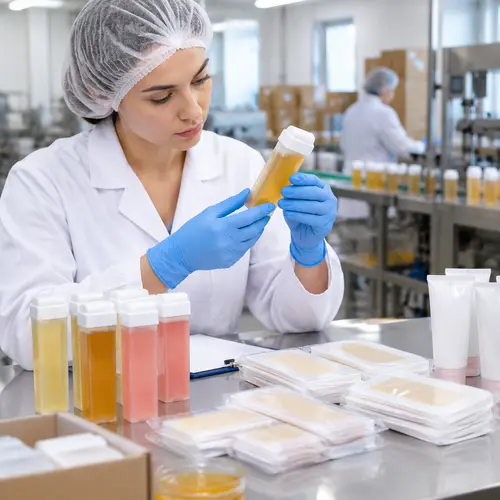
Supplier Checklist
- Confirm which hair removal formats are routinely manufactured on site and which steps are subcontracted.
- Review batch records, formula revision controls, retained samples, deviation handling, and corrective-action examples.
- Set measurable specifications for texture, color, odor, wax melt behavior, cream flow, coating weight, fill weight, seal integrity, and leakage.
- Verify that production raw materials and pack components match those used for the approved sample, with formal notification before substitutions.
- Request stability summaries, packaging observations, and acceptance criteria for every formula-pack combination.
- Separate finished-goods MOQ from component MOQs, tooling commitments, artwork setup, and sample quantities.
- Check ingredient lists, safety assessments, claim support, warnings, directions, lot coding, and market-specific labeling documents.
- Audit supplier capacity, maintenance records, backup utilities, critical-material sourcing, and recovery plans for interruption.
- Review shipment specifications, warehouse conditions, loading controls, arrival inspection, and responsibility for transit-related damage.
- Confirm information-security controls, ethical labor evidence, environmental records, insurance certificates, and third-party audit findings.
FAQ
Can a factory guarantee that our core formula will never be disclosed?
No credible supplier can promise absolute zero risk. Buyers should instead verify role-based system access, separated customer files, encrypted storage, access logs, restrictions on removable media, controlled laboratory entry, confidentiality agreements, and documented disposal of samples and records. Formula access should be limited to personnel who need it, with periodic access reviews and incident-response procedures.
How can a strategic customer secure supply during global raw-material shortages?
Priority must be contractual and operational, not verbal. Use rolling forecasts, agreed allocation rules, reserved inventory for critical inputs, qualified alternate sources, and escalation contacts. Confirm whether substitutes require buyer approval and whether the supplier can trace the alternate input to the affected batches. Review these arrangements before a shortage occurs.
What evidence supports environmental and carbon transparency?
Request current permits, wastewater and emissions records, utility data, waste-transfer documents, corrective-action history, and the methodology used for carbon reporting. If headquarters requires core suppliers to move toward carbon neutrality by 2030, define the reporting boundary and independent verification method. Records should be traceable to source data rather than presented only as a summary certificate.
What should we do if an incumbent supplier fails an unannounced audit?
Classify findings by product, legal, labor, environmental, and continuity risk. Freeze unapproved changes, increase incoming inspection where justified, and qualify an alternate manufacturer using the same approved specification. Do not transfer production solely from a sales sample; compare formula identity, pack components, documentation, and full-scale process capability.
Does a low initial MOQ reduce project risk?
Not automatically. A smaller order may reduce inventory exposure but may rely on stock packaging, shared materials, or limited customization. Compare total commitments across formula, printed components, testing, and future replenishment. Also verify whether repeat production can maintain the confirmed specification.
Are hair removal cosmetics approved by the FDA before sale?
Cosmetics generally are regulated rather than preapproved by the FDA, although companies remain responsible for safety, labeling, and compliance. Classification depends on intended use and claims, so avoid language that changes how the product is regulated without a specific review.