Direct Answer
Effective cosmetic production lead time planning begins before an ODM receives the purchase order. For hair-removal products, buyers should prepare a controlled formula brief, target-market compliance matrix, approved packaging architecture, forecast quantity, testing plan, and named approval owners before sampling starts. These inputs determine whether formulation, packaging validation, documentation, and material procurement can proceed in parallel or remain trapped in a sequential approval cycle.
A sub-30-day formulation-to-production program may be feasible when the buyer selects a validated baseline formula, uses qualified packaging, accepts a defined sample scope, and returns decisions within agreed review windows. A project can extend toward 90 days or longer when claims, fragrance, wax behavior, depilatory performance, component compatibility, or regional labeling requirements remain open. The primary planning objective is therefore not simply factory speed. It is the removal of unresolved decisions that could stop production after materials have been committed.

Key Takeaways for Private Label Buyers
- Freeze commercial requirements early: Confirm product format, markets, claims, pack size, forecast quantity, launch date, and acceptable formula boundaries before requesting samples.
- Separate essential customization from optional variation: Changes to active systems, fragrance, color, wax adhesion, or depilatory contact time may require additional review and should not be treated as simple artwork changes.
- Approve formula and packaging as one system: A stable bulk formula can still fail through cartridge leakage, tube deformation, liner interaction, wax-strip delamination, or closure incompatibility.
- Run compliance work in parallel: Ingredient screening, label review, safety substantiation, facility documentation, and market notifications should advance while samples and components are being qualified.
- Control decision latency: Name accountable approvers across procurement, R&D, QA, regulatory, legal, and artwork teams, with defined response windows and escalation rules.
- Protect the launch with alternatives: Pre-approve secondary materials, component substitutions, shipment conditions, and capacity reservations before a disruption occurs.
Buyer Context
Lead-time risk is unusually concentrated in hair-removal manufacturing because product performance depends on the interaction of formula chemistry, application behavior, packaging, storage, and user instructions. A depilatory cream project must align removal efficacy with skin-tolerance review, odor control, viscosity, dispensing, and label directions. Wax strips require consistent adhesive coating, backing compatibility, peel behavior, and aging performance. Sugar wax and hot wax require controlled texture and temperature behavior, while roll-on wax cartridges add leakage, roller movement, and heat-cycle concerns.
This becomes strategically important when a current supplier has experienced a serious quality incident, an unexpected capacity interruption, or lacks the production line required for a new hair-removal format. Under those conditions, procurement teams may attempt to compress supplier qualification and sampling simultaneously. That approach can preserve the launch date only if the buyer provides a complete transfer package and the incoming ODM can demonstrate disciplined change control, traceability, and a repeatable hair removal manufacturing process.
For multinational brands, the critical path frequently sits inside the buyer organization rather than the plant. Regional claims may conflict. Packaging specifications may not match locally available components. Legal review may begin after artwork is complete. Procurement may reserve material before QA approves the specification. A credible timeline should therefore identify dependencies, decision owners, and evidence requirements rather than presenting one undifferentiated number of days.
Buyers evaluating hair removal OEM ODM services should issue a structured project brief covering target countries, formula restrictions, reference samples, expected quantity, pack configuration, testing scope, documentation requirements, shipment destination, and forecast ramp. Product-specific resources such as custom depilatory cream formulation, custom wax strips and hot wax, and post-depilation care OEM help procurement teams separate shared qualification requirements from format-specific risks.

Technical and Packaging Factors
Formula definition. The ODM needs more than a reference product and a target claim. The brief should define application area, desired texture, fragrance limits, color, rinse behavior, removal time expectations, prohibited ingredients, target markets, and any vegan or Halal requirements. For ingredient naming and preliminary list review, buyers may consult the INCI ingredient nomenclature database, while final decisions should remain with qualified regulatory and safety personnel. ([incidecoder.com](https://incidecoder.com/)) If Malaysian or wider Muslim-market certification is required, raw-material documentation and production controls should be assessed against the JAKIM Halal certification framework before formula approval. ([halal.gov.my](https://www.halal.gov.my/))
Performance specifications. Each format requires measurable release criteria. Depilatory cream specifications may cover viscosity, pH, appearance, odor, dispensing mass, and defined efficacy observations. Wax specifications may cover melting behavior, spreadability, brittleness, residue, peel force, and hair pickup. Wax strips require adhesive distribution and separation performance after storage. Aftercare products require texture, absorption, dispensing, and compatibility with the intended hair-removal routine. Buyers should request the proposed specification sheet during sampling, not after mass production.
Safety and claims review. Irritation risk cannot be managed solely through marketing language. The buyer should review ingredient exposure, use area, contact time, contraindications, patch-test directions, and foreseeable misuse. Any claim supported by testing should be linked to the exact formula, method, population, and packaging used. Peer-reviewed research indexed by PubMed/NCBI can support scientific review, but it does not replace product-specific safety substantiation. ([pubmed.ncbi.nlm.nih.gov](https://pubmed.ncbi.nlm.nih.gov/)) For products marketed in the United States, the documentation plan should also reflect FDA requirements under MoCRA, including facility registration, product listing, adverse-event processes, and records supporting adequate safety substantiation. ([fda.gov](https://www.fda.gov/cosmetics/cosmetics-laws-regulations/modernization-cosmetics-regulation-act-2022-mocra))
Packaging compatibility. Component selection should be locked early enough to permit fill, closure, transport, and storage checks. Depilatory creams can interact with tube layers, pumps, seals, or printed surfaces. Roll-on cartridges require review of roller fit, cap retention, leakage, and formula flow after heating and cooling. Wax containers must tolerate filling temperature and subsequent handling without distortion. Buyers should define whether the ODM is responsible for sourcing, incoming inspection, assembly, coding, and final pack-out under the agreed cosmetic filling and packaging process.
Stability and shipment conditions. The testing plan should include ambient, elevated-temperature, cold-storage, and transport-relevant observations appropriate to the formula and package. Approval criteria should cover separation, crystallization, viscosity drift, odor change, color change, leakage, label adhesion, closure integrity, and application performance. Accelerated observations can support an informed launch decision, but they should not be represented as a substitute for an agreed ongoing stability program.
For mild positioning, the buyer should define what evidence supports a mild hair removal formula. If the range includes a companion serum or lotion, qualification should extend to the complete regimen through resources such as post hair removal serum supplier capabilities and broader depilatory product development solutions. Technical background can be reviewed through depilatory product development articles, while a formal hair removal product RFQ should document the final scope, samples, quantity, responsibilities, and approval gates.

Decision Framework
| Factor | What to Check | Why It Matters | ODM Buyer Note |
|---|---|---|---|
| Project definition | Format, markets, claims, quantity, pack size, launch date | Determines the true critical path | Issue one controlled brief to all functions |
| Formula readiness | Baseline selection, customization scope, restricted materials, specifications | Uncontrolled changes restart review and sampling | Classify every request as essential or optional |
| Packaging readiness | Component drawings, resin or laminate, closure, liner, decoration, case pack | Packaging failure can invalidate a stable bulk formula | Approve the filled package, not isolated components |
| Testing plan | Stability, compatibility, safety review, performance, shipment simulation | Testing duration and acceptance criteria affect release timing | Agree on interim and final decision gates |
| Compliance package | INCI list, safety records, labels, facility records, market notifications | Missing documents can block shipment after production | Assign regional regulatory owners before artwork begins |
| Supply continuity | Material sources, secondary components, reserved capacity, change control | Single-source dependencies amplify disruption risk | Require written substitution and escalation procedures |
| Governance | Approvers, response windows, escalation path, version control | Internal waiting time can exceed factory processing time | Use one decision log across procurement, QA, R&D, and legal |
ODM Manufacturing Considerations
Effective cosmetic production lead time planning depends on decisions made before the factory reserves materials or production capacity. This becomes especially important when a brand is replacing a supplier after a quality failure or capacity interruption, or when corporate procurement introduces new carbon-accounting requirements. Buyers should prepare a written project brief covering the target product, formula positioning, expected quantity, sales markets, reference samples, packaging format, required documents, and shipment window.
Sample Confirmation and Formula Customization
Sample approval should follow a controlled sequence rather than informal email comments. The buyer should identify the approved sample by code, date, fragrance, color, texture, application performance, removal result, and after-feel. For wax or sugar wax, confirmation may include working temperature, flexibility after cooling, residue level, and suitability for the intended body area. For depilatory cream, the review should include spreading behavior, removal time, odor acceptance, skin-comfort observations, and consistency after standing.
Customization can affect more than the visible formula. A fragrance change may alter user tolerance or interact with color and odor-masking systems. Adjusting wax hardness can affect brittleness, application force, and removal performance. Buyers should therefore request a revised sample whenever a functional material, fragrance system, processing parameter, or packaging component changes. A signed approval record should define which sample becomes the production standard.
Packaging, Stability, and Production Gates
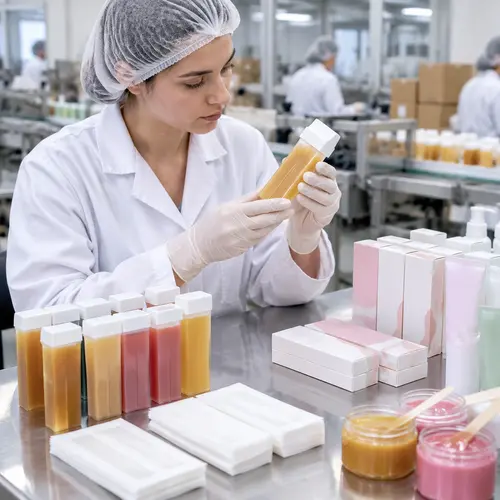
Packaging confirmation should use production-intent components whenever possible. A hand-filled sample in a temporary container may not reveal problems that appear during automated filling, warehousing, or distribution. The buyer and supplier should agree on checks for fill weight, container distortion, printed-decoration resistance, liner performance, carton compression, and component fit. Roll-on wax cartridges require particular attention because small dimensional differences can produce leakage or uneven product delivery.
A stability review should have written checkpoints and pass criteria rather than a general statement that the product is stable. The protocol should define the approved formula batch, packaging batch, examination dates, and acceptable changes in appearance, odor, consistency, application, and pack condition. If commercial timing requires production before the review is complete, the buyer should document the residual risk and the party authorized to approve that exception.
MOQ, Labeling Documents, and Shipment Conditions
MOQ should be separated into formula-batch quantity, printed-component quantity, assembly quantity, and finished-goods quantity. These numbers may differ. A supplier might manufacture a workable cosmetic batch while the printed carton or custom cartridge requires a larger purchase commitment. Buyers should ask what unused materials remain after production, who owns them, how long they can be stored, and whether they can be used for a later order.
Before artwork approval, request the ingredient declaration, product identity, net-content format, directions, warnings, batch-coding position, responsible-party details, country-of-origin statement where applicable, and supporting test or specification documents. For products marketed in the United States, MoCRA includes facility registration, cosmetic product listing, and safety-substantiation responsibilities that should be assigned clearly between the brand, responsible person, and manufacturer. ([fda.gov](https://www.fda.gov/cosmetics/cosmetics-laws-regulations/modernization-cosmetics-regulation-act-2022-mocra)) For markets requiring halal review, buyers should confirm whether ingredients, processing controls, and the manufacturing site align with the JAKIM Halal certification framework rather than assuming that a material-level declaration is sufficient. ([halal.gov.my](https://www.halal.gov.my/))
Shipment planning should define pallet configuration, carton protection, container loading method, temperature-related precautions, dangerous-goods status where relevant, export documents, and acceptance procedures at destination. These details should be agreed before the booking date because late changes can add days or weeks to the project timeline. Buyers can compare the supplier’s stated workflow with the hair-removal manufacturing process and OEM/ODM service scope before confirming an order.

Common Problems or Failure Cases
Wax brittleness: A hard-wax batch may crack during handling or break instead of lifting cleanly. Possible causes include an unsuitable resin-to-wax balance, excessive cooling, material variation, or a process deviation. Approval samples should be tested under the buyer’s intended use conditions, not only at the factory bench.
Strip adhesion loss: Wax strips can lose grip after storage if the adhesive mass migrates, dries, or bonds unevenly to the backing. The buyer should compare initial performance with aged samples and inspect whether each strip separates cleanly from its protective layer.
Cream separation: Depilatory cream may develop liquid release, graininess, air pockets, or uneven consistency. A visually acceptable laboratory sample does not guarantee that scale-up mixing and filling will produce the same structure. The production specification should include objective acceptance limits and retained samples for comparison.
Cartridge leakage: Leakage may appear around the roller, neck, seam, or cap after filling and distribution. Root-cause review should separate formula flow behavior from dimensional variation, assembly pressure, and shipping orientation.
Fragrance sensitivity: Strong fragrance can mask raw-material odor but may increase consumer complaints among sensitive users. Buyers should review fragrance level, warning language, target application area, and available safety support. Peer-reviewed research indexed by PubMed/NCBI can help safety teams locate relevant published evidence, although literature searches do not replace product-specific assessment. ([pubmed.ncbi.nlm.nih.gov](https://pubmed.ncbi.nlm.nih.gov/))
Packaging deformation: Wax containers, cartridge bodies, or caps may warp when the material and process are poorly matched. The supplier should record the affected component lot, filling parameters, defect rate, containment action, and corrective plan rather than treating deformation as a cosmetic issue only.
Supplier Checklist
- Confirm that the factory has active lines and documented quality controls for the specific hair-removal format being sourced.
- Request coded samples, written specifications, acceptance criteria, and retained-sample procedures.
- Verify how formula changes, material substitutions, packaging changes, and artwork revisions are approved.
- Separate MOQ commitments for bulk formula, primary pack, printed pack, assembly, and finished quantity.
- Review irritation-risk assessment, ingredient documentation, fragrance support, and market-specific labeling files.
- Ask for component drawings, incoming inspection standards, defect limits, and production-line trial records.
- Confirm stability checkpoints, production release authority, deviation handling, and complaint traceability.
- Review shipment configuration, carton strength, lot coding, export paperwork, and destination acceptance rules.
- Inspect information-access controls, confidentiality agreements, electronic permissions, physical sample storage, and visitor restrictions.
- Evaluate business continuity through dual-source options, strategic material reserves, capacity allocation rules, and escalation contacts.
- Request environmental records, waste-treatment evidence, worker-hour controls, payroll compliance, and recent independent audit findings.
- Confirm product-liability insurance limits, territories, exclusions, policy validity, and the process for handling a major claim.
FAQ
How should a buyer confirm the final sample before mass production?
Approve a uniquely coded sample and attach a written standard covering appearance, fragrance, application, removal performance, after-feel, pack components, and allowable variation. Any later formula or component change should trigger documented review.
Can a supplier guarantee that a proprietary formula will never leak?
No responsible supplier can promise absolute security. Buyers should verify role-based system access, segregated formula files, confidentiality obligations, restricted laboratory access, physical sample controls, download logs, backup permissions, and procedures for employees or subcontractors leaving the project.
How can strategic customers receive priority during a global material shortage?
Priority should be contractual and operational, not verbal. Define forecast commitments, reserved capacity, safety-stock ownership, allocation rules, approved alternate materials, notification deadlines, and executive escalation. The buyer should also understand whether competing customers use the same constrained material.
What insurance evidence should be reviewed before placing a large order?
Request a current certificate and, when commercially appropriate, policy details showing product-liability limits, covered territories, recall provisions, exclusions, deductibles, and insurer identity. Confirm whether claims arising in the buyer’s sales markets are covered and how compensation would be coordinated.
Why can packaging MOQ be higher than the formula quantity?
Printed cartons, decorated containers, liners, rollers, or custom-molded components may have separate production runs. Ask the supplier to show each component MOQ, expected overage, ownership of unused stock, storage period, and obsolescence responsibility.
Which labeling documents should be ready before artwork release?
Prepare the approved ingredient declaration, product identity, net contents, directions, warnings, responsible-party information, coding area, required symbols, language versions, and substantiation files. Regulatory responsibility should be assigned by market before printing begins.
When should shipment conditions be finalized?
Set them before production scheduling. Pallet dimensions, loading orientation, carton protection, documentation, routing, destination handling, and seasonal exposure can affect material selection, quantity planning, booking dates, and the final release timeline.
References
- U.S. Food and Drug Administration: Modernization of Cosmetics Regulation Act of 2022 ([fda.gov](https://www.fda.gov/cosmetics/cosmetics-laws-regulations/modernization-cosmetics-regulation-act-2022-mocra))
- Halal Malaysia Portal: JAKIM certification and verification resources ([halal.gov.my](https://www.halal.gov.my/))
- PubMed by the U.S. National Library of Medicine ([pubmed.ncbi.nlm.nih.gov](https://pubmed.ncbi.nlm.nih.gov/))