Single-Format vs Multi-Format Hair Removal Product Lines
Direct Answer
For most creator-led launches, a single-format hair removal product line is the stronger first move. One visually distinctive depilatory cream, sugar wax, wax strip kit, or roll-on wax system concentrates inventory, content, testing, and customer education around one clear promise. It is faster to sample and easier to improve after launch.
A multi-format line makes sense when each format serves a distinct use case and the brand can support separate packaging, stability, labeling, and application testing. It can increase basket size, but it also multiplies failure points. A cream, wax strip, and aftercare gel are not simple variations of one SKU; they require different production controls and consumer instructions.
The practical path is usually format depth before format breadth: launch one hero removal format, validate demand, then add a complementary product rather than a competing one.
Key Takeaways for Private Label Buyers
- Start with one job. Define the body area, user experience, application time, cleanup method, and desired camera effect before selecting a format.
- Count testing paths, not just SKUs. Each cream, wax, strip, cartridge, and aftercare package needs its own compatibility and storage review.
- Protect consistency. Confirm that the approved sample and mass-production formula use the same ingredients, process, color, fragrance, and texture targets.
- Choose packaging with the formula. Leakage, paneling, seal failure, wax migration, and label lifting can turn an attractive pack into a costly launch delay.
- Expand through adjacency. Pair a proven hero with soothing aftercare before adding another primary removal method.

Buyer Context
Hair removal products look related on a storefront, but they behave very differently in development. Depilatory cream depends on controlled viscosity, uniform spreading, odor management, dispensing, and clear exposure instructions. Sugar wax depends on working texture across realistic room and hand temperatures. Wax strips require reliable adhesion, clean separation, and stable strip saturation. Roll-on cartridges add heating behavior, roller movement, cap fit, and leakage risk.
This matters especially for an audience-led brand. A creator may want the dramatic spread of a glossy cream, the pull shot of a wax strip, and the satisfying flow of a roll-on cartridge in one launch. Visually, that feels cohesive. Operationally, it creates three separate sampling programs, packaging bills, instruction sets, content demonstrations, and inventory forecasts.
A single format gives the team more room to perfect the moment shown on camera. Buyers can compare spread, pickup, residue, fragrance, removal performance, and cleanup across focused prototypes. Review available hair removal product guides before writing the sample brief, then map responsibilities through the supplier’s hair removal manufacturing process.
A multi-format range becomes more defensible when products form a sequence. Wax strips followed by a calming gel create a clear routine. A cream and a second cream with only a different scent may instead divide demand without adding a meaningful customer outcome. Buyers evaluating both models can compare broader hair removal product solutions and the scope of available hair removal OEM ODM services.
Technical or Packaging Factors
Formula Performance Must Be Defined by Format
Do not approve a sample only because it removes hair in one demonstration. For a cream, document appearance, odor, spread, target viscosity range, dispensing force, rinse behavior, and performance at the intended application time. Include an irritation-risk review and instructions that address patch testing, maximum contact time, and unsuitable body areas. The custom depilatory cream formulation brief should state whether the product is positioned for legs, body, underarms, or another permitted area.
For wax and sugar wax, request a declared melting or working-temperature window, pickup behavior, stringing, residue, reheating limits, and removal consistency. Wax strips should be checked after aging for adhesion, separation from the liner, and transfer to skin. A supplier offering custom wax strips and hot wax should provide separate acceptance criteria for jars, beads, and prepared strips.

Packaging Is Part of Product Performance
Evaluate the exact production-intent pack, not a convenient lab container. Cream tubes and pumps need dispensing and seal checks. Wax jars need closure, liner, and heat-resistance review. Roll-on cartridges need upright, inverted, heated, cooled, and shipment-orientation leakage checks. Strip sachets need seal-integrity and oil-migration review. Labels must remain readable after storage and normal product contact.
Ask for hot and cold storage observations, temperature cycling, compatibility findings, fill-weight tolerances, carton fit, and shipment conditions. Independent providers such as SGS cosmetics and personal care testing services can support selected stability and compatibility work when third-party verification is required.
Safety and Launch Documents Scale with SKU Count
Every additional format adds an ingredient list, product specification, batch record, label review, safety support file, and market-specific notification path. US buyers should review FDA cosmetics requirements and the Modernization of Cosmetics Regulation Act of 2022. The responsible brand should confirm current obligations rather than treating a supplier statement as final legal advice.
If seven-day sampling is promised, verify what that milestone includes. It may mean a texture prototype rather than a production-ready pack with completed storage data. Request a transparent BOM, sample scope, packaging assumptions, estimated freight, and revision limits through a formal hair removal product RFQ.
Decision Framework
| Factor | What to Check | Why It Matters | ODM Buyer Note |
|---|---|---|---|
| Launch thesis | One user, body area, removal method, and content hook | A focused promise is easier to explain and demonstrate | Choose single-format when the audience hypothesis is still being tested |
| Formula workload | Texture targets, viscosity or working window, odor, residue, and application instructions | Each format needs different acceptance standards | Approve measurable specifications with the final sample |
| Packaging fit | Seal integrity, leakage, dispensing, heat response, label adhesion, and carton fit | Pack failure can occur even when the bulk formula passes review | Test production-intent components from the nominated vendor |
| Range logic | Whether SKUs complement or compete with one another | Complementary products support bundles without splitting hero-SKU demand | Consider soothing gel after hair removal as a second-step extension |
| Sensitive positioning | Ingredient review, exposure directions, patch-test language, and claim support | Gentle positioning does not remove irritation risk | Use a dedicated mild hair removal formula review rather than changing label language alone |
| Scale plan | MOQ by SKU, component lead time, reserved capacity, and reorder conditions | More formats divide working capital and complicate forecasting | Confirm whether a 1,000-unit pilot can scale beyond 500,000 units per SKU without changing the approved product |

ODM Manufacturing Considerations
For an ODM hair removal product line, sample approval should be based on written acceptance criteria rather than visual preference alone. The approval sheet should identify the sample code, formula version, color, fragrance level, texture, application method, removal behavior, net contents, and intended pack. For wax and sugar wax, buyers should also record the acceptable softening or melting range and the expected handling behavior at normal use temperatures. For depilatory cream, define an acceptable viscosity range, spreadability, rinse-off behavior, and maximum permitted color drift.
Formula customization should begin with the target user, body area, use instructions, desired sensory profile, and destination market. A request such as ‘make it more dramatic on camera’ is not specific enough. Translate the creative goal into observable criteria: stronger color contrast, a denser cream ribbon, cleaner wax pull, reduced stringing, or a glossy sugar wax surface. Any change to fragrance, pigment, botanical ingredients, or processing conditions may affect performance and should result in a new coded sample.
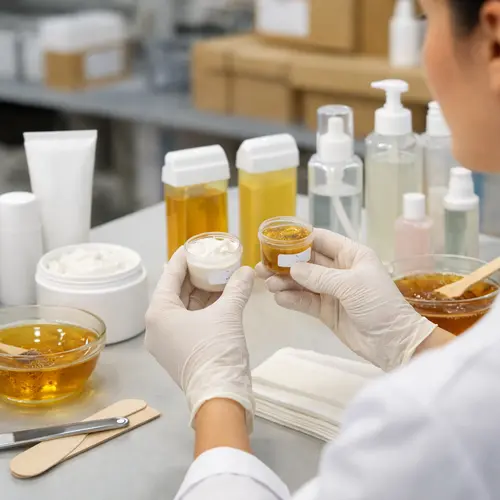
The selected container and formula must be assessed together. Buyers should request filled-pack observations across expected storage environments, followed by checks for paneling, swelling, staining, cap loosening, seal failure, label lifting, and dispensing changes. Shipment simulation should reflect the likely route, carton orientation, pallet pattern, and seasonal temperature exposure. A pack that performs in an air-conditioned sample room may behave differently in a hot parcel network or an unheated warehouse.
Stability review should cover appearance, odor, texture, weight change, pack condition, and application performance at defined checkpoints. Where relevant, request third-party support such as SGS cosmetics and personal care testing services. The buyer and manufacturer should agree in writing on what results permit production release and what changes require another approval round.
MOQ discussions should separate the formula batch minimum, packaging component minimum, decoration minimum, and finished-product minimum. Ask whether excess printed components must be purchased or stored, and whether mixed colors or fragrances can share a production run. A transparent BOM should distinguish formula, primary pack, secondary pack, printing, testing, assembly, freight preparation, and optional services.
Before the contract is signed, confirm the labeling document package. Depending on the product and market, this may include the ingredient declaration, product specifications, batch identification format, directions, warnings, responsible-party details, artwork review record, safety data for transport where applicable, and finished-batch test results. U.S. buyers should review the FDA cosmetics overview and determine how the Modernization of Cosmetics Regulation Act of 2022 applies to their business.
Common Problems or Failure Cases
Wax becomes brittle: Hard wax may crack instead of flexing when its resin balance, pour conditions, storage exposure, or application thickness differs from the approved sample. Compare retained samples and production units at the same room temperature before changing the formula.
Pre-coated strips lose grip: Poor removal can result from insufficient wax loading, uneven coating, backing variation, contamination, or prolonged heat exposure. Buyers should define acceptable pull behavior and inspect units from the beginning, middle, and end of a run.
Depilatory cream separates: Oil pooling, watery discharge, graininess, or inconsistent dispensing may appear after storage or transit. Do not treat remixing as a consumer solution. Quarantine the affected batch and review raw-material records, processing logs, fill conditions, and retained units.
Roll-on cartridges leak: Leakage can originate at the roller fit, neck, cap, or body seam and may worsen when cartons are stored sideways. Test filled units in multiple orientations and inspect the shipping carton for staining or odor transfer.
Fragrance causes complaints: A pleasant fragrance can still be too strong for the intended audience. Approve fragrance at the final dosage, document allergens where required, provide clear use instructions, and avoid implying that fragrance can mask an unsuitable base odor.
Packaging deforms: Jars, cartridges, caps, or inner trays can warp under heat or stacking pressure. Confirm component specifications, filled-unit behavior, carton strength, and maximum stacking conditions before commercial shipment.
Supplier Checklist
- Request coded samples with formula version, pack version, production date, and measurable acceptance criteria.
- Verify texture, viscosity or melting range where relevant, color tolerance, fragrance level, application behavior, and removal result.
- Ask which formula elements are customizable and which are fixed platform options.
- Confirm pack material, fill weight, dispensing performance, closure fit, decoration limits, and storage observations.
- Review irritation-risk controls, ingredient restrictions, use warnings, complaint handling, traceability, and batch-release records.
- Separate formula, component, printing, assembly, testing, and finished-goods MOQs in the quotation.
- Obtain a clear BOM, tooling charges if any, sample fees, expected waste allowance, and freight assumptions.
- Review ingredient lists, specifications, artwork records, batch coding, transport papers, and destination-market labeling responsibilities.
- Confirm master-carton dimensions, unit orientation, pallet requirements, temperature precautions, and shipment release criteria.
- Ask for capacity evidence, lead-time assumptions, surge-order rules, and how production slots are allocated among customers.
- Document confidentiality, formula ownership, permitted use of samples, and restrictions on displaying branded work.
- Assess whether the assigned contact can translate content concepts into measurable product requirements and written change records.
Buyers can also compare a supplier’s stated capabilities with its OEM and ODM service scope, manufacturing process, and relevant hair removal product categories before issuing an RFQ.

FAQ
Can a Chinese manufacturer reuse my idea or formula?
No supplier can remove all commercial risk. Use a signed confidentiality and development agreement that defines background formulas, buyer-funded modifications, artwork ownership, sample use, and whether similar products may be offered to others. Limit early disclosure to necessary information, keep dated version records, and confirm ownership terms in the manufacturing contract.
How can I tell whether the sample will look strong enough on camera?
Test the coded sample under the lighting, lens distance, application thickness, and editing conditions planned for content. Record objective goals such as color contrast, ribbon shape, gloss, spread pattern, or wax pull. Approve the same formula and pack combination intended for production rather than a hand-prepared presentation sample.
Can quality controls guarantee that no customer will have a bad reaction?
No responsible supplier should promise zero reactions. Risk can be reduced through ingredient review, controlled production, batch testing, traceability, clear warnings, use directions, retained samples, and a documented complaint process. Brands should avoid overclaiming and maintain a rapid escalation plan for adverse consumer reports.
What if I do not understand technical ingredient terminology?
Ask the supplier to convert marketing requests into a written product brief with measurable targets, exclusions, and pass-fail criteria. A capable account manager should explain tradeoffs in plain English and confirm every change by sample code rather than expecting the buyer to manage technical details.
What happens if social content creates a sudden order spike?
Ask for realistic output by format, component availability, reserved-capacity options, reorder lead times, and rules for allocating production slots. Keep approved packaging forecasts and discuss staged releases. Surge planning is more credible when supported by written assumptions rather than a general promise of unlimited capacity.
Should I launch one format before building a broader range?
Usually, yes, when demand is unproven or the team has limited quality and inventory resources. Add formats only after the first product establishes repeatable specifications, complaint data, reorder timing, and stable margins. A multi-format launch is more suitable when each SKU has a clear role and sufficient testing and working capital.