Direct Answer
Before launching, a facial hair removal products private label buyer should validate five connected decisions: removal method, facial-skin tolerance, formula performance, packaging compatibility, and market-specific compliance. A cream that removes coarse chin hair quickly may be too aggressive for the upper lip. A sugar wax with excellent pull can become difficult to spread after cold storage. A roll-on cartridge may perform in the lab yet leak during warm-weather shipment.
Treat the launch as a controlled system rather than a formula-selection exercise. Define the intended facial area, hair type, application time, removal behavior, aftercare routine, and consumer claims before sampling. Then require documented stability, packaging, irritation-risk, and labeling reviews on the exact commercial configuration. For emerging DTC brands, a pilot run from 1,000 units can preserve capital, but only when the pilot uses the same formula, components, filling controls, and quality criteria planned for scale-up.

Key Takeaways for Private Label Buyers
- Choose the removal format around the use case. Depilatory cream, wax strips, sugar wax, and roll-on wax differ in precision, pain profile, application skill, and suitability for small facial zones.
- Approve measurable performance. Record texture, spread, removal time, residue, odor, skin feel, and results across representative hair types instead of approving a sample by appearance alone.
- Test the final pack. Formula stability does not prove tube, sachet, jar, strip pouch, or cartridge compatibility. Evaluate sealing, dispensing, leakage, paneling, label adhesion, and decoration.
- Review irritation risk before claims. Facial use requires clear application limits, warnings, patch-test directions where appropriate, and a defensible safety assessment for the intended market.
- Lock compliance and scale-up together. Confirm ingredient records, labeling files, batch specifications, and change-control responsibilities before approving production.
Buyer Context
Facial hair removal sits in a narrow performance window. Consumers expect visible removal, but facial skin is highly noticeable when redness, residue, uneven pull, or post-removal discomfort occurs. Social media compresses that experience into close-up demonstrations, making texture and application behavior part of both product performance and customer acquisition.
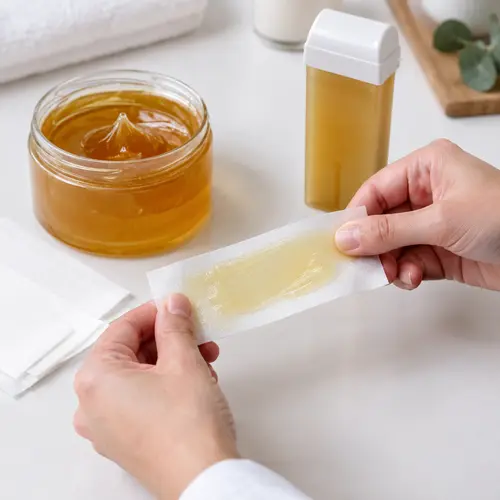
The first strategic decision is format. A custom depilatory cream formulation can offer a convenient, no-pull experience, but application time and alkaline-system control require careful instructions. Precision wax strips are portable and visually intuitive, while hot wax or sugar wax gives the user more control over placement and layer thickness. Buyers comparing these systems can review custom wax strips and hot wax alongside broader hair removal product solutions.
This choice also affects packaging, content strategy, returns, and customer support. A creator-led launch may favor a demonstrable texture, while a subscription program may prioritize compact dimensions and dependable storage. A brand replacing an unreliable supplier will usually place greater weight on batch consistency, retained samples, and documented change control. Clean Beauty, Vegan, and Cruelty-Free positioning adds another layer: each claim needs ingredient and supplier documentation, not just an absence list in a sales deck.
Regulatory language deserves equal attention. The FDA explanation of cosmetic regulatory authority clarifies why ordinary cosmetics should not be presented as FDA-approved. The FDA Cosmetics Labeling Guide is also a useful baseline for identity statements, net contents, ingredient declarations, and required business information. For US and EU launches, ask the ODM to map responsible-party tasks, safety documentation, MoCRA obligations, and CPNP notification responsibilities in writing.
Technical or Packaging Factors
Formula Performance and Facial Tolerance
Start with a written target product profile. It should identify the facial zones, hair characteristics, application amount, dwell or setting time, removal method, acceptable residue, fragrance direction, and after-feel. During samples, compare performance on a defined scorecard. For creams, monitor viscosity, spread, odor evolution, dispensing, removal efficacy, and signs of formula separation. A mild hair removal formula should still meet a clear performance threshold; the word gentle cannot substitute for testing.
For wax and sugar wax, evaluate working temperature, softening or melting behavior, grip, brittleness, stringing, residue, and pull consistency. Wax strips need aging checks because adhesive transfer and backing separation can change over time. Roll-on cartridges need controlled flow without clogging or flooding. Record the agreed viscosity or working-temperature range in the finished-product specification rather than relying on descriptors such as silky or salon quality.
Aftercare should be developed as part of the routine, not as an unrelated add-on. A soothing gel after hair removal may improve perceived comfort, but fragrance, alcohol, exfoliating acids, and other potentially sensitizing choices require review for recently depilated skin. If an aftercare formula contains alpha hydroxy acids, consider the FDA consumer advisory on alpha hydroxy acids, including its discussion of sun sensitivity.
Stability, Packaging, and Shipment
Request a protocol covering ambient storage, accelerated storage such as 40 C, cold storage such as 4 C, and at least 3 freeze-thaw cycles when relevant to the route and formula. These conditions are screening tools, not universal proof of shelf life, so the ODM should justify the protocol and acceptance criteria. Review appearance, odor, weight loss, viscosity, phase separation, package distortion, dispensing, and removal performance at each checkpoint.
Packaging compatibility must use the intended commercial components and decoration. Depilatory creams can challenge some tubes, liners, and seals. Wax jars may deform or leak when exposed to heat. Roll-on wax requires fit, roller rotation, cap retention, and upright and inverted leakage checks over 24 to 48 hours. Strip pouches need seal-integrity and adhesive-aging review. Ask whether recycled or lower-material packaging has been tested with the formula; environmental positioning does not remove the need for barrier and shipment performance.
The hair removal manufacturing process should show where incoming inspection, filling-weight control, coding, line clearance, finished-product release, and retained samples occur. ISO 22716 operation is useful only when the relevant controls are visible in batch records and release documents. Buyers using custom hair removal product development should also confirm that the approved sample will not be reformulated during scale-up without written authorization. PZIK’s model targets a formulation-to-shelf cycle reduced from 90 days to under 30, but schedule approval should never bypass compatibility or safety gates.

Decision Framework Table
| Factor | What to Check | Why It Matters | ODM Buyer Note |
|---|---|---|---|
| Removal format | Facial zone, hair type, consumer skill, application time, residue | Determines the realistic efficacy and tolerance target | Sample at least the leading format and one credible alternative before locking the brief |
| Formula control | Viscosity or working-temperature range, spread, odor, grip, separation | Turns subjective approval into a repeatable release standard | Place agreed ranges and test methods in the finished-product specification |
| Facial-use safety | Ingredient review, exposure directions, warnings, safety assessment, complaint plan | Reduces foreseeable misuse and supports compliant labeling | Do not treat a consumer patch test as a replacement for product safety substantiation |
| Packaging compatibility | Seal, leakage, dispensing, decoration, label adhesion, component distortion | The pack can fail even when the formula remains stable | Test the exact tube, jar, pouch, strip backing, or cartridge intended for launch |
| Storage and shipment | Ambient, heat, cold, cycling, orientation, carton protection | Cross-border routes can alter texture and create leakage | Align the protocol with destination climate and fulfillment conditions |
| Launch readiness | MOQ, sample scope, approved artwork, ingredient files, batch documents, lead time | Prevents late compliance changes and unplanned cash exposure | Use a written gate review before placing a 1,000-unit pilot |
Before final approval, consolidate these checks into one launch file containing the formula specification, packaging bill of materials, compatibility results, stability status, safety support, artwork approval, and shipment assumptions. The broader private label hair removal products portfolio can help frame format options, while a hair removal product RFQ should state the target market, pilot quantity, claims, pack format, and required documentation from the first discussion.
ODM Manufacturing Considerations
For facial hair removal products private label programs, sample approval should define the product that will enter production rather than serve as a general indication of quality. Buyers should confirm appearance, odor, application feel, removal performance, residue, rinse-off behavior, and post-use skin feel. The approved sample should be linked to a formula code, packaging components, fill weight, and signed specification so later changes can be identified and reviewed.
Formula customization should begin with a clear product brief. For a depilatory cream, specify the intended facial area, target application time, desired viscosity range, fragrance direction, and skin-tolerance expectations. For wax or sugar wax, document the preferred working consistency, melting behavior, pickup, spread, and residue. Customization may involve fragrance, color, selected botanical oils, texture, or aftercare positioning, but each change can affect performance and review timelines. A supplier claiming access to a distinctive imported oil should provide its INCI name, country of origin, supplier documentation, and lot-level traceability before it becomes part of the brand story.
Packaging should be assessed as part of the product system. Buyers should request component specifications, material identification, fill tolerances, closure requirements, and evidence that the chosen container remains functional throughout the intended shelf life. A decoration sample is not enough: the actual filled presentation must dispense cleanly, close securely, withstand distribution handling, and remain visually acceptable under expected storage conditions.
Before approving production, obtain a stability review plan that reflects the formula, pack, destination markets, and expected transport route. The resulting report should distinguish observations from pass criteria and record changes in color, odor, texture, weight, container shape, and dispensing performance. Shipment planning should address carton configuration, pallet pattern, temperature exposure, orientation, and any handling instructions required for waxes, creams, or roll-on formats.
MOQ should be evaluated against the complete commercial setup, not as an isolated number. Ask whether the minimum applies by formula, fragrance, shade, package, artwork, or purchase order. Also separate one-time costs such as molds, print plates, regulatory review, and custom component development from recurring unit costs. The supplier should state what is included in sampling, how many revisions are allowed, and whether sample materials match the proposed production inputs.
Labeling support should include the ingredient declaration, net contents, responsible-party details, country-of-origin information where applicable, warnings, directions, lot identification, and supporting product records. Buyers remain responsible for market-specific claims and final artwork approval. Review the supplier’s broader OEM/ODM capabilities and manufacturing process to understand who controls formulation, component sourcing, filling, inspection, and release.

Common Problems or Failure Cases
Wax becomes brittle or cracks. A wax that performs during sampling may fracture after storage or exposure to a colder distribution environment. Confirm the acceptable texture and working range, then evaluate filled units from representative batches rather than judging only a fresh laboratory sample.
Wax strips lose adhesion. Poor release-liner selection, formula migration, or storage exposure can reduce grip or cause uneven transfer. Buyers should define peel behavior, residue expectations, and acceptable removal performance at the end of the proposed shelf life.
Depilatory cream separates. Separation can appear as liquid release, graininess, or uneven texture. Beyond appearance, this may create inconsistent dosing across the face. Investigate raw-material variation, mixing controls, filling conditions, and container interaction before accepting a corrective sample.
Roll-on cartridges leak. Leakage can result from component tolerances, closure fit, formula flow, or temperature exposure during transit. Review assembled units from the intended component supplier and confirm how leakage findings are recorded, investigated, and prevented in subsequent lots.
Fragrance increases sensitivity complaints. A pleasant fragrance does not offset discomfort on facial skin. Compare fragranced and fragrance-free samples, review allergen declarations, and ensure directions do not encourage longer contact than intended. Consumer feedback should distinguish odor preference from reports of burning, redness, or prolonged irritation.
Packaging deforms in distribution. Panels may collapse, caps may loosen, or labels may shift when products experience pressure and temperature changes. Shipping cartons and product packs should be considered together, especially for e-commerce routes where parcels may be stored in uncontrolled conditions.
Supplier Checklist
- Confirm the legal manufacturer, production location, quality certifications, audit scope, and certificate validity directly with the issuing or auditing body.
- Request the formula code, complete INCI list, target texture or viscosity, wax working range where relevant, fragrance allergens, and irritation-risk assessment.
- Define sample stages, included revisions, approval criteria, reference sample ownership, and the process for controlling post-approval changes.
- Verify package materials, component suppliers, fill tolerances, dispensing performance, closure fit, and compatibility evidence for the final formula-pack combination.
- Review stability conclusions, shelf-life rationale, microbiological documentation where applicable, and the method for handling out-of-specification results.
- Clarify MOQ by SKU and component, setup charges, lead times, capacity constraints, payment milestones, and responsibility for excess custom packaging.
- Obtain labeling inputs, safety support, claims substantiation, batch documents, lot coding format, and market-specific regulatory responsibilities.
- Confirm shipment orientation, carton strength, pallet and parcel options, temperature considerations, release checks, and complaint or recall procedures.
- Ask for traceability records for featured oils, waxes, fragrances, and other story-driving ingredients rather than relying on marketing descriptions.
- Review confidentiality terms, ownership of custom work, access to testing records, change-notification periods, and restrictions on sharing brand plans.
Product format options can also be compared through the hair-removal product range before the specification and sampling scope are finalized.

FAQ
Can an Asian manufacturer comply with Western clean beauty and cruelty-free requirements?
Location alone does not establish compliance. Define the exact retailer, certification, restricted-substance, and animal-testing standards in the quality agreement. Verify ingredient declarations, supplier statements, audit records, market policy, and change controls. Terms such as clean beauty are not universally defined, so convert them into a written restricted-ingredient specification.
Will a low MOQ make customer acquisition economics unworkable?
It can if custom components and setup costs are spread across too few units. Model landed unit cost, fulfillment, expected returns, promotional allowance, and CAC before selecting the MOQ. A higher unit price may still be rational for launch validation, but only when the contribution margin and reorder plan are explicit.
Will a turnkey base formula make the product indistinguishable from competing brands?
Not necessarily. Differentiation can come from verified performance targets, fragrance-free positioning, texture, application format, selected traceable oils, pack usability, directions, and aftercare pairing. Ask which formula elements are fixed, which can be changed, whether exclusivity is available, and what testing a modification will require.
Can we require a strict NDA before sharing the product plan?
Yes, but the NDA should identify protected information, permitted recipients, subcontractor obligations, duration, governing law, and remedies. It should also align with the development agreement on formula ownership, sample use, and whether the supplier may show the finished product in its portfolio.
What labeling documents should the supplier provide?
At minimum, request the INCI declaration, warnings, directions, net-content data, lot-code format, responsible-party inputs, and records supporting claims. The FDA Cosmetics Labeling Guide explains core US labeling expectations, but the brand should arrange a final market-specific review.
How quickly can an urgent replacement supplier be qualified?
A supplier may prepare a brief or initial samples quickly, but qualification should not skip document review, sample confirmation, compatibility evidence, capacity verification, and shipment planning. For a disrupted launch, separate critical requirements from optional customization and establish written decision gates before committing inventory.