Direct Answer
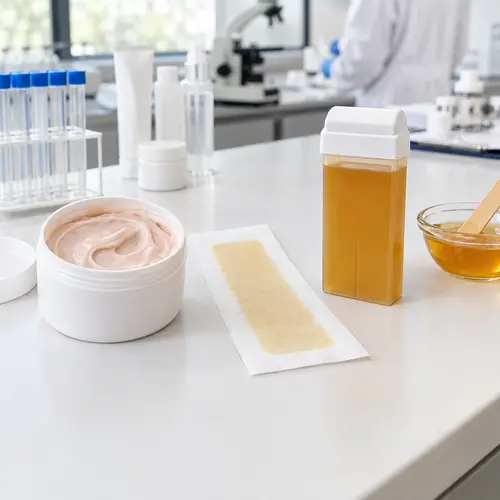
For private-label buyers comparing depilatory cream vs wax, the central difference is not simply chemical removal versus mechanical removal. Each format creates a different formulation, packaging, testing, and consumer-use system. Depilatory creams require controlled chemical activity, uniform viscosity, odor management, skin-contact validation, and packaging that remains compatible with an alkaline formula. Wax products depend more heavily on melt behavior, adhesion, application temperature, strip performance, residue, and resistance to leakage or deformation during shipment.
In practical sourcing terms, cream is usually the more formulation-sensitive project, while wax is often the more format- and packaging-sensitive project. Neither is automatically easier to launch. The right choice depends on the intended body area, target user, application ritual, climate, claims, retail channel, and acceptable irritation profile. Buyers should compare complete product systems rather than selecting from samples based only on initial texture or hair-removal speed.
Key Takeaways for Private Label Buyers
- Sourcing: Confirm whether the supplier controls formulation, filling, compatibility testing, and corrective work within one documented development workflow.
- Formulation: For creams, review active-system consistency, viscosity, odor, spread, removal time, and post-use feel. For wax, evaluate melt profile, grip, flexibility, residue, and reheating behavior.
- Packaging: Match the formula to the actual tube, pump, jar, sachet, strip pouch, or roll-on cartridge before approving appearance or unit cost.
- Testing: Require stability, packaging compatibility, heat and cold storage, leakage, and batch-level quality checks using the intended commercial components.
- Launch: Align product type with consumer skill, content strategy, claims, shipping environment, and the amount of use education the brand can support.
Buyer Context
Hair-removal products sit unusually close to the boundary between cosmetic performance and user technique. A depilatory cream can have an elegant appearance yet perform inconsistently if its active system, application thickness, or contact-time instructions are poorly controlled. A wax can remove hair effectively in a laboratory demonstration but disappoint consumers when a roll-on head drags, a strip loses adhesion during aging, or a jar softens in a warm fulfillment center.
This matters especially for DTC brands because social content compresses the product judgment into a few visible moments: how evenly a cream spreads, whether it wipes away cleanly, how a wax pulls, and how much residue remains. However, the most visually dramatic sample is not necessarily the most dependable commercial SKU. Buyers need evidence that the same texture and removal behavior can be reproduced through routine hair removal product quality control, not only in a hand-prepared development sample.
The category also spans distinct consumer expectations. Facial cream calls for different positioning and irritation-risk review than a leg product. Ready-to-use strips prioritize convenience and pouch integrity. Sugar wax may support a simpler ingredient narrative but remains sensitive to water balance and storage conditions. Hot wax and roll-on cartridges introduce heating instructions, flow behavior, and packaging-fit questions. A companion soothing gel after hair removal can improve the routine, but it should not be used to disguise an unnecessarily aggressive primary product.
A broad literature review of hair-removal practices also reinforces why removal method, body site, and adverse-effect potential should be considered together. Consumer-oriented comparisons such as this review of waxing and hair-removal cream can help buyers understand the language shoppers encounter, although supplier decisions still require formula-specific evidence. For face-positioned products, the FDA eye-area cosmetic safety framework is a useful reminder that facial use does not imply eye-area suitability; directions and warnings must define that boundary clearly.
Technical and Packaging Factors
Depilatory Cream: Activity Must Stay Controlled
Depilatory formulations work by weakening hair so it can be removed from the skin surface. Development therefore requires a controlled relationship among the active system, pH, water phase, emulsion structure, viscosity, and contact time. A richer texture may improve application control, but excessive drag can encourage uneven coverage. A thinner cream may spread quickly yet migrate beyond the intended area or deliver an inconsistent layer.
Ask the developer to define measurable acceptance ranges for viscosity, pH, appearance, odor, fill weight, and removal performance rather than approving subjective descriptions such as creamy or mild. Sensitive positioning needs an ingredient-level irritation review, appropriate safety substantiation, and realistic use directions. The mild hair removal formula pathway should include testing on the final composition, not an assumption based on one soothing ingredient.
Packaging compatibility is equally important. The selected tube laminate, shoulder, cap liner, pump pathway, and printed decoration must tolerate prolonged formula contact. Compatibility review should check panel distortion, seal integrity, clogging, discoloration, odor transfer, print damage, and changes in dispensing force after heat and cold storage. The scope of a custom depilatory cream formulation should state whether these checks use the intended commercial pack or only a laboratory container.

Wax: Performance Extends Beyond the Formula
Wax development begins with the use format. Hard wax must melt, spread, set, flex, and pull without becoming brittle or excessively stringy. Soft wax must coordinate with the strip substrate. Sugar wax depends on a controlled consistency across room-temperature and warmed use. Roll-on wax must flow through the cartridge head evenly while resisting leakage during storage and transit.
Buyers should request a target melting or application-temperature range where relevant, along with test methods for adhesion, residue, flexibility, and repeated heating. The exact range depends on the wax architecture and pack, so a generic number copied from another formula is not a sound specification. Evaluation should include short and coarse hair, application at the labeled thickness, and realistic operator technique. The available custom wax strips and hot wax formats should be reviewed as separate systems rather than interchangeable versions of one base.
For strips, inspect wax distribution, liner release, strip alignment, pouch seals, and adhesion after aging. For jars, assess closure fit, seepage, label movement, and deformation in warm storage. For cartridges, test cap security, roller rotation, output uniformity, and leakage in multiple orientations. Shipment simulation should reflect the route and season in which the product will launch, particularly when inventory may remain in unrefrigerated vehicles or fulfillment facilities.
Sampling Without a Scale-Up Surprise
A sample is useful only when its relationship to routine production is clear. Ask whether it was made with the same ingredient grades, mixing sequence, heating profile, filling equipment, and packaging components planned for the launch. PZIK’s agile model supports ISO 22716 pilot runs from 1,000 units and targets a formulation-to-shelf cycle of under 30 days, but speed still depends on decisive briefs, available components, and parallel testing.
A structured custom hair removal product development brief should define target body area, hair type, texture, claims, fragrance limits, pack format, market, sample quantities, testing scope, and required labeling documents. Buyers comparing broader depilatory product development solutions should also establish who owns deviations, retesting, and packaging substitutions before approval.

Decision Framework
| Factor | What to Check | Why It Matters | ODM Buyer Note |
|---|---|---|---|
| Removal mechanism | Chemical contact time for cream; adhesion and pull behavior for wax | Shapes efficacy, irritation risk, directions, and user technique | Test the complete routine on the intended body area |
| Texture specification | Viscosity and spread for cream; melt, flow, set, and flexibility for wax | Controls dose consistency and visible consumer experience | Approve numerical ranges and test methods where applicable |
| Packaging compatibility | Tube seals, pump flow, pouch integrity, jar closure, or cartridge leakage | Formula-pack interaction can create failures after approval | Use commercial components in stability and compatibility work |
| Storage and shipment | Heat, cold, orientation, reheating, and post-storage performance | Temperature excursions can alter viscosity, adhesion, seals, or appearance | Match testing to launch geography and fulfillment route |
| Safety and labeling | Ingredient review, use area, warnings, directions, and substantiation file | Clear boundaries reduce misuse and unsupported claims | Request market-ready documentation before artwork lock |
| Pilot readiness | Sample representativeness, component availability, QC limits, and change control | Prevents reformulation or pack changes after consumer testing | Map every approved sample attribute to the production specification |
ODM Manufacturing Considerations
For a depilatory cream vs wax sourcing decision, sample approval should define measurable acceptance criteria rather than depend only on appearance. Record the approved sample code, formula revision, fragrance level, color, application feel, removal performance, and permitted variation. Wax samples should also document working temperature, setting behavior, break resistance, residue, and removal technique. For creams, buyers should confirm spreadability, coverage, removal time, rinse behavior, odor, and the intended body areas.
Formula customization can range from limited adjustments to a more differentiated development brief. Buyers may change fragrance, color, emollient profile, wax blend, botanical ingredients, aftercare components, or application format. Every change can affect performance or tolerance, so the supplier should explain which modifications require new testing. A stock formulation can still become distinctive through a controlled sensory profile, format, accessory set, fill size, and brand-specific performance criteria. However, unsupported ingredient claims or excessive fragrance should not substitute for meaningful differentiation.
Packaging must be assessed as part of the product system. Confirm that the container, closure, applicator, liner, label, and secondary pack tolerate prolonged formula contact and expected handling. For roll-on formats, evaluate flow through the roller and closure cleanliness. For creams, monitor dispensing consistency and whether the pack remains usable as it empties. Wax strips require attention to pouch integrity, release liners, and the ease of separating paired strips.
Stability review should cover representative batches in the final intended pack. The protocol should define checkpoints, acceptance limits, and responsibilities when color, odor, texture, weight, or performance changes. Ask whether the review includes elevated and reduced temperatures, repeated temperature transitions, and conditions that reflect the destination market. Results from a laboratory container do not automatically support the selected retail pack.
MOQ discussions should separate formula minimums, packaging minimums, decoration minimums, and finished-unit minimums. A low finished quantity may still require excess printed components or ingredients. Request a cost breakdown for samples, tooling, testing, artwork changes, freight preparation, and unused component inventory. This gives the buyer a more realistic contribution-margin model against customer acquisition cost.
Before approval, obtain the ingredient declaration, specification, safety documentation, batch coding format, directions, cautions, net-content details, and available substantiation for claims. Responsibilities for US or EU notification support should be written into the development schedule. The supplier should also document carton configuration, pallet pattern, temperature limits, destination requirements, and handling expectations for air or ocean shipment. A transparent manufacturing process and defined OEM/ODM development workflow make these dependencies easier to audit.

Common Problems or Failure Cases
Wax brittleness: Hard wax can crack during removal if its blend, application thickness, cooling behavior, or working temperature is unsuitable. Buyers should compare breakage across intended use areas and confirm that user directions match the tested technique.
Strip adhesion loss: Pre-coated strips may lose grip after prolonged warmth, pressure, or liner interaction. Warning signs include uneven wax transfer, difficult strip separation, or reduced hair pickup. Evaluation should use aged retail packs, not only freshly prepared samples.
Cream separation: Oil release, watery discharge, graininess, or uneven dispensing can indicate that the formulation or pack is not holding under storage stress. Acceptance criteria should include appearance after rest, dispensing from different fill levels, and performance after temperature transitions.
Cartridge leakage: Roll-on wax may migrate around the roller, cap, or neck when heated or transported. Leakage can soil labels and cartons even when the primary pack still functions. Check multiple closure lots and evaluate packed cartons in realistic shipping positions.
Fragrance sensitivity: A stronger scent may mask raw-material odor but increase user complaints. Review fragrance concentration, allergen documentation where applicable, intended application area, and whether an unscented option is commercially appropriate. Hair-removal products already involve meaningful skin exposure, so masking odor should not override an irritation-risk assessment.
Packaging deformation: Warm storage may distort cartridges, tubs, closures, or strip pouches. Cosmetic damage can also affect dispensing or seal integrity. Confirm pack dimensions, closure fit, label condition, and function after conditioning.

Supplier Checklist
- Define the exact format: depilatory cream, hard wax, sugar wax, wax strips, roll-on cartridge, or aftercare product.
- Request an approved-sample record with formula version, pack version, fragrance, color, fill weight, and performance criteria.
- Confirm the intended use area, hair type, application method, removal time, and contraindication language.
- Review formula specifications, raw-material documentation, irritation-risk controls, and claim substantiation.
- Ask for relevant viscosity or wax working-range limits and the test method used to release batches.
- Evaluate the complete retail pack after storage, including closure function, dispensing, label condition, seals, liners, and accessories.
- Compare pilot samples with retained samples from the first commercial batch using the same acceptance sheet.
- Separate MOQ and lead-time assumptions for formula, components, printing, assembly, and testing.
- Verify ingredient lists, directions, warnings, batch traceability, safety files, and market-specific labeling responsibilities.
- Document carton count, palletization, container loading assumptions, temperature exposure, and freight handling limits.
- Review change-control terms for ingredients, component suppliers, processing parameters, artwork, and test methods.
- Confirm complaint handling, retained-sample policy, investigation timing, and corrective-action documentation in the manufacturing contract.
FAQ
Can an Asian manufacturing site meet US and European clean beauty and cruelty-free expectations?
Location alone does not prove or disprove compliance. Define what clean beauty means for your brand, because it is not one universal regulatory standard. Audit ingredient restrictions, supplier declarations, animal-testing policies, traceability records, and market-specific documentation. Certifications can support due diligence, but their scope, issuing body, validity, and covered site must be verified rather than inferred from a logo.
Will a low MOQ make the unit cost incompatible with our customer acquisition cost?
It can, particularly when testing, decorated packaging, setup, and freight are spread across fewer units. Model landed cost together with fulfillment fees, expected discounting, returns, and CAC. Compare a lower opening quantity with a stepped forecast showing how component commitments and unit economics change at later volumes.
Will a turnkey or ready formula make our product indistinguishable from other brands?
Not necessarily, but changing only the label creates that risk. Ask which sensory, performance, ingredient, fragrance, format, and packaging variables can be modified without undermining safety or stability. Put agreed exclusivity, formula ownership, and permitted reuse terms in the contract; do not assume customization automatically creates exclusivity.
Can we require a strict NDA before sharing the brief?
Yes. The NDA should identify protected formula concepts, launch plans, artwork, pricing, test data, and supplier information. It should also address access by affiliates and subcontractors, permitted use, retention, disclosure required by law, and the survival period. An NDA complements, but does not replace, clear ownership and confidentiality clauses in the development agreement.
What should be approved before placing the first commercial order?
Approve the final formula and pack samples, specifications, artwork, ingredient declaration, directions, cautions, claims, quality limits, batch coding, case configuration, and shipment assumptions. Any open test result or temporary packaging substitution should be listed as a written deviation with an owner and resolution date.
How should buyers compare depilatory cream and wax complaints?
Use format-specific categories. Cream records should distinguish odor, removal efficacy, skin response, separation, and dispensing. Wax records should separate temperature misuse, brittleness, residue, grip, leakage, and accessory failures. Hair-removal methods have different mechanisms and adverse-effect profiles, as summarized in the hair removal practices literature review, so a single generic complaint code is not sufficient.