How Many Sample Rounds Are Typical for Depilatory Cream Development?
Direct Answer
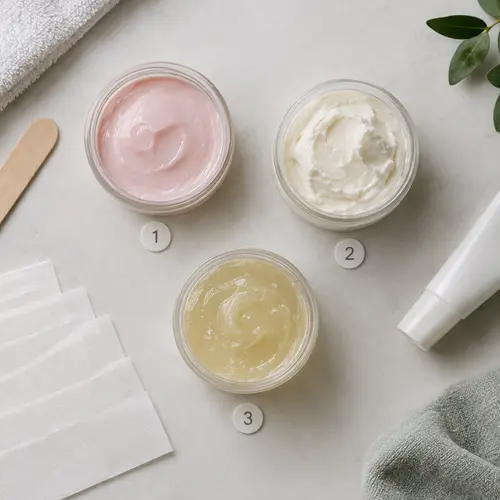
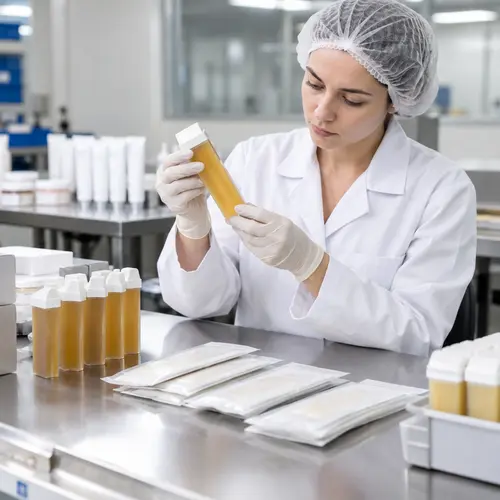
Most private-label projects require two to three physical sample rounds before the depilatory cream formulation is approved for production. Round one confirms core hair-removal performance, application time, texture, odor, and initial skin feel. Round two refines sensory details, color, fragrance, viscosity, and packaging interaction. A third round is usually a final confirmation sample made against the locked specification.
A stock formula with only branding changes may be approved in one round. A custom formula for sensitive skin, a camera-ready texture, or an unusual applicator may need three or four. More than four rounds often signals an incomplete brief, changing creative direction, or a conflict between fast removal and mild positioning.
For planning, allow five to seven business days for a standard first sample and several additional days for each revision. Sampling can move quickly, but production approval should still depend on performance, stability, packaging compatibility, and documentation—not appearance alone.
Key Takeaways for Private Label Buyers
- Plan for two to three rounds. Define approval criteria before the first sample ships.
- Test performance before fragrance. Removal time, coverage, rinse behavior, and post-use feel should be settled first.
- Review samples in final packaging. A stable cream in a lab jar may behave differently in a tube, pump, or sachet.
- Separate visual feedback from technical feedback. Record camera appearance, viscosity, odor, and efficacy as distinct decisions.
- Lock the formula before artwork release. Ingredient labeling and warning copy can change when the formula changes.
- Request a written sample scope. It should state variant count, sample quantity, cost, freight, revision limits, and target dates.
Buyer Context
Sampling is not simply a request to make the cream thicker or add a better fragrance. Each round reduces a different launch risk. For creator-led brands, the product must remove hair predictably while also looking clean and intentional in close-up video. A texture that spreads unevenly, collapses on camera, or leaves visible residue can weaken content even when basic performance is acceptable.
The first decision is whether the project starts from a validated base or from a more extensive custom brief. Buyers using a custom depilatory cream formulation should expect more iteration than buyers selecting a ready base through established hair removal OEM ODM services. Sensitive-skin positioning adds another review layer because fragrance, exposure time, alkalinity, and after-feel must be considered together. Relevant options can be compared through sensitive skin hair removal products.
The intended sales market also affects sampling. In the United States, buyers should first determine whether the planned claims keep the item within the cosmetic category using the FDA guidance on how personal care products are regulated. Facility, product listing, recordkeeping, and safety responsibilities should be reviewed against the FDA overview of MoCRA requirements. Ingredient questions may also be checked against Cosmetic Ingredient Review safety assessments. Gulf launches require market-specific review, with standards information available through the Gulf Standardization Organization.
This is why formula, claims, artwork, and packaging should move in parallel—but should not be approved independently. A fast first sample is valuable only when it leads to a production-ready specification.
Technical and Packaging Factors
1. Hair-removal performance
Round one should establish the target use area, hair type, application weight, removal window, and rinse method. Many thioglycolate-based creams operate in a highly alkaline range, often around pH 11.0 to 12.5, but the acceptable target depends on the ingredient system, intended market, and safety review. Buyers should not compare samples by pH alone.
Ask the ODM to document whether the formula removes hair evenly within the labeled time and whether performance changes when the layer is applied more thinly than intended. Review at least three sample units per variant rather than judging a single jar. For face or sensitive-area positioning, require a separate formula assessment rather than extending body-cream claims without review.
2. Texture, odor, and camera behavior
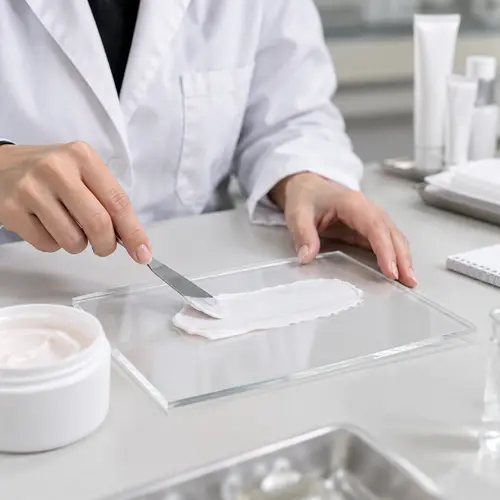
Viscosity affects application control, perceived quality, filling speed, and leakage. The supplier should provide a target viscosity range together with the measurement temperature, spindle, and speed; a number without test conditions is not comparable. For social content, film the cream under the lighting and lens setup planned for launch. Check whether it holds a clean edge, spreads without stringing, and wipes away without unattractive residue.
Depilatory ingredients can create a recognizable sulfur-like odor. Fragrance may reduce perception, but excessive fragrance can create another irritation concern. Sample feedback should therefore distinguish odor masking, fragrance preference, and post-rinse odor instead of combining them into one approval comment.
3. Packaging compatibility
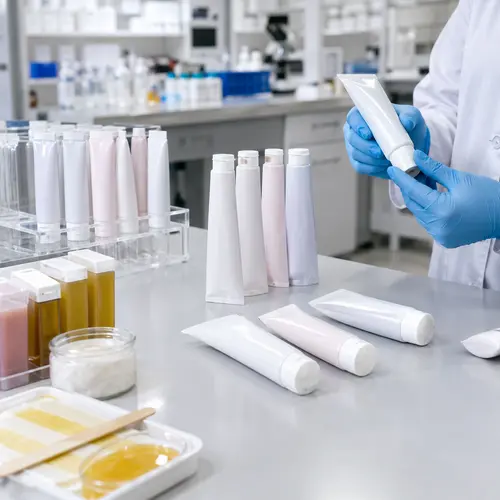
Do not approve only from a generic lab container. Fill the selected tube, pump, sachet, or applicator and review dispensing force, closure seal, panel distortion, staining, odor migration, and cream remaining in the pack. A two-to-four-week compatibility screen can identify early problems, while longer stability work continues.
Packaging should be tested upright, inverted, and on its side. Include heat and cold storage, then inspect leakage and viscosity recovery. Common checkpoints include 4°C, 25°C, and 40°C, plus three freeze-thaw cycles where appropriate. These are screening conditions, not substitutes for the supplier’s full stability plan. The broader depilatory product production process should show when filling, packaging checks, quality review, and shipment release occur.
4. Aftercare and range planning
If the launch includes a soothing gel or lotion, sample it as part of the use sequence rather than as an isolated product. The scent, residue, and packaging should complement the cream. Buyers can review options through post-depilation care OEM and compare broader depilatory product development solutions. This avoids discovering after approval that the two products pill, clash in fragrance, or create excessive packaging weight for fulfillment.
Before the final round, request the draft ingredient list, use directions, warnings, net weight, batch coding position, carton dimensions, and shipment conditions. For further technical reading, use these depilatory product development articles. When the brief is ready, a hair removal product RFQ should include target market, pack format, desired sample date, forecast quantity, and launch deadline.
Decision Framework
| Factor | What to Check | Why It Matters | ODM Buyer Note |
|---|---|---|---|
| Sample scope | Variants, units, cost, freight, revision limit, and timing | Prevents open-ended rounds | Start with no more than two or three meaningful variants |
| Performance | Target area, application weight, removal time, and rinse result | Defines whether the formula works as labeled | Approve against a written test method |
| Texture | Viscosity range, spread, edge hold, residue, and camera appearance | Affects use, filling, and content quality | Record instrument conditions and visual feedback separately |
| Irritation risk | Ingredient review, alkalinity, fragrance level, warnings, and exposure time | Protects users and brand reputation | Do not treat mild positioning as a fragrance choice |
| Packaging | Dispensing, seal integrity, leakage, staining, and panel distortion | Prevents failure after filling or shipment | Test the actual production pack before approval |
| Storage | Heat, cold, orientation, freeze-thaw response, odor, and viscosity recovery | Shows how the cream behaves in distribution | Confirm shipment conditions for each destination |
| Final lock | Approved formula code, packaging code, artwork, fill weight, and master sample | Keeps production aligned with sampling | No substitutions without written approval |
ODM Manufacturing Considerations
Before approving a depilatory cream formulation for production, define exactly what the approved sample represents. The confirmation record should identify the formula code, appearance, odor, application feel, removal time, rinse behavior, fill weight, container, closure, applicator, and printed components. Both buyer and manufacturer should retain sealed reference samples so later batches can be compared against the same benchmark.
Customization should begin with measurable priorities rather than broad requests such as ‘stronger’ or ‘more premium.’ Specify the intended body area, hair type, desired cream viscosity, acceptable fragrance intensity, target color, application thickness, and whether the product must remain visually distinct under bright filming lights. A formula intended for the face should not simply be treated as a relabeled body-hair product. Ingredient choices, directions, contact time, and irritation-risk review need to match the intended use.
Packaging decisions should be made alongside formula work. The supplier should verify that the cream can be filled consistently, dispensed without excessive force, and stored without attacking the container or closure. For wax strips, confirm that the backing, wax layer, release liner, and pouch maintain usable adhesion. Sugar wax and depilatory wax projects should define an acceptable melting-point or working-temperature window. Roll-on wax cartridges require particular attention to roller movement, cap fit, and seal integrity.
Stability review should track more than whether a product still looks acceptable. Buyers should request observations for viscosity drift, separation, discoloration, odor change, wax crystallization, strip drying, container softening, print damage, and net-weight loss. Results should be recorded by formula and packaging combination because the same cream may behave differently in another tube or closure.
MOQ discussions should separate formula MOQ, bulk-production MOQ, packaging MOQ, decoration MOQ, and finished-goods MOQ. Ask whether unused custom containers or labels must be purchased in full and whether later production can draw from that inventory. A transparent BOM should distinguish bulk formula, primary packaging, secondary packaging, testing, printing, assembly, freight preparation, and optional services. This prevents low initial quotations from being offset by unlisted charges.
Labeling files should include the ingredient declaration, batch identification format, net contents, directions, warnings, responsible-party details, shelf-life marking, and country-of-origin information where applicable. Market obligations vary with intended use and claims. In the United States, buyers should review the FDA explanation of when personal-care products are regulated as cosmetics and the applicable MoCRA requirements. For Gulf markets, confirm relevant GSO requirements and whether product processing through SABER applies.
Shipment planning should state carton quantity, gross and net weight, pallet pattern, storage limitations, and handling conditions. Heat-sensitive wax, deformable containers, and pressure-prone closures may require route-specific precautions. Pre-shipment approval should cover finished-product appearance, coding, carton marks, packing list data, and transport documents.
Common Problems or Failure Cases
Wax becomes brittle or grainy: The selected wax blend may not tolerate the expected storage or transit temperatures. Confirm melting behavior, flexibility, and application performance after realistic transport exposure rather than judging only a freshly prepared sample.
Wax strips lose adhesion: Common causes include wax migration, incompatible liners, pouch seal weakness, or storage conditions that dry or soften the wax layer. Evaluate the complete strip and pouch combination, including ease of separation and residue left on skin.
Cream separates or changes viscosity: A sample may appear stable initially but later release liquid, become runny, or thicken until dispensing is difficult. The supplier should document whether the issue comes from the formula, filling process, storage exposure, or interaction with the selected packaging.
Roll-on cartridges leak: Leakage can result from inconsistent roller dimensions, weak cap retention, excessive headspace, or wax behavior during warm shipment. Inspect filled cartridges from actual production tooling, not only empty packaging samples.
Fragrance creates sensitivity or masks performance issues: A stronger fragrance is not automatically better. It may increase consumer discomfort or create an unpleasant odor during use. Compare fragranced and low-fragrance options while keeping hair-removal performance and rinse feel consistent.
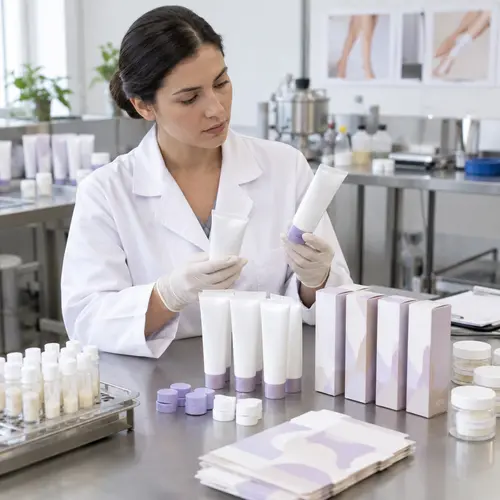
Packaging deforms: Tubes, caps, pouches, or cartridges may warp, soften, split, or lose decoration during storage and shipping. Failure often appears only after formula contact or carton compression, so component approval alone is insufficient.
Production differs from the approved sample: This usually reflects uncontrolled raw-material substitutions, process variation, or unclear acceptance limits. Purchase documents should define acceptable ranges for color, odor, viscosity, fill weight, and functional performance, plus the procedure for handling an out-of-range batch.
Supplier Checklist
- Confirm experience with depilatory creams, wax strips, sugar wax, roll-on cartridges, and aftercare products relevant to the planned range.
- Request a written sample scope showing included variants, packaging options, customization limits, fees, and ownership of custom work.
- Set measurable acceptance criteria for texture, viscosity or melting behavior, color, odor, removal performance, residue, and rinse feel.
- Ask for ingredient documentation, finished-product specifications, batch records, safety data where relevant, and labeling support documents.
- Verify that irritation-risk evaluation matches the intended body area, directions, contact time, and target user.
- Review formula-to-package suitability, decoration durability, fill accuracy, closure performance, and transport resilience.
- Obtain a separated BOM and logistics estimate showing tooling, printing, assembly, cartons, pallets, freight assumptions, and recurring charges.
- Clarify MOQs for bulk, each package component, each artwork version, and each finished SKU.
- Ask how approved specifications are transferred to production and how deviations, rework, or rejected goods are managed.
- Assess whether the account contact can translate social-media goals into measurable product requirements instead of relying on subjective descriptions.
- Review capacity by line, normal lead-time assumptions, surge options, material reservations, and scheduling priority during peak periods.
- Where useful, compare the supplier’s hair-removal product range, OEM and ODM services, and manufacturing process before issuing an RFQ.
FAQ
Can a Chinese OEM copy my idea or sell my custom formula to another buyer?
No contract can eliminate every commercial risk. Use a signed confidentiality and development agreement that defines ownership of briefs, custom formulas, artwork, molds, and test results. Ask whether the base formula is stock, semi-custom, or exclusive, and specify any market, channel, or time-limited exclusivity in writing.
How can I know whether the texture and color will look dramatic enough on video?
Provide reference footage, lighting conditions, background color, application thickness, and the visual moment that matters. Review the physical sample under your actual filming setup. On-screen impact should still remain compatible with safe directions, stable color, reliable dispensing, and consistent removal.
Can quality control guarantee that no customer will have a severe reaction?
No responsible supplier can promise zero reactions. Risk can be reduced through suitable ingredients, controlled production, intended-use assessment, clear warnings, traceable batches, and documented complaint handling. Do not market a body formula for facial use unless that use has been specifically evaluated.
What if I do not understand technical ingredient terminology?
A capable project contact should convert marketing goals into testable requirements and explain tradeoffs in plain English. Ask for a one-page specification summary covering performance, texture, odor, packaging, claims, and acceptance limits before each revision.
What happens if a video creates a sudden order surge?
Ask for written capacity scenarios before launch. Confirm available line capacity, critical component lead times, raw-material reservation options, reorder quantities, and whether forecast commitments affect scheduling priority. Packaging often limits replenishment faster than bulk cream production.
Should I approve the lowest MOQ available?
Not automatically. A low finished-goods MOQ may still require full payment for custom tubes, labels, cartons, or wax-strip pouches. Compare total committed inventory, unit cost, storage exposure, and likely reorder timing rather than evaluating one MOQ figure.