Hair Removal Products for Distributors: Formula and Packaging Decisions Across Markets
Direct Answer
For distributors building a cross-market range, the best hair removal products for distributors are not simply the formulas with the broadest claims. They are products whose texture, pack, instructions, storage profile, and documentation work together in the intended sales region.
Start with a focused system: one hero removal format, one sensitive-positioned option, and one aftercare SKU. Define the target market before approving fragrance, application time, tube material, wax cartridge, or label copy. Then review formula specifications, packaging compatibility, heat and cold storage, leakage, irritation risk, and shipment conditions as one approval track.
A capable hair removal OEM manufacturer should provide sample specifications, a clear BOM, pack options, test scope, and market-specific label files before production. For creator-led launches, a seven-day sample target and a pilot run from 1,000 units can keep content planning aligned with product readiness without treating speed as a substitute for verification.
Key Takeaways for Private Label Buyers
- Select the market and sales channel before locking the formula, claims, fragrance, or pack size.
- Approve measurable texture criteria, not only a visually attractive first sample.
- Test the filled product in its final tube, jar, pouch, strip sachet, or roll-on cartridge.
- Review irritation risk, directions, warnings, and removal time together.
- Run heat, cold, leakage, and transport checks before approving printed packaging.
- Keep the pilot BOM and scaled-production BOM identical unless a change is documented and reapproved.

Buyer Context
Hair removal is a system category. A depilatory cream can perform well but fail commercially because the tube panel cracks, the cap seal leaks, or the instructions understate the importance of timing. Wax strips may look simple, yet strip adhesion, nonwoven strength, release behavior, sachet sealing, and storage temperature all affect the user experience. Sugar wax can change handling characteristics after warm transit. Roll-on wax can leak around the roller housing if the cartridge and formula expand differently under heat.
This matters more for distributors serving several markets. Climate, language, permitted claims, ingredient restrictions, retail dimensions, and consumer habits may differ. The European Commission CosIng ingredient database is a useful starting point for EU ingredient functions and restrictions. In the United States, buyers should also understand the FDA position on how cosmetics are regulated; cosmetic products are generally not preapproved by FDA, so responsible documentation and labeling remain essential.
A concise range is easier to validate and explain on camera. Buyers can compare formats through the hair removal product solutions hub, then use custom hair removal product development to define the sample brief, packaging route, and launch market.
Technical and Packaging Factors
Formula behavior must be observable
For depilatory cream, record appearance, odor, spread, viscosity range, application thickness, removal time, and rinse behavior. The formula is typically alkaline, making pH control and package compatibility especially important. A result that works on one hair type should not be presented as universal. Buyers evaluating a custom depilatory cream formulation should request controlled sample comparisons across intended use areas and defined contact times.
For hot wax, sugar wax, and roll-on wax, specify the usable temperature window, flow, stringing, pickup, residue, and removal behavior. A highly fluid wax may look dramatic in a short video but create drips during normal use. A firmer wax can improve control while requiring more careful heating directions. Wax strip review should include adhesion aging, strip separation, residue, grip-tab handling, and performance after warm storage. Relevant testing methods and cosmetic science discussions can be tracked through the International Journal of Cosmetic Science.
Packaging is part of the formula approval
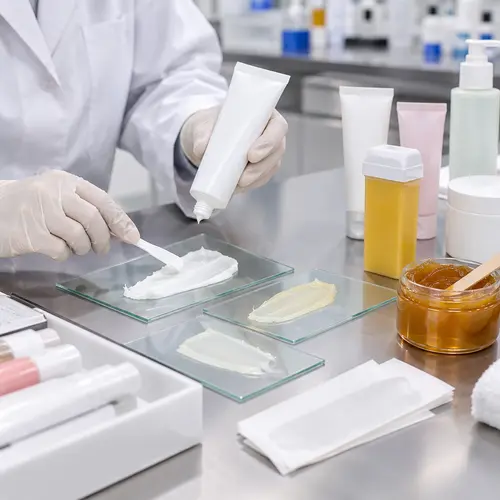
Do not approve bulk formula and packaging separately. Fill the final pack and evaluate it as a unit. Depilatory cream tubes require review of the tube wall, shoulder, cap liner, orifice, crimp, print resistance, and dispensing force. Wax jars need lid-torque and leakage checks. Roll-on cartridges need heated inversion testing around the roller and neck. Wax strip sachets need seal-integrity and oil-migration review. Aftercare pumps should be checked for priming, clogging, dose consistency, and leakage.
The review should cover ambient storage, 40°C accelerated storage, 4°C cold storage, and at least three freeze-thaw cycles when relevant to the shipment route. These are screening conditions, not universal acceptance standards. The final plan should reflect the formula, pack, expected shelf life, and destination climate. The documented hair removal manufacturing process should show where compatibility, filling, coding, inspection, and release decisions occur.
Safety language must match product use
Fast removal claims can encourage overexposure if directions are unclear. Review application area, maximum contact time, repeat-use interval, patch directions, contraindications, rinse instructions, and actions for discomfort. Sensitive positioning should be supported by a mildness-focused formula review rather than fragrance removal alone. The mild hair removal formula route can be evaluated alongside standard cream, but neither should use absolute no-irritation language.
Aftercare can improve range logic without implying that it corrects unsafe removal. A calming gel or lotion should be compatible with freshly depilated skin and packaged for clean dispensing. Buyers can compare after wax care products or a complementary after hair removal serum when building a two-step kit.
Decision Framework
| Factor | What to Check | Why It Matters | ODM Buyer Note |
|---|---|---|---|
| Market | Ingredient status, claims, language, responsible-party details, and label format | A single global label may not satisfy every destination | Approve market-specific artwork before print release |
| Formula | pH, viscosity, odor, color, application time, rinse or removal behavior | Defines safety, consistency, and camera-visible performance | Keep a signed reference sample and specification |
| Wax performance | Usable temperature, flow, adhesion, residue, strip strength, and reheating behavior | Warm transit and repeated heating can change handling | Review custom wax strips and hot wax in final packs |
| Pack compatibility | Leakage, paneling, swelling, cracking, seal integrity, print resistance, and dispensing | The pack can fail even when bulk material remains stable | Test decorated production-intent components |
| Storage and shipment | Heat, cold, freeze-thaw exposure, carton fit, orientation, and transit leakage | Distributor inventory may cross several climates | Define shipment conditions and rejection criteria in writing |
| Sampling | Sample quantity, fragrance options, pack mockups, test scope, and revision limits | Prevents repeated subjective sampling rounds | Use a visual brief plus measurable acceptance criteria |
| Commercial readiness | MOQ, BOM, lead time, coding, case pack, documents, and scale plan | Protects margin and launch timing | Use a hair removal product RFQ with target market and forecast |

ODM Manufacturing Considerations
For hair removal products for distributors, ODM approval should move through defined gates rather than a general sample sign-off. The buyer should confirm what the sample represents: an existing base formula, a modified base, or a fully custom formula. Record the approved color, fragrance, texture, application feel, removal performance, residue level, and appearance after use. Photos and videos can support the record, but a retained physical sample and written specification are more reliable references for production.
Customization should begin with the intended user and application area. A face depilatory cream, body cream, hard wax, sugar wax, strip wax, and aftercare product require different performance expectations. Ask the supplier to define measurable acceptance ranges for viscosity or melting point where relevant. Also document spreading behavior, working time, hair-grip performance, rinse-off characteristics, and any fragrance limits. If dramatic texture or color is important for social content, evaluate it under the lighting, camera settings, application thickness, and room conditions used by the brand.
Packaging compatibility must be reviewed as a complete pack, including the product-contact material, closure, liner, applicator, label, and secondary carton. Buyers should inspect filled packs for swelling, softening, discoloration, poor closure fit, seepage, and label lifting. Decorative finishes also need attention because wax residue, oils, heat, or rubbing during transport can change their appearance. Review components from the proposed production vendor rather than assuming visually similar packaging will behave identically.
The stability review should reflect the expected market and distribution route. Agree on storage conditions, review intervals, pass criteria, and retained-sample responsibilities before issuing a purchase order. Evaluation should cover odor, color, texture, phase uniformity, pack shape, closure performance, and application behavior. Stability work reduces uncertainty, but it cannot prove that no user will ever experience irritation. Fragrance load, application area, contact time, warnings, and directions all require an irritation-risk review.
MOQ discussions should separate formula MOQ, component MOQ, printing MOQ, and finished-goods MOQ. A low filling quantity may still require the buyer to purchase excess cartridges, sachets, cartons, or decorated containers. Request an itemized BOM showing formula, primary pack, decoration, carton, testing, assembly, and freight assumptions. This makes hidden cost differences easier to identify and helps distributors compare custom manufacturing with stock packaging.
Before production, confirm the available labeling documents, ingredient list format, batch coding method, shelf-life basis, product specifications, and safety support files. Ingredient naming and restrictions for European sales can be checked through the European Commission CosIng ingredient database. For the United States, buyers should understand that cosmetics are regulated but are generally not approved before sale, as explained in the FDA overview of its authority over cosmetics.
Shipment planning should state carton count, pallet pattern if used, storage limits, orientation requirements, destination climate, and responsibility for freight damage. Wax and cream products may encounter prolonged heat, cold, or vibration in transit. Ask how cartons are selected, how empty space is controlled, and how the supplier handles a damaged-arrival claim. Related capabilities can be compared through the supplier’s OEM/ODM service scope and manufacturing process.

Common Problems or Failure Cases
Wax becomes brittle: Hard wax may crack instead of flexing when its formula, use temperature, application thickness, or storage history falls outside the approved range. Buyers should compare break pattern, edge flexibility, and hair pickup against the retained sample.
Strip adhesion declines: Pre-coated strips can lose grip or transfer unevenly because of aging, contamination, unsuitable storage, or changes in the backing material. Inspect peel behavior, coating uniformity, residue, and removal performance across several packs and batch positions.
Depilatory cream separates: A watery layer, grainy texture, or major viscosity shift can indicate instability or exposure to unsuitable conditions. Do not accept remixing as the default solution. Record the batch, storage history, package type, and time since filling so the manufacturer can investigate the pattern.
Roll-on cartridges leak: Leakage may originate from the roller fit, cap engagement, filling level, component variation, or deformation during transport. Examine whether residue appears around the roller, neck, cap, or carton and provide clear photographs by batch.
Fragrance causes complaints: A scent that performs well in a brief sample review may feel overpowering during application or bother fragrance-sensitive users. Confirm fragrance strength after storage and ensure directions and warnings are appropriate for the intended body area.
Packaging deforms: Jars, cartridges, or closures can warp, dent, or lose sealing pressure after exposure to demanding shipment conditions. Component substitutions made after approval are a frequent source of avoidable differences, so substitutions should require written buyer authorization.
Supplier Checklist
- Identify whether each SKU uses a stock, modified, or custom formula and establish ownership terms in writing.
- Request a signed specification covering appearance, odor, color, viscosity or melting point where relevant, fill quantity, and performance criteria.
- Compare the approved sample with a pre-shipment unit from the finished batch.
- Confirm irritation-risk review, intended application area, contact time, directions, warnings, and patch-test language where appropriate.
- Verify the exact primary pack, closure, label material, carton, decoration, and approved component vendors.
- Review stability scope, acceptance criteria, records, deviations, and retained-sample availability.
- Separate all MOQs and request a transparent BOM plus estimated freight assumptions.
- Check ingredient, specification, batch, shelf-life, labeling, and shipment documents needed by each destination market.
- Ask for normal output, peak output, lead-time assumptions, and the process for reserving capacity.
- Define complaint handling, traceability, replacement responsibility, and investigation timelines in the supply agreement.

FAQ
Can a Chinese OEM use my idea or custom formula for another brand?
No supplier can make a credible zero-risk promise. Reduce exposure with a mutual confidentiality agreement, written formula-ownership terms, restricted sample access, component and artwork controls, and a clause covering unauthorized sale or disclosure. Clarify whether the core formula is supplier-owned, jointly developed, or exclusive to your brand and market.
How can I confirm that the sample will look dramatic enough on camera?
Send visual references and define observable targets such as color intensity, stringiness, gloss, spread, strip pull, and residue. Film the sample using your normal lighting and application method. Approve both a retained physical unit and a short visual standard instead of relying on descriptive words such as rich or bold.
Can quality control guarantee that followers will never have a bad reaction?
No. Manufacturing controls can reduce variation and identify obvious defects, but they cannot eliminate individual sensitivity or misuse. Review ingredients, fragrance, intended body area, contact time, warnings, directions, complaint handling, and batch traceability. Avoid claims that imply universal tolerance.
What if I do not understand technical ingredient language?
A capable account team should translate marketing goals into testable product requirements. Ask the supplier to restate requests in plain English and confirm them in a written brief. Terms such as fast-melting, camera-visible, low-residue, or easy-rinse should each be linked to a sample observation or measurable specification.
What happens if a video creates a sudden order spike?
Ask for documented normal and peak monthly output by product type, component lead times, labor constraints, and capacity-reservation options. Confirm whether repeat orders receive protected scheduling and whether packaging inventory can be held. Forecast scenarios should include both finished-goods demand and long-lead printed components.
Should every market receive the same formula and label?
Not automatically. Climate, fragrance preference, use habits, ingredient restrictions, required language, warnings, and distributor documentation can differ. Keep a controlled SKU matrix showing which formula, pack, artwork, and shipment specification applies to each market.