Hard Wax vs Soft Wax: The Direct Answer
Hard wax vs soft wax is not a brand-positioning question. It is a removal-mechanics question, and it cascades through your entire SKU. Hard wax sets into a flexible film that grips the hair shaft and lifts away without a strip; it goes on warm, in a thick layer, and is reheated in a professional pot or a small consumer warmer. Soft wax stays tacky, goes on thin, and is pulled off with a cloth or nonwoven strip pressed over it. That difference decides who the product is for (salon professional or first-time home user), which heating hardware you design around, what packaging survives a parcel network, and how much aftercare the kit must carry. Neither format is superior. The right pick depends on your buyer’s skill level, your heating accessory, and your fulfillment route. The checks below keep that decision from turning into a reformulation or a leakage claim six weeks after launch.
Key Takeaways for Private Label Buyers
- Format follows the removal method, not the marketing. Hard wax needs no strip and tolerates a thick, slow application; soft wax needs a strip, a thin film, and a fast pull. Match the format to the skill level of the person holding the spatula.
- Heating hardware is part of the SKU. If the kit ships a warmer, the wax melt point and the warmer wattage must be validated together before you commit to a tooling order.
- Texture is a spec, not a mood. Grip, film flexibility, and cooling speed should be written into the sample approval sheet, with a photo or short clip attached to the signed standard.
- Packaging compatibility gets its own test. Wax at 60-70 degrees C is an aggressive load. Jar threads, tin liners, and cartridge valves need a hot-fill and transit check, not just a room-temperature compatibility note.
- Sample scope should mirror production. Ask for the pilot run to be made on the same line, with the same formula, that will produce your scale-up batch.
- Ship-season testing beats lab-only data. Summer parcel routes and unheated warehouses break more wax SKUs than any formula flaw.
Why This Choice Shapes the Whole Product Line
Waxing is a category where the buyer experience is almost entirely tactile. A consumer cannot evaluate the product in a photo; they judge it on how it smells when it melts, whether it grabs fine hair on the first pass, and whether the residue comes off the skin with the enclosed wipe. That makes the texture decision commercially load-bearing. It also explains why the category splits so cleanly: a salon operator buying hard wax in bulk and a subscription buyer receiving a travel-size waxing kit are solving different problems, and one formula cannot serve both without compromise.
For founders building a line rather than a single item, the practical move is to treat wax as a small family: a hard wax bead or tin for precision areas, a soft wax strip or roll-on cartridge for legs and arms, and an aftercare item that ties the kit together. Buyers exploring that structure usually start with our hot wax OEM manufacturer page, then look at waxing product solutions to see how kits are assembled for different retail channels. The mistake to avoid is launching one format and adding the second eighteen months later, after the packaging tooling is already paid for. Decide the family at the brief stage.
There is also a documentation angle. Every market you sell into expects a product information file, ingredient disclosure, and a batch-linked label. Our waxing and depilatory guides cover the labels buyers most often get wrong, and the base expectations sit with the EU Cosmetics Regulation for European listings and with MoCRA for US listings. None of that changes between hard and soft wax, but the ingredient list does, and the claims on the front of the pack must match it.
Technical and Packaging Factors That Decide the SKU
Melting point and working temperature
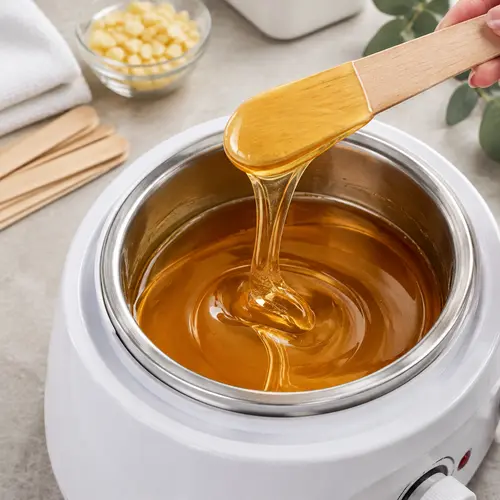
Hard waxes typically melt in the 45-55 degrees C band and are applied at roughly 38-42 degrees C, cool enough to sit on skin without a burn risk when the film is tested at the correct thickness. Soft waxes are heated higher, often 55-65 degrees C, and applied thinner, which means the burn exposure is a function of film thickness as much as temperature. Write both the melt point and the intended application temperature into the spec sheet, and require the supplier to show you a viscosity curve across the working range, not a single number. Consumers reheat wax badly, so a formula that stays workable across a fifteen-minute window causes far fewer complaints than one that is perfect at exactly one temperature.
Texture, grip, and removal behavior
Hard wax should pull into a pliable film that flexes rather than shatters. A brittle film cracks at the edges and leaves fragments behind; an over-plasticized film slides instead of gripping. Ask for a removal demonstration on a hair swatch at three film thicknesses. Soft wax is the opposite discipline: it must stay tacky long enough to bond to the strip but release cleanly from the skin, and the strip fabric weight drives that behavior as much as the wax does. A comparison of two strip weights in your sample box will tell you more than any data sheet.
Packaging compatibility and leakage
Hot fill is where wax SKUs fail. Jars need a liner and thread geometry that tolerate a warm, oily load and a cooling shrink; tins need a coated interior to resist rosin staining; roll-on cartridges need a valve and cap checked at 45 degrees C for a minimum of 48 hours, then in a drop test. Ask specifically for a leakage review on cartridges after transit simulation, and confirm the cap torque figure in writing. For a wider view of how those steps sequence, see the cosmetic filling and packaging process and the related private label depilatory products service scope.
Storage, stability, and labeling
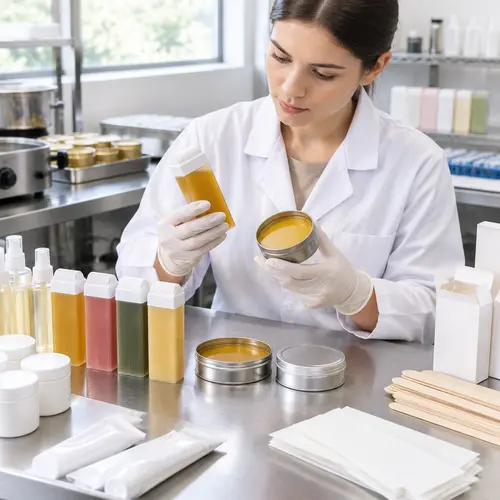
A sensible screening protocol is twelve weeks accelerated at 40 degrees C plus three freeze-thaw cycles, checked for phase separation, graininess, color drift, and odor change. Waxes that survive this usually survive a warehouse summer. Labeling follows the same logic: storage temperature, batch code, and use-by date must be legible after the pack has been handled. Sensitive-skin positioning needs a supporting irritation review and a 24-48 hour patch test instruction printed on the carton, not buried in a leaflet. Buyers building that variant should read our low irritation hair removal products notes before finalizing claims.
Sampling and scale-up
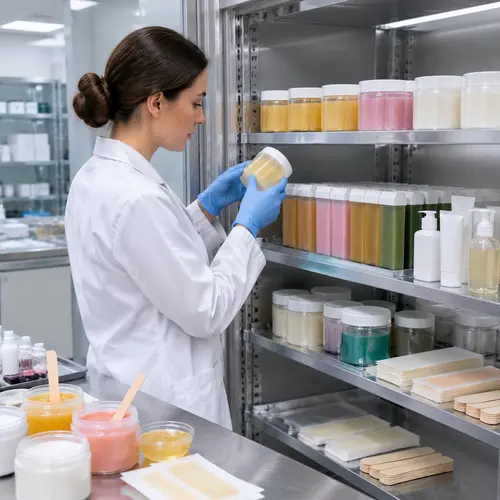
The sample is where trust is built or lost. Request a 7-day prototype window, a BOM with pack-out costs itemized, and confirmation that the pilot run of 1,000 units comes off the same line as your scale-up batch. Certifications such as Ecocert organic and natural cosmetic certification matter to some buyers and not others, so decide early whether the formula needs to be built toward that standard. If you want a second opinion on strip versus hard wax behavior in real use, this soft wax vs hard wax breakdown is a readable orientation for your content team.
Decision Framework
| Factor | What to Check | Why It Matters | ODM Buyer Note |
|---|---|---|---|
| Melt and application temperature | Melt point, working range, viscosity curve across 15 minutes | Drives burn risk, spatula behavior, and warmer wattage | Tie temperature to the bundled warmer, or omit the warmer |
| Texture and grip | Film flexibility, tack retention, residue on skin after removal | Determines first-pass hair pick-up and repeat purchase | Approve against a filmed removal demo, not a photo |
| Packaging compatibility | Hot-fill behavior, liner fit, cap torque, drop test at 45 degrees C | Prevents leakage claims and marketplace suspensions | Request the leakage review in writing before tooling |
| Stability and storage | 12-week accelerated run, 3 freeze-thaw cycles, odor and color check | Predicts performance through summer parcel routes | Ask which cycle failed, if any, and what changed |
| Sample and MOQ scope | 7-day prototype, itemized BOM, 1,000-unit pilot on the production line | Reveals whether the sample and the shipment will match | Confirm no reformulation between pilot and scale-up |
| Aftercare and kit logic | Soothing gel or lotion, wipe format, ingredient overlap with the wax | Raises perceived value and reduces post-use complaints | Source aftercare on the same PO to control freight |
The short version: choose the format your buyer can actually use well, build the packaging around heat, and lock the sample standard before you sign a tooling order. Everything else is downstream of those three decisions.
ODM Manufacturing Considerations for Wax and Waxing Product Lines
Choosing between hard wax vs soft wax settles the concept. The ODM stage decides whether that concept becomes a repeatable SKU or a series of batch complaints. Treat each step below as a sign-off gate, because most failures trace back to something approved verbally and never written down.
Sample confirmation and the master sample
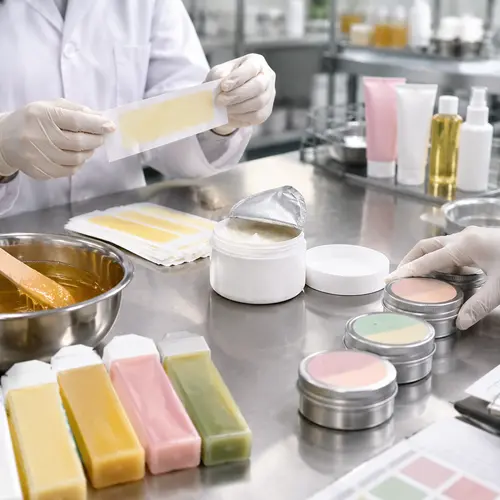
Ask for three things before bulk: a production sample pulled from the same line configuration that will run your order, a retained counter-sample sealed at the factory, and a signed specification sheet. The spec should state ranges, not single numbers: color tolerance, texture description, softening bracket, odor profile, adhesion on a hair swatch, and how the wax breaks when flexed. Hand-poured bench samples and tank-drawn line samples differ in pigment dispersion and set time, so confirm which one you actually approved.
If the launch depends on a specific look — matte finish, deep pigment, visible beans in a pot — inspect the sample under the light you will shoot in. A supplier with real OEM/ODM sampling support should be able to send a small shoot set beside the production sample.
Formula customization scope
Not every request carries equal risk. Changing colorant, shimmer level, or fragrance strength is usually a low-tier change confirmed on a pilot batch. Swapping the base resin, altering the oil phase, or replacing a preservative in a depilatory cream is a high-tier change that resets compatibility work. Ask for a written change matrix showing which adjustments keep existing test data and which restart it. That document also reveals whether you are being quoted a stock formula with a new label or a genuine build to the brand brief.
Packaging compatibility
Fill temperature drives most container problems. Thin-wall jars can warp at the shoulder, caps lose thread engagement after repeated hot cycles, and label adhesive lifts on a curved tin as it cools. For roll-on wax cartridges, confirm cap torque and roller retention against the exact shell you plan to use, not a catalog equivalent. For strip pouches, confirm seal integrity and stacking compression, since a pallet sitting in a warm container is a different test than a warehouse shelf.
Stability review and documentation
The useful output is a document package, not verbal assurance. Request the panel notes behind each check: color shift, odor drift, oil migration to the surface, and whether strip adhesion held. Confirm who signs release, which retention samples are kept, and how long they are held against batch code. Buyers with natural or organic positioning should confirm the certificate covers the finished product rather than the raw material alone — Ecocert sets out how scope is defined.
MOQ, labeling documents, and shipment conditions
Minimum order quantity is usually set by the base wax batch size, not by units, which is why a two-color range can cost less than two separate formulas. Ask how MOQ behaves when you split a run across a tin and a cartridge from one base. On labels you need ingredients in correct order, net weight, batch code, precaution text, and allergen declarations; the EU rules for cosmetic products are a reasonable baseline if you sell into Europe. Shipping matters as much as price: confirm pallet configuration, whether containers route through hot ports in summer, and who absorbs deformation or leakage claims on arrival.

Common Problems and Failure Cases
Most complaints in this category are predictable. Reading them as symptoms rather than defects makes the supplier conversation much faster.
Hard wax that shatters. A strip that cracks instead of lifting usually points to a base too resin-heavy for the room temperature where it is used, or a batch cooled too fast during fill. Check the softening bracket against the climate of the end market.
Adhesion loss on soft wax strips. If fabric peels away and leaves wax behind, suspect film thickness, fabric weight, or oil that migrated to the surface in storage. A formula that passed on a bench sample can fail after two months in a warm warehouse.
Depilatory cream separation. Phases drifting apart or a thin liquid layer on the surface is usually a temperature-cycling story rather than a mixing error. Confirm the emulsifier system tolerates the shipping route, not just the factory floor.
Cartridge leakage. Leaks at the cap or roller are almost always fill temperature, torque, or seal geometry. Pair the shell and cap you will actually buy, and ask what torque value the line records.
Fragrance sensitivity and pack deformation. Citrus top notes oxidize in storage and generate complaints in a real waxing service around the face, so keep allergen declarations accurate. Warped jar shoulders, wrinkled labels, and dented tins read as quality defects to a customer even when the wax inside is fine.
Supplier Checklist for Hair Removal OEM/ODM
- Production sample plus retained counter-sample, both signed against a written spec with ranges.
- Change matrix showing which formula adjustments require fresh stability and compatibility work.
- Compatibility report for your exact jar, tin, cartridge, or pouch — including fill temperature and cap torque.
- Stability documentation with panel notes, retention period, and named release signatory.
- Labeling support: ingredient order, allergen list, batch coding, and market-specific precaution text.
- MOQ stated per base formula and per SKU, with mixed-SKU rules in writing.
- Capacity disclosure: current line loading, repeat-order lead time, and what happens to your slot when a larger account books.
- Transparent BOM breakdown and a freight estimate that names the routing.
- Change-control clause covering base, fragrance, and packaging substitutions.
- Batch traceability from retention sample to shipment, plus a named contact for complaints.
FAQ
Will the factory take my formula or packaging concept and offer it to another client?
No agreement makes copying impossible, but the right terms make it expensive and traceable. Ask for exclusivity on your colorant and fragrance pairing for a defined period, ownership of any tooling you pay for, and written ownership of artwork. Buyers who worry about this should also keep one deliberately unusual element — a pigment, a finish, a custom tin — that a copy would have to match exactly.
My launch depends on how the product looks on camera. Can that be checked before bulk?
Yes, and it deserves its own sign-off. Photograph the production sample under your own lighting and compare matte versus gloss variants, pigment load, and surface texture in the pot. A wax that looks rich in a factory photo can read flat under ring light. As a rule, avoid borrowing language from hair styling wax marketing — depilatory texture photographs differently.
How do I limit damage if a batch causes irritation complaints?
Start with accurate labeling: correct ingredient order, declared allergens, and clear usage and patch-test guidance on the pack. Keep retention samples per batch so a complaint ties to a specific lot instead of a general apology. For waxing near the brow, follow established periorbital safety guidance from the American Academy of Ophthalmology and keep service instructions conservative about proximity to the lid margin.
What happens if a video goes viral and orders spike?
Ask before launch, not after. Request current line loading, a stated repeat-order lead time, and a written answer on whether your slot is protected when a bigger account books. Some suppliers hold a buffer of base wax for forecasting customers; many do not. A 30 to 60 day buffer of finished stock is cheaper than an apology video.
I do not know chemistry. Can I still brief a factory clearly?
You do not need to. Describe outcomes: how the wax should feel, how it should break, how it should look in the pot, and which market it sells into. A useful partner translates that into a spec sheet and returns with two or three options and their tradeoffs. A raw technical sheet with no plain-language summary tells you something about the working relationship. See how private label wax programs are typically scoped.
What is a realistic first order for a two-SKU launch?
Usually one base formula, two colorants, one or two pack formats, sized to the base batch minimum rather than two separate orders. That keeps production simple, reduces the number of stability files, and lets you test the market before committing to a second base.