Direct Answer
A standard depilatory cream formulation is usually optimized for fast, consistent removal on normal body skin. A sensitive-skin version is engineered around a narrower balance: sufficient hair breakdown, controlled contact time, lower sensory irritation, and better recovery after rinsing. It is not simply a standard formula with less active ingredient.
For private-label buyers, the decision should begin with target area, hair type, consumer profile, claim language, and expected use time. Standard creams often suit legs, arms, underarms, and coarse hair positioning. Sensitive formulas require closer review of alkalinity, fragrance, emollients, viscosity, application thickness, and packaging compatibility. A face product should never be created by relabeling a body cream.
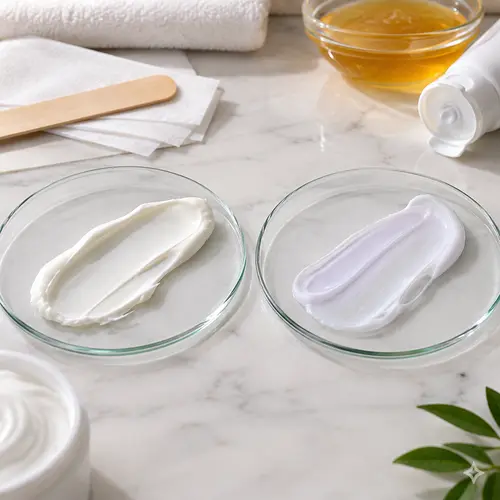
The best sourcing route is to compare both formulas through controlled removal tests, camera-visible texture samples, irritation-risk review, and accelerated storage checks before selecting packaging or approving claims.
Key Takeaways for Private Label Buyers
- Define the use case first. Specify body area, hair coarseness, contact-time goal, fragrance direction, and whether sensitive positioning is central or secondary.
- Judge the complete system. Thioglycolate level, alkalizing system, emollients, fragrance, viscosity, and application thickness work together. One ingredient does not determine mildness.
- Request measurable sample criteria. Approve pH, viscosity method, spread, odor, rinse feel, removal performance, and appearance under studio lighting.
- Test the final pack. Formula stability alone does not confirm tube, pump, liner, decoration, or closure compatibility.
- Keep claims market-specific. Ingredient acceptability, warnings, responsible-party details, and notification obligations vary across the United States, European Union, and Gulf markets.
- Plan scale before launch. Confirm that a 1,000-unit pilot can move into larger production without changing the approved formula, raw-material grade, or filling method.
Buyer Context
Hair removal products create an unusually visible trust equation. Consumers expect obvious results within minutes, yet discomfort, odor, uneven removal, or a leaking tube can become immediate social content. For a creator-led brand, the formula must perform off camera and present well on camera.
A standard cream typically supports broad-market positioning, faster perceived action, and coarse-hair removal. A sensitive cream may prioritize a softer after-feel, reduced fragrance load, controlled spread, and conservative use directions. Neither position is automatically better. The right choice depends on the audience and the content promise.
Buyers should compare prototypes through a structured custom depilatory cream formulation process rather than selecting from ingredient lists alone. Brands entering the category can also review broader depilatory product development solutions, including wax strips, sugar wax, roll-on wax, and aftercare. These formats have different irritation, storage, shipment, and demonstration profiles.
Speed still matters. A seven-day first-sample target can support a content calendar, but only when the brief is specific. Color reference, texture video, target pack, use area, benchmark product, market, and desired net weight should arrive together. A capable partner should translate these inputs into sample acceptance criteria through its hair removal OEM ODM services.

Technical and Packaging Factors
Hair Breakdown and Alkalinity
Most depilatory creams use a thioglycolate-based system in an alkaline environment to weaken hair so it can be wiped away. Finished products commonly sit around pH 11.5 to 12.5, although the correct specification depends on the complete formula and intended market. A lower number does not automatically mean a gentle product; it may also reduce removal consistency.
Ask the ODM to report pH at a defined temperature and compare results at release and during storage. The removal test should record hair type, application weight, contact time, removal method, and skin area. Without fixed conditions, comparisons between standard and sensitive samples are unreliable.
Texture, Coverage, and Camera Performance
A depilatory must remain where it is applied and maintain even contact with hair. If it is too fluid, it may run and produce patchy removal. If it is too dense, consumers may apply an insufficient layer or struggle to dispense it.
An illustrative filling target might be 30,000 to 80,000 cP, but that range is meaningful only when the test temperature, spindle, speed, and equipment are documented. Buyers should evaluate ribbon definition, vertical hold, spread, opacity, wipe-off, rinse residue, and nozzle cutoff. Review samples under bathroom lighting and studio lighting before signing the appearance standard.
Sensitive-Skin Design
Sensitive positioning normally requires several coordinated decisions: controlled alkalinity, reduced or carefully selected fragrance, supportive emollients, uniform coverage, clear maximum-use directions, and appropriate aftercare. A soothing additive cannot compensate for an aggressive base or excessive exposure.
Request a documented irritation-risk review and consumer patch-test directions. Face, bikini, underarm, and body claims should be assessed separately. Buyers developing a narrower-positioned SKU can review mild hair removal formula options and pair the cream with a soothing gel after hair removal.
Packaging Compatibility
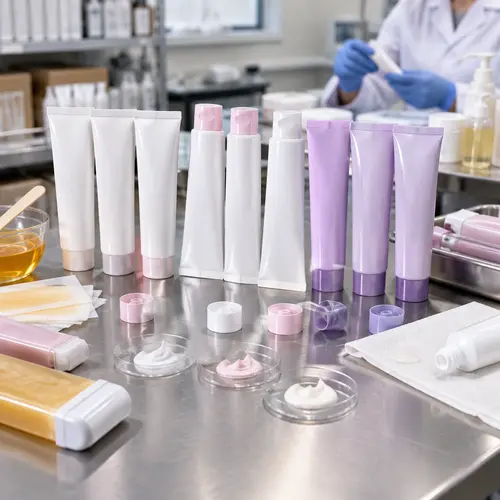
Alkaline creams can interact with metal components, liners, adhesives, inks, and decorative finishes. HDPE or compatible multilayer tubes are common starting points, but material names alone are not approval evidence. Test the actual decorated pack, closure, seal, and applicator with the final bulk.
Compatibility work should include upright and inverted storage at approximately 4°C, 25°C, and 40°C, plus leakage, paneling, swelling, seal integrity, odor migration, print resistance, and dispensing checks. Shipment simulation is especially important for warm routes and air freight. The expected checkpoints should appear in the depilatory product production process before artwork is locked.
Market and Label Review
Ingredient screening and label files must match the destination market. EU buyers can check ingredient functions through the European Commission’s CosIng ingredient database, while recognizing that a database listing does not replace a finished-product assessment. In the United States, the FDA explains that cosmetics are regulated but generally not pre-approved, except for applicable color additives, in its guidance on FDA authority over cosmetics. Responsible-party and facility obligations should also be checked against the FDA’s MoCRA information. Gulf launches should be reviewed against destination requirements and relevant GSO standards.
A practical dossier should cover ingredient naming, warnings, directions, batch coding, net contents, stability status, pack compatibility, and shipment conditions. These items can be scoped with a hair removal OEM manufacturer before sampling and confirmed through a hair removal product RFQ.
Decision Framework
| Factor | What to Check | Why It Matters | ODM Buyer Note |
|---|---|---|---|
| Target user | Skin profile, body area, hair coarseness | Determines performance and risk priorities | Do not combine face and body claims by default |
| Removal system | Active system, pH, contact-time instructions | Controls speed and removal consistency | Compare samples under fixed test conditions |
| Sensitive positioning | Fragrance, emollients, after-feel, warning text | Mildness depends on the complete product | Do not approve from a hero ingredient alone |
| Texture | Viscosity method, spread, vertical hold, rinse | Affects coverage, filling, and consumer use | Approve a physical standard and texture video |
| Packaging | Tube resin, liner, seal, closure, decoration | Prevents leakage, distortion, and print damage | Test the final decorated pack with final bulk |
| Storage | Cold, ambient, heat, inversion, shipment checks | Reveals separation and pack interaction | Define pass criteria before production |
| Launch readiness | Sample scope, MOQ, documents, scale plan | Reduces changes after content production | Confirm that pilot and scale formulas remain identical |
ODM Manufacturing Considerations
For a private-label depilatory cream project, sample approval should be treated as a controlled buyer decision rather than a simple color or fragrance preference. Ask the supplier to provide a written sample record covering formula version, intended use area, fragrance level, color, texture, application thickness, removal timing, and storage conditions. The approved reference should be retained by both parties so that later production can be compared against the same physical standard.
Formula customization may involve hair-removal strength, spreadability, fragrance intensity, skin-feel after removal, color, and the difference between face and body positioning. A standard body cream may prioritize fast coverage and a dense texture, while a sensitive-skin version generally needs a more conservative sensory profile and a clear irritation-risk review. Request a list of all ingredients, their function, permitted use level where applicable, and any restrictions associated with the destination market. The WXMO OEM and ODM services page can be used as an internal reference when comparing the scope of customization offered by different suppliers.
Packaging should be tested with the actual cream, not with water or an unrelated lotion. Check tube or jar material, inner coating, cap fit, nozzle size, label adhesion, print durability, and the effect of alkaline product contact on decorated surfaces. For a squeeze tube, confirm that the opening dispenses a controlled ribbon without clogging or sudden spurting. For a wax cartridge, inspect roller movement, seam quality, and leakage after storage in different orientations. Packaging samples should also be exposed to expected heat and cold conditions before artwork is finalized.
A stability review should cover appearance, odor, color, texture, separation, dispensing behavior, and closure condition over the planned storage period. Ask for observations at ambient, warm, and cold conditions, together with the test duration and acceptance criteria. The buyer should also request a shipment simulation that considers carton compression, vibration, temperature exposure, and the possibility of inverted storage. These checks are especially important for social-commerce brands that may ship individual units directly to consumers.
MOQ should be separated into sample quantity, printed packaging quantity, and finished-product production quantity. A supplier may accept a small formula sample while requiring a higher minimum for custom tubes, cartons, or decorated cartridges. Request a transparent BOM quote showing formula, filling, packaging, artwork setup, testing, labeling support, and freight assumptions as separate items. This helps identify hidden costs before the brand commits to a launch schedule.
Before shipment, request the documents needed for the target market, including the full ingredient declaration, product specifications, batch or lot identification approach, shelf-life information, packaging material details, safety handling information, and finished-product test records that the supplier normally provides. Requirements vary by country, so the buyer should confirm the final label and import documentation with its own local adviser. For US-facing products, review the FDA information on the Modernization of Cosmetics Regulation Act of 2022 and distinguish cosmetic labeling duties from unsupported performance claims.
Shipment conditions should be agreed in writing. Define acceptable temperature exposure, carton configuration, pallet or parcel requirements, protection against freezing or overheating, and the procedure for reporting damage. For Gulf destinations, the Gulf Standardization Organization framework may be relevant to market-entry review, while ingredient and product naming can also be checked against the European Commission’s CosIng ingredient database.
Review the manufacturing process with the supplier before approving the purchase order. The useful question is not only whether the factory can make the cream, but whether it can document what was approved, what will be filled, and what will be shipped.
Common Problems or Failure Cases
Wax brittleness: A wax strip or depilatory wax may become brittle after cold exposure, causing cracking during application or removal. Confirm the working temperature, storage range, strip substrate, and flexibility after shipment. A sample that performs well in a warm room may fail in a cooler warehouse.
Loss of strip adhesion: Wax strips can lose pickup performance when the wax layer is uneven, the backing absorbs too much product, or the package allows heat exposure. Check adhesion on the intended hair type and skin area, then repeat the check after storage and transport simulation.
Cream separation: A depilatory cream that separates, releases liquid, develops lumps, or changes odor is not ready for commercial release. Review the fill process, mixing uniformity, container compatibility, and storage history. The buyer should ask how out-of-specification units are identified and held before shipment.
Cartridge leakage: Roll-on wax cartridges may leak through the roller assembly, cap, weld, or end seal. Test upright and inverted units, inspect cartons for staining, and check whether the roller remains usable after storage. Do not approve packaging based only on an empty cartridge test.
Fragrance sensitivity: A strong fragrance can make a product feel more premium in a short video but can also create negative feedback from users who expect a milder experience. Ask for fragrance options, allergen information where relevant, and an unscented or lower-fragrance sample when the product is positioned for sensitive users.
Packaging deformation: Tubes, caps, pouches, and wax containers can soften, warp, or lose their printed appearance after heat exposure. A supplier should identify the package material, closure type, and expected temperature limits. Deformation is a product-quality issue as well as a presentation problem.
Supplier Checklist
- Can the supplier provide a numbered sample record and retain the approved reference?
- Does the formula brief clearly separate face, body, sensitive-skin, wax, and aftercare applications?
- Are formula changes documented with a new version number before production?
- Can the supplier provide ingredient, specification, labeling, and batch documentation for the destination market?
- Has the finished product been checked for separation, odor, color, texture, dispensing, and package condition?
- Has the actual product been tested in the proposed tube, cartridge, jar, strip pouch, or carton?
- Are MOQ, sample scope, printed packaging quantities, setup fees, and freight assumptions itemized?
- Does the quotation state lead times for samples, packaging, filling, inspection, and shipment?
- Can the factory explain how it handles rejected units, complaints, formula ownership, and confidentiality?
- Can production capacity be reserved or expanded if a social campaign creates an unexpected order increase?
- Does the account manager understand the brand’s content requirements, visual texture goals, and launch date?
FAQ
Could the factory copy my formula or sell my concept to another brand?
Reduce this risk with a signed confidentiality and ownership agreement before detailed development begins. Define who owns the custom formula, artwork, test records, and approved samples, and state whether the supplier may reuse any unique formula or visual concept. A clear version history and restricted access to brand files also make disputes easier to resolve.
Can the cream texture and color look dramatic enough on camera?
They can, but the visual effect must be tested in the actual camera setup. Ask for a sample showing ribbon formation, spread, coverage, removal, and post-removal appearance under the lighting used for content. Do not approve a formula solely from edited supplier footage; compare the physical sample, batch notes, and intended packaging.
How can I reduce the risk of a product causing severe customer complaints?
No supplier can guarantee zero reactions. Lower the risk through conservative claims, clear use instructions, patch-test guidance where appropriate, ingredient review, finished-product checks, retained samples, complaint handling, and documented release criteria. Ask how the factory investigates a failed unit and whether it can trace the relevant lot and packaging components.
Will the supplier understand social-media marketing requirements if I am not a chemist?
A capable account manager should translate marketing goals into testable product requirements. Describe the desired camera appearance, application speed, removal moment, fragrance impression, target body area, and content schedule. The supplier should return a written brief using plain language and identify which requests affect formula, packaging, cost, or lead time.
Can the factory keep up if a video suddenly drives a large order?
Ask for current filling capacity, packaging availability, planned maintenance periods, and the process for reserving production space. Separate the capacity of formula making, filling, printed packaging, inspection, and freight. A supplier that can offer a staged production plan or approved backup packaging option may reduce delay after an unexpected demand spike.
What should I do when the sample and mass-produced product feel different?
Compare both products against the approved sample record and retained reference. Check texture, color, odor, spread, removal performance, fill weight, and package dispensing. If the difference is material, pause release, document the affected lot, and request the supplier’s investigation before accepting replacement units.
References
European Commission’s CosIng ingredient database
Gulf Standardization Organization
FDA: Modernization of Cosmetics Regulation Act of 2022