Direct Answer
When developing private label hair removal products, buyers should define five variables before requesting samples: the removal method, target body area and skin profile, performance specification, packaging system, and launch-market compliance requirements. These decisions affect the formulation, texture, cost, stability plan, labeling file, and realistic launch date.
A depilatory cream for sensitive legs has a different risk profile from a roll-on wax cartridge for salon use. Wax strips require controlled adhesion and clean release, while sugar wax must remain workable across expected storage temperatures. The right development brief therefore describes measurable product behavior rather than only a color, fragrance, or reference product. A capable ODM partner can then match the concept to a validated formulation platform, test packaging compatibility, and provide samples that represent the eventual manufacturing process. For DTC brands moving quickly, this definition stage is where compliance, margin, and customer experience are either protected or quietly compromised.
Key Takeaways for Private Label Buyers
- Define the removal format first: depilatory cream, soft wax, hard wax, wax strips, sugar wax, roll-on wax, or a post-depilation care product.
- Write performance requirements in observable terms, including spreadability, setting time, adhesion, residue, scent intensity, rinse behavior, and after-feel.
- Approve the formula and packaging as one system. A compatible jar, tube, cartridge, or strip pouch is part of product performance, not an afterthought.
- Request stability, compatibility, leakage, and transport evidence that reflects the intended market and shipment conditions.
- Confirm the sample scope, pilot quantity, documentation package, and change-control process before approving a production formula.
- Build the launch schedule around labeling review and market requirements, including FDA-aligned documentation for the United States and CPNP preparation for the European Union.
Buyer Context
Hair removal is a performance-led cosmetics category. Customers notice immediately whether a cream removes hair evenly, whether a strip lifts without excessive residue, or whether wax remains usable after sitting in a warm bathroom. That direct feedback makes product development more demanding than simply selecting a pleasant texture and applying a label.
For a new DTC brand, the first run may be a controlled market test rather than a permanent global assortment. The product still needs a specification that can survive scale. A depilatory cream may need a defined viscosity window so it spreads evenly from a squeeze tube and does not separate during storage. A wax strip needs consistent wax loading, substrate strength, and peel behavior. A sugar wax may require a workable balance between firmness and pickup, especially when customers apply it without professional training.
These variables also shape brand positioning. Clean Beauty, vegan, cruelty-free, fragrance-free, and sensitive-skin claims require documented ingredient decisions and a review of the final label language. Buyers should distinguish between a marketing preference and a verified claim. An ingredient list, supplier statement, allergen review, and product safety file may all be needed before launch. The European Commission’s CosIng ingredient database can help buyers review ingredient names and regulatory context, but it does not replace a complete product safety assessment.
Compliance planning should run alongside formulation and packaging work. In the United States, cosmetics are regulated by the FDA, but they are generally not pre-approved by the agency. Buyers can review the FDA explanation of how cosmetics are regulated when setting expectations for records, safety substantiation, labeling, and responsible-person obligations. For a broader project view, buyers can also review hair removal product solutions by application and channel.
Speed matters because a trend-led launch can lose relevance while samples move through repeated revisions. At the same time, speed without a documented specification often creates a second delay: the sample looks right, but the filling process, package, or mass-production batch behaves differently. The development brief should close that gap from the beginning.

Technical or Packaging Factors
1. Formula behavior
Start with the user action. For depilatory cream, define application thickness, dwell-time target, rinse behavior, odor tolerance, and acceptable post-use feel. The formula should undergo an irritation-risk review appropriate to the intended body area and use instructions. Avoid treating a cream designed for legs as automatically suitable for the face, underarms, or bikini area. Those applications may require different substantiation, warnings, and consumer directions.
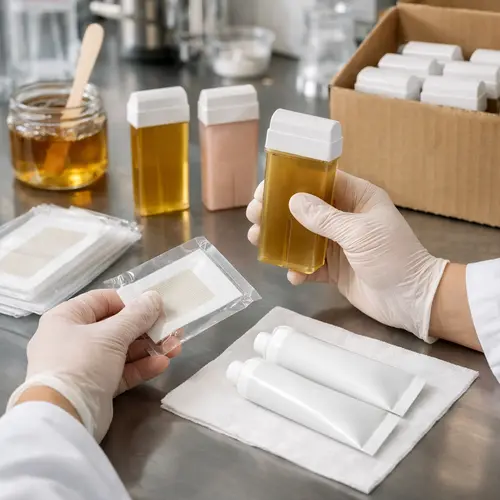
For wax products, specify the working temperature, melting behavior, pickup, setting time, flexibility, and residue level. A hot wax or sugar wax brief should state the expected melting range and heating method, while a soft wax brief should describe how it spreads and whether it is removed with strips. Roll-on wax cartridges need controlled viscosity and a roller head that delivers an even film without clogging or dripping. These are formulation and packaging decisions at the same time.
2. Packaging compatibility
Packaging must be tested with the actual formula, not only evaluated from a supplier catalog. For cream, review tube weld integrity, cap fit, dispensing force, and formula contact with the inner barrier. For wax, assess jar deformation, liner performance, closure torque, and heat exposure. A roll-on cartridge requires a leakage review in upright, inverted, and vibration conditions. Wax strips require pouch seals that protect adhesion from humidity and temperature swings.
Aftercare gels, calming lotions, or post-wax serums may be included as a kit, but each component should have its own compatibility and labeling review. A premium visual design cannot compensate for a cap that loosens in transit or a pouch that allows the strip adhesive to age prematurely. Buyers developing packaging concepts can use the hair removal manufacturing process as a reference for how sampling, filling, packaging, quality control, and shipment planning connect.
3. Stability and shipment conditions
Request a stability matrix that reflects the destination market, shipping route, and expected consumer storage. Review appearance, odor, color, viscosity, phase separation, pH where relevant, package weight loss, seal integrity, and dispensing performance. Include heat and cold exposure when the product may travel through seasonal temperature extremes. For wax and sugar wax, document whether the material becomes too fluid, crystallizes, or loses pickup performance. For cream, verify that viscosity and removal performance remain consistent after storage.
Shipment conditions should be written into the approval record: orientation, carton protection, temperature sensitivity, and whether air or ocean freight is planned. A product that passes a bench sample review can still fail after vibration, compression, or temperature cycling. The same principle applies to an aftercare kit assembled from multiple components.
Decision Framework Table
| Factor | What to Check | Why It Matters | ODM Buyer Note |
|---|---|---|---|
| Removal format | Cream, wax strips, hot wax, sugar wax, roll-on wax, or aftercare | Determines user technique, formula architecture, and instructions | Provide the target body area and home or salon use case before sampling |
| Texture and performance | Viscosity, spread, setting time, adhesion, residue, rinse behavior, and after-feel | Controls removal consistency and customer-perceived quality | Approve against a written specification, not a visual sample alone |
| Irritation-risk review | Ingredient profile, fragrance, intended skin area, directions, and warnings | Supports responsible positioning and reduces avoidable complaints | Review sensitive-skin positioning separately from general-use claims |
| Packaging compatibility | Tube, jar, pouch, cartridge, seal, closure, roller head, and contact materials | Prevents leakage, drying, separation, and dispensing failure | Test the final formula in the intended package before approval |
| Stability and transport | Heat, cold, vibration, seal integrity, appearance, odor, and viscosity | Connects laboratory performance with real shipment conditions | Match the plan to the destination, freight method, and seasonal route |
| Documentation | Ingredient list, specifications, safety records, claims support, and labeling review | Creates a usable compliance file for each market | Confirm document ownership, update rules, and change control in writing |
| Sampling and scale | Sample quantity, revision limit, pilot scope, and production equivalence | Prevents a gap between approved sample and launch inventory | Ask whether the pilot uses the same formulation and filling process planned for scale |
For buyers comparing possible development routes, the most useful question is not whether a supplier has a large catalog. It is whether the supplier can connect formulation, packaging, testing, documentation, and scale-up in one controlled workflow. PZIK’s vertically specialized library includes more than 800 baseline formulations, with over 150 supported by third-party clinical or instrumental validation, while its micro-batch GMP architecture supports pilot runs from 1,000 units and scale-up beyond 500,000 units per SKU without a planned formulation re-engineering step. Those figures should still be verified against the exact product, package, market, and claim set.
A buyer preparing a brief can begin with the hair removal OEM ODM services overview, then compare the technical requirements for a custom depilatory cream formulation, custom wax strips and hot wax, or low irritation hair removal products. For an assortment that includes recovery products, review post-depilation care OEM and post hair removal serum supplier options. The next stage should convert these choices into a controlled sample brief, testing plan, and launch document list.
ODM Manufacturing Considerations
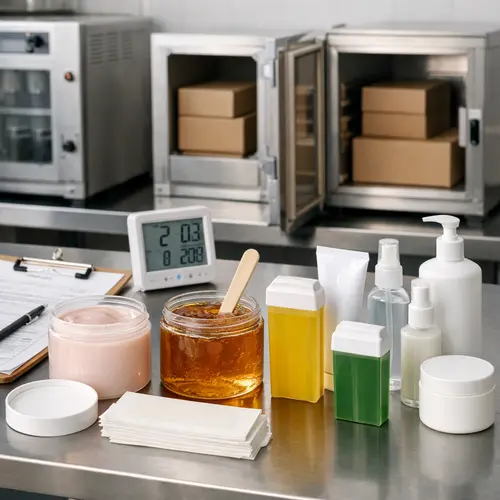
For private label hair removal products, development should be treated as a sequence of documented approvals rather than a single sample request. The buyer should first define the intended product format, target body area, user profile, fragrance position, sales market, pack size, and expected shelf life. These decisions affect the formula, label claims, filling method, packaging, and shipment plan.
Sample confirmation
A sample approval should record more than color and fragrance. Ask for the batch reference, formula version, texture description, fill weight, package specification, application instructions, and the acceptance criteria for the next pilot batch. For wax, confirm spreadability, setting behavior, working temperature, melting point range where relevant, and residue after removal. For depilatory cream, review viscosity, odor, application thickness, contact-time instructions, rinse behavior, and an irritation-risk assessment. A signed sample standard helps prevent the approved reference from changing during scale-up.
Formula customization
Customization may involve fragrance level, pigment shade, botanical positioning, wax hardness, sugar concentration, cream viscosity, or an aftercare format. Each change should be linked to a revised formula record and a new compatibility review. Buyers should request ingredient names using the applicable market convention, allergen information where required, and documentation supporting any sensitive claims such as fragrance-free, vegan, or cruelty-free. A ready formulation can shorten development, but it does not remove the need to confirm performance with the final package and label claims.
Packaging compatibility
Packaging must be evaluated with the actual product, not only with an empty component. Check whether depilatory cream attacks the tube shoulder, cap liner, or printed surface. For roll-on wax cartridges, inspect the roller fit, seal, cap, and orientation during storage. For wax strips, verify pouch seal strength, strip adhesion, release liner performance, and resistance to oil migration. Sugar wax may require a container that tolerates repeated opening and changes in consistency. Ask for filled-pack samples and retain samples from the approved configuration.
Stability, labeling, and shipment review
Request a written stability summary covering appearance, odor, texture, pH when relevant, separation, leakage, and package deformation. Heat and cold exposure should reflect the markets and transport routes where the product will be sold. Shipment planning should define carton configuration, pallet limits, orientation, temperature precautions, vibration exposure, and the response process for damaged units. Labeling documents should include the ingredient declaration, net contents, batch or lot coding, responsible-party information where applicable, warnings, directions, shelf-life or period-after-opening information, and supporting claim records. The hair removal development process should keep these records connected to the approved sample.
MOQ and commercial planning
MOQ should be discussed by SKU, fragrance, shade, package component, and printed artwork version. A lower initial quantity can carry higher component and setup costs, so calculate landed cost using formula, filling, packaging, testing, freight, inspection, and expected waste. Compare that cost with the planned retail price and customer acquisition cost before approving the concept. Ask whether components can be shared across related SKUs and whether a staged launch can reduce obsolete packaging. The manufacturing process overview should make the handoffs and approval points clear.

Common Problems or Failure Cases
Wax brittleness: A hard wax or strip wax may crack during removal when the formula, film thickness, cooling profile, or storage temperature is unsuitable. Evaluate a retained sample after warm and cool storage, then test the strip on the intended substrate and under the stated application conditions. Record whether the wax lifts cleanly or fragments.
Loss of strip adhesion: Wax strips can lose pickup performance when the wax migrates into the backing, the pouch seal permits moisture exchange, or the release liner is inconsistent. Check adhesion at the beginning and end of the stated shelf-life target, including after transport simulation. Do not approve based only on a fresh production sample.
Cream separation or thinning: A depilatory cream may separate, develop liquid at the surface, or lose body after temperature cycling. Review the emulsion system, preservative strategy, fill process, headspace, and tube compatibility. Confirm that the formula still spreads evenly and remains within its intended contact-time instructions after storage.
Roll-on cartridge leakage: Leakage may come from the roller assembly, cap seal, filling level, or carton orientation. Inspect cartridges in upright, horizontal, and inverted positions, then examine cartons after shipment simulation. Any residue around the roller should be distinguished from normal product transfer during use.
Fragrance sensitivity: A strong fragrance can increase complaints even when the hair-removal performance is acceptable. Ask for a fragrance allergen review, an unscented option, and clear usage warnings. Consumer testing should include odor perception and skin comfort, not only purchase preference.
Packaging deformation: Tubes, jars, pouches, and cartridges can soften, warp, or lose seal integrity in warm distribution environments. Review the filled package under realistic temperature exposure and stacking pressure. Environmental claims should also be checked against actual material specifications, recycled-content evidence, and available certification rather than broad wording.
Supplier Checklist
- Can the supplier provide a controlled sample record with formula version, fill weight, package specification, and acceptance criteria?
- Are wax melting point, working temperature, setting behavior, or cream viscosity documented where those properties affect use?
- Is there a documented irritation-risk and fragrance-allergen review for the intended application area?
- Has the final filled package been checked for leakage, seal integrity, adhesion retention, chemical compatibility, and deformation?
- Does the stability file cover appearance, odor, texture, separation, pH where relevant, and storage conditions?
- Can the supplier provide ingredient declarations, warnings, directions, lot coding details, claim support, and market-specific labeling documents?
- Is MOQ stated separately for formula, fragrance, shade, package component, and printed artwork?
- Are shipment conditions defined for temperature, orientation, carton loading, palletization, and damaged-goods handling?
- Can the supplier explain how NDA terms, formula ownership, artwork confidentiality, and competitor separation are handled?
- For environmental claims, are material sources, recycled content, chain-of-custody records, and recognized certifications available for review?
FAQ
Can an Asian supplier meet European and North American clean beauty or cruelty-free requirements?
Geographic location does not establish compliance. Ask for a restricted-substance policy, ingredient traceability, animal-testing position, supplier declarations, claim substantiation, and market-specific labeling review. Clean beauty is not one universal legal standard, so define the exact retailer or brand standard in the product brief and verify each claim against supporting records.
Will a low MOQ make the unit cost too high for customer acquisition costs?
It can, especially when custom components, multiple fragrances, short runs, and separate artwork versions are involved. Request a complete landed-cost model and separate one-time charges from recurring unit costs. Shared packaging, fewer variants, and a staged SKU launch can help determine whether the first quantity is commercially viable.
Will a turnkey or existing base formula make my product look identical to competitors?
Similarity risk depends on how much of the product is standardized. Ask which elements are fixed and which can be customized, including texture, wax hardness, fragrance, pigment, application format, packaging, and aftercare pairing. A differentiated brief, documented formula changes, distinctive pack architecture, and defensible claims can create a more specific market position than a generic base alone.
Can we sign a strict NDA before sharing our brand plan?
Discuss confidentiality before sending sensitive artwork, launch timing, customer data, or proprietary formula requirements. The agreement should identify confidential information, permitted use, disclosure exceptions, duration, ownership of buyer-created materials, and procedures for returning or destroying records. Formula ownership and exclusivity should be addressed separately when applicable.
How can we avoid greenwashing when selecting packaging?
Ask for the exact material specification, recycled-content percentage, certification or chain-of-custody evidence, recyclability conditions by market, and disposal instructions. Use narrow, verifiable wording on the label. A packaging claim should describe what the component actually contains or supports, not imply a broader environmental benefit without evidence.
Which regulatory references should be reviewed before artwork approval?
Review the applicable cosmetic rules for each destination market and match the ingredient declaration, warnings, directions, and claims to the finished formula. The European Commission’s CosIng ingredient database can support ingredient-name and regulatory research, while the FDA explanation of cosmetic regulation provides U.S. regulatory context. These resources do not replace a market-specific compliance review.
References
- European Commission’s CosIng ingredient database
- FDA Authority Over Cosmetics
- Cosmetic Ingredient Review Expert Panel safety assessments