Direct Answer
Back-bar products are built for trained operators, repeated service use, and high-throughput dispensing. Retail take-home products are designed for consumers who need smaller packs, simpler instructions, controlled dosing, and fewer opportunities for misuse. A strong salon retail hair removal products strategy should not place the same bulk formula into a smaller container without review.
The formula may remain closely related, but viscosity, working time, fragrance level, application tools, warnings, fill size, and packaging must match the use environment. Professional wax needs predictable melting and spread behavior across multiple appointments. A take-home depilatory cream needs clear timing, manageable dispensing, and packaging that limits contamination or overapplication. The most efficient sourcing model is a shared formula platform with format-specific testing, labels, and pack components. This reduces unnecessary redevelopment while protecting performance at the salon chair and in the consumer bathroom.

Key Takeaways for Private Label Buyers
- Source by use case. Define who applies the product, where it is used, and how often the pack will be opened before selecting a formula.
- Do not assume automatic pack transfer. A bulk jar, roll-on cartridge, tube, sachet, and wax-strip pouch create different leakage, evaporation, and dosing risks.
- Set measurable texture specifications. Record viscosity, spread, removal time, wax melting range, residue, and cooling behavior where relevant.
- Test the finished pack. Stability, transport, seal integrity, hot storage, cold storage, and dispensing checks should use production-intent components.
- Separate professional and consumer labels. Directions, warnings, body-area limits, patch-test language, batch coding, and responsible-party details must fit the market.
- Approve the camera view. Review color, pull, spread, residue, and packaging on video before signing off a creator-led launch.
Buyer Context
Salon products solve for operational consistency. A wax technician may open the same jar repeatedly, warm it for hours, and expect stable pickup from the first service to the last. Roll-on wax cartridges must heat evenly, move smoothly over skin, and remain sealed during storage. Wax strips need repeatable adhesion and clean separation. Aftercare needs fast spread, low tack, and packaging that can be handled during a busy appointment.
Retail products solve for interpretation. The consumer may use too much depilatory cream, exceed the stated contact time, store the product in a hot bathroom, or apply it to an unintended area. Instructions and dispensing therefore become part of product performance. Buyers evaluating depilatory cream OEM options should review removal timing, odor profile, rinse behavior, and viscosity alongside the ingredient list.
The commercial difference matters as well. Back-bar packs prioritize cost per service and fast handling. Retail packs must communicate value on a shelf or short-form video, survive individual shipment, and preserve margin after secondary packaging and fulfillment. A shared contract manufacturing project can include both formats, but each SKU needs its own bill of materials, pack compatibility record, artwork, and release specification.
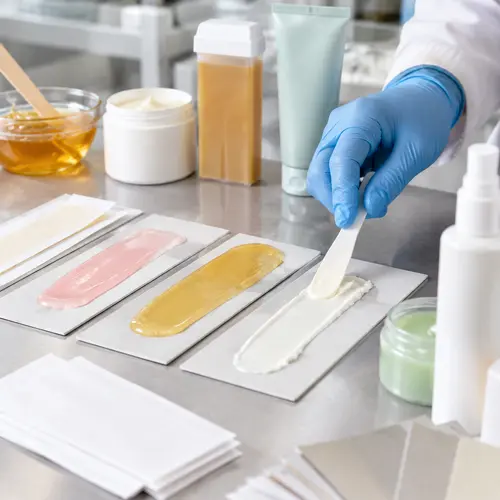
Start with a visual sample brief rather than a vague request for premium wax. Show the intended spread, stringing, strip pull, cream ribbon, or sugar wax consistency on camera. Ask whether the first sample can arrive within seven days, what is included in the sample scope, and which changes affect the BOM. The available hair removal OEM ODM services should be reviewed against that brief, not only against unit price.
Technical or Packaging Factors
Formula Behavior Must Match the Operator
For wax, define the melting and working-temperature range, pickup, spread thickness, cooling time, flexibility, breakage, and residue. The supplier should record these values as release targets rather than relying on subjective descriptions. For sugar wax, check firmness after warm storage and whether repeated opening changes water balance or grip.
For depilatory cream, evaluate removal performance on the intended body area, contact-time margin, odor, rinse-off, and viscosity after storage. Face and body positioning should not be treated as interchangeable. An irritation-risk review should cover directions, restricted areas, patch-test wording, fragrance, and likely consumer misuse. Buyers developing gentler positioning can compare sensitive skin hair removal products, but mild language still requires substantiation and careful labeling.
Packaging Is a Functional Component
A 500–1,000 mL professional pack may need a pump, wide opening, or heater-compatible jar. A 100–200 mL retail pack may favor a tube or controlled-orifice bottle. These are illustrative ranges, not universal standards. Confirm actual service count, dose, viscosity, and local label space before selecting volume.
For roll-on wax, test cartridge fit, roller movement, cap retention, and leakage while upright, horizontal, and inverted. For hot wax, check jar distortion and closure performance near expected storage and working conditions. Wax-strip pouches need seal integrity and aging checks because adhesive behavior can shift under heat. Buyers can compare format options through private label waxing products and pair them with post-depilation care OEM formats.
Storage Testing Must Use the Final Pack
A practical screening plan may include 8–12 weeks at 40°C, a package challenge at 45°C, and three freeze-thaw cycles. Conditions should be adjusted for the formula, destination market, and shipment route. Accelerated screening alone does not establish the full shelf life; it identifies early risks such as separation, viscosity drift, fragrance loss, seal failure, roller blockage, or leakage.
Review the supplier’s hair removal manufacturing process for sampling, filling, coding, inspection, and retained samples. Ingredient naming can be checked through the INCI ingredient nomenclature database. US-facing artwork should reflect current FDA cosmetics requirements and avoid implying that ordinary cosmetics receive FDA preapproval. Natural or organic positioning should be assessed against a defined standard such as Ecocert organic and natural cosmetic certification, rather than treated as a flexible marketing phrase.

Decision Framework
| Factor | What to Check | Why It Matters | ODM Buyer Note |
|---|---|---|---|
| User | Professional application or unsupervised home use | Changes dosing, instructions, warnings, and error tolerance | Create separate use briefs before sampling |
| Formula | Viscosity, melting range, spread, removal time, residue, and odor | Defines service speed and consumer experience | Approve measurable limits and visual references |
| Primary pack | Material compatibility, closure, dispensing, heat response, and leakage | The pack can alter stability and application | Test production-intent components with the actual formula |
| Storage | Heat, cold, cycling, orientation, and transport vibration | Exposes separation, seal failure, and texture drift | Match testing to destination and shipment conditions |
| Label | Directions, timing, restricted areas, warnings, INCI list, and coding | Reduces misuse and supports market access | Review professional and retail artwork separately |
| Launch scope | MOQ, sample revisions, BOM, tooling, lead time, and scale-up plan | Protects the content calendar and working capital | Use get a private label sample requirements to request a written scope |
Before approval, compare the finished samples under salon lighting, bathroom lighting, and the camera setup used for launch content. Supplement supplier claims with practical hair removal product guides, then sign off the formula, pack, label, shipment condition, and retained-sample plan as one system.
ODM Manufacturing Considerations
For salon retail hair removal products, ODM planning should convert the approved concept into measurable standards for the formula, packaging, labeling, production, and shipment. A visual sample alone is insufficient because color, texture, fragrance, and removal performance can change when batch size, filling equipment, or packaging components change.
Sample Confirmation and Formula Customization
Define what each sample round is intended to confirm. Early samples may establish texture, spread, fragrance direction, and residue level. The final approved sample should become the reference standard, supported by written specifications for appearance, odor, viscosity range, net content, and any relevant softening or melting-point range.
Clarify whether the project uses a supplier base formula, a modified platform, or a fully customized formula. This distinction affects MOQ, testing scope, lead time, ownership, and future supplier transfer options. The manufacturing agreement should identify who owns the approved formula, whether it is exclusive, and whether the factory may offer substantially similar versions to other buyers.
Buyers should also request a transparent BOM showing formula cost, primary packaging, secondary packaging, decoration, testing, cartons, and expected logistics charges. This makes cost changes easier to trace when fragrance, wax composition, applicators, or pack finishes are revised.
Packaging, Stability, and Shipment Readiness
Compatibility work should use the selected container, closure, liner, applicator, label stock, and decoration. Check closure torque, seal integrity, label lifting, component swelling, product migration, and dispensing consistency after hot and cold storage. For wax strips, confirm that the pouch protects the coated strips without transferring oil or fragrance to printed surfaces. For depilatory cream, confirm that the pack dispenses the intended dose without drawing air back into the container.
Stability review should record appearance, odor, viscosity, separation, weight change, and package condition at defined intervals. Acceptance limits should be agreed before testing begins. A vague result such as ‘looks fine’ is not a release specification.
MOQ discussions should separate bulk-formula MOQ from decorated-component MOQ. A factory may accept a modest filling run while the tube printer, cartridge producer, or carton converter requires a larger commitment. Ask whether unused components will be stored, invoiced, or discarded and how long they can remain usable.
Before production, collect the ingredient list, batch coding format, product specifications, safety documentation, artwork approval, and test summaries needed for the target market. For U.S. cosmetic positioning, avoid artwork that implies government preapproval; the FDA explains that cosmetics generally do not receive premarket approval, with limited exceptions such as certain color additives. Shipment planning should document carton strength, inner dividers, pallet pattern, temperature exposure expectations, container orientation, and procedures for damaged or leaking cases.
Related capabilities can be reviewed through the supplier’s OEM and ODM services, hair removal product categories, and manufacturing process pages.

Common Problems or Failure Cases
- Wax becomes brittle: Hard wax may crack during application or removal when the resin and plasticizing balance does not suit the expected room temperature. Compare retained batches against the approved flexibility and softening specifications.
- Strip adhesion declines: Coated strips can lose grip, become oily, or leave excess residue. Investigate coating weight, pouch barrier performance, storage exposure, and the consistency of the nonwoven material.
- Depilatory cream separates: Water release, graininess, or thinning can appear after storage. Hold production if viscosity, odor, or homogeneity moves beyond the approved limits, even when the cream can be remixed by shaking.
- Cartridges leak: Leakage may arise from poor cap fit, damaged roller components, incorrect filling temperature, or pressure changes in transit. Test complete shipping cases in more than one orientation.
- Fragrance causes complaints: A strong scent can mask base odor but may increase user discomfort, especially for face-use products. Review fragrance level, allergens requiring declaration, directions, warnings, and patch-test language.
- Packaging deforms: Panels, caps, or pouches may warp or weaken when exposed to warehouse or freight conditions. Do not substitute resin, liner, adhesive, or wall thickness without documented reassessment.

Supplier Checklist
- Confirm experience with the exact removal format: wax, sugar wax, coated strips, depilatory cream, cartridge, or aftercare.
- Request the facility’s current business licenses, cGMP-related audit evidence, quality manual summary, and batch traceability process.
- Define sample scope, revision limits, sample charges, courier costs, and the standards used for final approval.
- Obtain formula specifications covering texture, color, odor, viscosity or melting behavior, and removal performance.
- Review the irritation-risk assessment, restricted-ingredient checks, fragrance documentation, warnings, and intended body area.
- Verify compatibility work for every product-contact component and decorated surface.
- Ask for hot and cold storage observations, leakage records, and retained-sample procedures.
- Separate formula, filling, packaging, printing, and carton MOQs in the quotation.
- Review the ingredient list, label copy, batch code, shelf-life basis, and market-specific document package.
- Confirm production capacity, normal scheduling rules, surge options, and whether larger customers receive priority.
- Request shipment assumptions for case count, weights, palletization, freight mode, and temperature-sensitive handling.
- Evaluate communication quality: the project manager should translate content goals into measurable product requirements rather than relying on subjective descriptions.
- Check credible examples of comparable overseas launches, while respecting the confidentiality of previous clients.
FAQ
How can I stop a factory from reusing my idea or formula?
Use a signed confidentiality and manufacturing agreement that defines formula ownership, exclusivity, approved subcontractors, sample handling, and remedies for unauthorized use. Keep dated briefs and approval records. Contract language is more useful than verbal assurances.
Can any quality system guarantee that followers will never react badly?
No. A supplier can reduce risk through ingredient review, controlled manufacturing, defined release checks, traceability, suitable warnings, and complaint investigation, but no cosmetic is risk-free. Avoid absolute safety claims and establish a documented response plan before launch.
Will the factory understand social-media-driven product requirements?
Test this during briefing. Provide reference footage, intended use steps, target texture, acceptable residue, fragrance direction, and pack interaction. A capable contact should convert those marketing goals into sample criteria that production and QC teams can measure.
Can the product deliver a dramatic visual effect on camera?
Potentially, but appearance depends on lighting, application thickness, temperature, and filming distance. Approve the physical sample under the brand’s normal content conditions, then preserve measurable color and texture tolerances for production.
What happens if demand rises suddenly after a video performs well?
Ask for monthly capacity by product format, component reorder times, reserved-line options, and rules for allocating production slots. Maintain a rolling forecast and approve backup packaging components where practical. Capacity claims should be supported by equipment and staffing records.
Does an organic claim change supplier selection?
Yes. Identify the target certification and approved ingredient standard before development. Natural positioning alone does not establish certified organic status. Ecocert publishes requirements relevant to organic and natural cosmetics, including ingredient and processing expectations.