Direct Answer
Effective hair removal product range planning for 2027 should be managed as a supply-chain qualification program, not as a catalogue exercise. The central question is whether each depilatory cream, wax strip, sugar wax, roll-on cartridge, or aftercare SKU can meet its intended performance, packaging, regulatory, and delivery requirements across the markets where it will be sold. Private-label buyers should approve a range only after confirming formula repeatability, ingredient and labeling documentation, packaging compatibility, stability evidence, batch-release controls, and contingency capacity. The commercial objective is not simply to add more formats. It is to build a controlled product architecture that can support regional preferences, salon and at-home use cases, and multiple shipment conditions without creating separate quality risks. A qualified ODM should be able to show how samples transfer to production, how deviations are managed, and how supply continuity is protected when raw materials, transport routes, or demand assumptions change.
Key Takeaways for Private Label Buyers
- Define the role of every SKU before sampling: facial hair removal, body use, salon service, travel retail, subscription, or post-depilation recovery.
- Compare formulas by measurable attributes such as viscosity, spreadability, pull strength, melting behavior, residue, fragrance profile, and removal performance.
- Qualify the primary package and its closure system together with the formula. Tubes, jars, sachets, strips, cartridges, and pumps create different leakage and compatibility risks.
- Require stability and transport evidence covering heat, cold, humidity, freeze-thaw exposure where relevant, and extended storage in the final commercial pack.
- Separate sample approval from production approval. Confirm that the approved formula, raw materials, filling process, and artwork controls remain unchanged at scale.
- Build a supplier decision around auditability, ESG evidence, IP controls, capacity resilience, and documented corrective-action performance.
Buyer Context
For an international brand, a hair-removal range creates a chain of interdependent decisions. Depilatory cream may require controlled alkalinity, consistent viscosity, and a package that protects the emulsion during repeated consumer use. Wax strips depend on the relationship between wax composition, strip substrate, coating weight, adhesion, and aging. Sugar wax introduces different requirements for moisture management, heating behavior, crystallization control, and user handling. Roll-on wax cartridges add a mechanical interface: the ball, housing, seal, and filling level must work together during storage and application. Aftercare products must complement the removal method without creating a second irritation or labeling concern.
This matters most when a group is diversifying its supplier pool after a quality event, a labor-audit failure, or a disruption at an incumbent factory. It also matters when the brand is entering a format that the current supplier cannot produce, such as a BOV-compatible depilatory foam or a high-throughput cartridge line. In each case, the replacement supplier must satisfy procurement, R&D, QA, regulatory, legal, and ESG reviewers simultaneously. A polished sample is insufficient evidence. The buyer needs a traceable path from specification to batch release.
Supplier selection should therefore begin with the hair removal OEM manufacturer capability profile and continue through the hair removal OEM ODM services scope. Buyers can then map the planned assortment against hair removal product solutions, including use case, market, pack size, and channel requirements.
Technical or Packaging Factors
Formula performance and user risk
For depilatory cream, request the target pH range, viscosity range, application thickness, recommended contact time, and removal endpoint. These parameters should be linked to an irritation-risk review, not treated as isolated laboratory values. The technical file should identify fragrance allergens, preservative rationale, active depilatory ingredients, and any restrictions that differ between the United States, the European Union, and other target markets. The FDA cosmetics framework should be reviewed alongside the brand’s own regulatory interpretation, while relevant claims and tolerance evidence should be supported by appropriate testing and, where applicable, peer-reviewed research indexed by PubMed/NCBI.
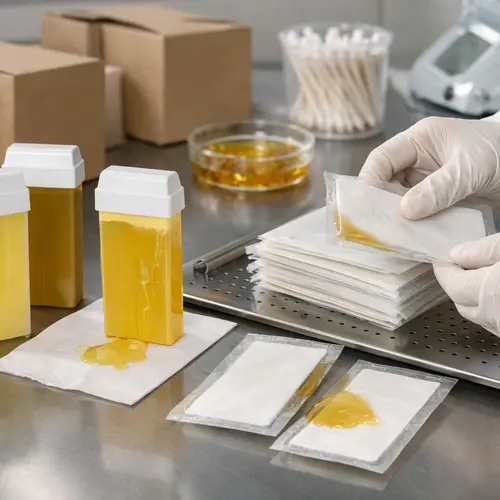
Wax products require a different control model. The buyer should review melting point or working-temperature behavior, set time, stringing, residue, peel strength, and performance after repeated heating cycles. Wax strips should be tested for adhesion after aging, substrate separation, oil migration, and clean release. Sugar wax should be examined for crystallization, water activity where relevant, and texture changes after heat exposure. A salon-oriented range may prioritize fast service and predictable pull strength, while a home-use range may need a wider handling window and clearer safety instructions.
Packaging compatibility and shipment conditions
Packaging qualification must use the final commercial formula and final component set. For creams, evaluate tube laminate, shoulder sealing, cap torque, nozzle blockage, and stress cracking. For jars, assess liner integrity, wall deformation, and consumer contamination risk. For roll-on cartridges, conduct leakage and ball rotation checks after inversion, vibration, temperature cycling, and extended storage. Wax strips should be checked for adhesive migration, pouch seal strength, and substrate protection. Aftercare gels or lotions require compatibility review for pumps, caps, and flexible tubes, especially when botanical extracts, oils, or volatile fragrance components are present.
Storage and logistics specifications should state acceptable heat and cold limits, pallet configuration, carton compression requirements, and shipment restrictions. A laboratory stability review that excludes the commercial pack does not establish launch readiness. Ask the ODM to retain samples from pilot and production batches, document fill-weight variation, and define the investigation path for leakage, separation, odor change, viscosity drift, or strip adhesion failure.
For buyers evaluating a depilatory cream OEM partner, the sample brief should include intended body area, target consumer, formula claims, pack format, market, and shipment route. Sensitive-skin positioning should be treated as a substantiation and risk-review requirement; review sensitive skin hair removal products with the same discipline applied to any regulated claim.
Decision Framework Table
| Factor | What to Check | Why It Matters | ODM Buyer Note |
|---|---|---|---|
| Formula control | Specification, viscosity or melting behavior, active system, fragrance, preservative rationale, and batch tolerances | Controls performance, irritation risk, and repeatability across markets | Require a signed master formula and documented change-control process |
| Package compatibility | Seals, closures, liners, tube laminate, cartridge mechanics, pouch barriers, and fill-weight checks | Prevents leakage, separation, blockage, migration, and consumer complaints | Test the final formula in the final commercial pack |
| Stability and logistics | Heat, cold, humidity, vibration, aging, palletization, and shipment conditions | Links laboratory evidence to real distribution exposure | Request protocols, acceptance criteria, retained samples, and deviation records |
| Compliance and ESG | ISO 22716 systems, ingredient files, labeling support, audit reports, labor controls, emissions records, and waste handling | Supports global launch approval and group-level supplier governance | Ask for current evidence and corrective-action closure, not policy statements alone |
| Capacity resilience | Pilot scope, line capability, raw-material alternatives, maintenance plans, and allocation rules | Protects NPD timing and strategic supply during disruption | Confirm whether pilot and mass production use the same validated process |
hair removal manufacturing process documentation should show how sampling, filling, packaging, QC release, and shipment handoffs are controlled. For a vertically specialized partner such as PZIK, the relevant diligence question is whether modular formulation libraries and micro-batch GMP operations shorten qualification without creating an uncontrolled transition between sample and mass production. A pilot capability from 1,000 units and scale capacity above 500,000 units per SKU can be useful, but only when the same raw-material specifications, equipment logic, and quality gates apply throughout the scale-up.
Range planning should also account for the full consumer journey. A depilatory cream may be paired with a soothing gel, a wax-strip assortment with an after-wax lotion, and a salon kit with a recovery product. Review the post-depilation care OEM scope and the hair inhibitor serum OEM brief only after claims, formula compatibility, and market classification have been established. For wax formats, assess wax strips OEM capability, including pouch sealing, strip coating, hot wax filling, and carton protection.
Finally, convert the decision into an auditable supplier checklist. Require formulation records, sample-to-batch comparison data, packaging drawings, stability protocols, release specifications, audit evidence, IP access controls, business-continuity plans, and escalation contacts. The request a hair removal product quote process should begin only after these inputs are defined. Technical questions can be sequenced through the hair removal product guides resource, but the final sourcing decision should rest on verifiable production and governance evidence.


ODM Manufacturing Considerations
For private-label buyers, ODM development should be managed as a documented approval sequence rather than an informal sample exchange. Start with a written product brief covering the hair-removal format, target market, application area, pack size, fragrance direction, texture, intended shelf life, and expected shipment route. A depilatory cream for face use, a salon wax, and an aftercare lotion require different performance priorities, so the supplier should confirm the intended use before proposing a base formula.
Sample confirmation should include more than visual approval. Record the sample code, batch date, formula version, color, fragrance, texture, application time, residue, removal comfort, and post-use skin feel. For wax, check spreadability, setting behavior, flexibility after cooling, and whether the product pulls cleanly from the skin or leaves excessive residue. For strips, compare adhesive pickup, tear resistance, release from the backing, and performance after exposure to normal warehouse conditions. For cream, inspect uniformity, odor, application thickness, removal completeness, and signs of separation during the agreed observation period.
Formula customization should be controlled through a change log. A request for a stronger fragrance, softer sugar wax, faster cream action, or a different aftercare texture can affect irritation risk, production handling, and package compatibility. Ask for a revised sample and an updated ingredient declaration after each material change. Buyers should also define which changes require renewed approval, especially changes to fragrance, preservatives, active depilatory ingredients, wax composition, or the manufacturing site.
Packaging compatibility needs to be assessed with the actual commercial components. Confirm that a tube nozzle dispenses the cream consistently, that a jar closure protects the formula during shipment, and that a roll-on cartridge does not seep around the roller assembly or cap. For wax strips, check that the adhesive does not migrate into the pouch or bond excessively to the inner surface. For aftercare products, verify pump priming, cap security, and dispensing after the package has been stored in different positions. Packaging artwork should be reviewed together with the final component specifications, because pack size, net contents, directions, warnings, batch coding, and ingredient information must remain consistent.
MOQ should be separated into development quantity, pilot quantity, and routine production quantity. Ask whether the supplier can provide enough samples for internal review, consumer or salon evaluation, packaging testing, and regulatory assessment without mixing formula versions. Request a written quotation showing component MOQ, formula MOQ, carton requirements, tooling or plate charges, lead-time assumptions, and the treatment of leftover packaging. This makes a private-label comparison more accurate than evaluating only the unit quotation.
Labeling documents should be prepared before the purchase order is finalized. Depending on the destination market, the buyer may need an ingredient list using accepted naming conventions, product specifications, safety documentation, batch information, usage directions, warnings, claims support, and country-of-origin details. The FDA’s regulatory framework for cosmetics is a useful reference for checking the basic structure of U.S. cosmetic labeling and compliance responsibilities: the FDA’s regulatory framework for cosmetics. The supplier should identify which documents it provides and which remain the brand owner’s responsibility.
Shipment conditions also require written agreement. Clarify acceptable transit exposure, carton stacking limits, pallet configuration, inner seals, cap protection, and storage instructions. Wax, cream, strips, and aftercare products may respond differently to prolonged heat, cold, pressure, or movement. Use retained samples from the shipped production batch where possible, and compare their appearance, odor, dispensing, and removal performance with the approved reference.

Common Problems or Failure Cases
Wax brittleness: A hard wax or sugar wax can become brittle when its composition, cooling behavior, or storage exposure is poorly controlled. The product may crack during application, break during removal, or leave fragments on the skin. Buyers should compare flexibility at the intended service temperature and after ordinary warehouse exposure. The acceptance standard should specify spread, setting, pull strength, residue, and the permitted visual change.
Strip adhesion loss: Wax strips can lose effective adhesion when the wax layer is uneven, the backing absorbs material, the pouch seal is weak, or the product encounters excessive heat. Test both newly opened strips and samples held under the agreed shipment and storage conditions. Examine whether the strip lifts hair consistently, whether the wax transfers too readily, and whether the backing separates from the wax layer.
Cream separation: A depilatory cream may show oiling, watery leakage, graininess, color change, or a split texture after storage. These changes can affect dosage, application time, and user confidence. Inspect samples upright and inverted, check the first and last portion dispensed from the package, and compare retained samples from multiple batches. A buyer should not approve a formula solely because it looks uniform immediately after filling.
Cartridge leakage: Roll-on wax cartridges may seep through the roller head, cap, seam, or closure when the wax softens or when cartons are compressed. Check leakage after standing, inversion, handling, and shipment simulation. Inspect the outer carton for staining and confirm that the roller still turns smoothly after the exposure period. A supplier should define the permitted leakage level, if any, rather than relying on a general visual inspection.
Fragrance sensitivity: A fragrance that performs well in a laboratory sample may be unacceptable for a sensitive-user segment or a salon environment. Request the fragrance specification, allergen declaration where required, and an unscented or lightly scented comparator. Claims such as gentle, sensitive, or suitable for facial use should be reviewed against the formula, directions, warnings, and available supporting evidence. Peer-reviewed research indexed by PubMed/NCBI can help buyers assess general background questions related to skin responses, but it does not replace product-specific assessment: peer-reviewed research indexed by PubMed/NCBI.
Packaging deformation: Tubes, pouches, jars, and cartridges can dent, warp, wrinkle, or lose their seal during filling or transit. Review filled samples, not empty components alone. Check the closure torque, seal area, label adhesion, print legibility, and carton fit after shipment handling. A package that looks acceptable at the factory may fail when stacked, exposed to a warm container, or moved through several distribution points.
Supplier Checklist
- Confirm the supplier’s experience with the specific format: depilatory cream, wax, strip, sugar wax, roll-on cartridge, or aftercare product.
- Request a controlled sample record showing formula version, batch reference, texture, fragrance, application behavior, residue, and approval status.
- Define which formula, fragrance, ingredient, component, or manufacturing-site changes require written buyer approval.
- Review component specifications for tubes, jars, pouches, strip backings, cartridge assemblies, pumps, caps, seals, and labels.
- Check product behavior after agreed heat, cold, pressure, handling, and shipment exposures.
- Separate sample MOQ, development MOQ, component MOQ, and routine production MOQ in the quotation.
- Request ingredient documentation, product specifications, safety documents, batch records, labeling data, and claim-support files relevant to the destination market.
- Verify that production and quality records can trace raw materials, filling, coding, packing, release, and retained samples.
- Ask how complaints are investigated, how affected batches are isolated, and how corrective actions are documented.
- Review labor, environmental, and business-continuity policies through current records and independent audit evidence where required by the buyer’s sourcing program.
FAQ
Can the factory protect our custom formula from internal or external disclosure?
Ask for role-based access controls, separate formula records, production-floor access rules, confidentiality agreements, and an approval trail for formula changes. A responsible supplier should explain how formula files, samples, raw-material records, and customer artwork are physically and digitally separated. No system can honestly promise absolute protection, so buyers should evaluate controls, audit rights, breach notification terms, and the limits of shared subcontracting.
How can a brand secure priority supply during a raw-material shortage?
Use a written supply-continuity plan covering approved alternative materials, minimum reserve expectations, allocation rules, forecast sharing, and escalation contacts. Ask whether critical waxes, preservatives, fragrances, tube materials, or cartridge components have qualified secondary sources. Priority status should be defined contractually and linked to forecast accuracy, purchase commitments, and transparent allocation records rather than treated as an informal promise.
How should we assess whether factory workers are treated fairly?
Request the supplier’s labor policy, working-hour records, wage documentation, age-verification procedure, grievance channel, and latest social-compliance audit. Look for evidence covering recruitment fees, wage deductions, overtime consent, rest periods, and freedom from forced or underage labor. For higher-risk sourcing programs, use an independent audit and require corrective-action closure records rather than relying only on a written self-assessment.
What should be approved before packaging artwork is released?
Approve the final formula version, ingredient list, net contents, directions, warnings, batch-code area, component dimensions, closure type, and country-specific labeling requirements. The signed artwork should match the actual filled pack and the documents supplied for the destination market. Keep a controlled master file so later reorders do not accidentally use an outdated warning or ingredient declaration.
What is a useful sample quantity for internal approval?
The quantity depends on the number of reviewers and tests, but it should cover formula evaluation, package inspection, salon or consumer feedback where appropriate, shipment exposure, and retained reference samples. Ask the supplier to label every sample with its version and date. More samples are not useful if they come from uncontrolled or different versions of the formula.
How do we compare two ODM suppliers fairly?
Give both suppliers the same product brief, pack specification, target market, documentation list, sample quantity, and shipment assumptions. Compare performance records, change control, component sourcing, lead-time logic, MOQ structure, complaint handling, and document quality alongside the quotation. The supplier with the clearest evidence may present lower execution risk even when the initial unit figures are similar.

References
The FDA’s regulatory framework for cosmetics supports review of U.S. cosmetic labeling and regulatory responsibilities.
Peer-reviewed research indexed by PubMed/NCBI provides a searchable source for background research on cosmetic ingredients and skin responses.