Wax Strips vs Hot Wax: Which Fits a Private Label Launch?
Direct Answer
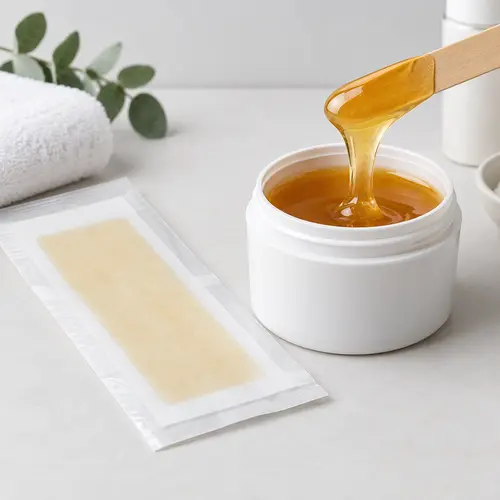
Choose private label wax strips when launch speed, simple consumer use, compact shipping, and predictable content demonstrations matter most. They arrive pre-dosed, require no heater, and fit creator-led tutorials built around an immediate peel-and-reveal moment. Choose hot wax when the brand concept depends on a more dramatic melting ritual, stronger texture customization, or a salon-inspired positioning.
For most first-time DTC founders, wax strips are the lower-complexity launch SKU. Hot wax can create greater visual differentiation, but it adds temperature control, container compatibility, application tools, and more detailed use instructions. Neither format is universally better. The right decision depends on the target body area, consumer skill level, desired camera effect, formula behavior, shipping climate, and planned retail price. Evaluate the complete use system rather than comparing wax formulas alone.
Key Takeaways for Private Label Buyers
- Start with the use moment. Wax strips support fast, portable routines; hot wax supports a more involved beauty ritual.
- Review performance on camera. Confirm grip, pull, residue, stringing, color, and texture under the lighting used for launch content.
- Test the final package. Wax migration, pouch seals, jar closures, spatulas, and outer cartons can fail even when the formula performs correctly.
- Request temperature testing. Heat can soften pre-waxed strips or cause leakage; cold can make some hot-wax formats brittle.
- Compare complete landed cost. Include applicators, liners, pouches, jars, instructions, cartons, freight, and fulfillment dimensions in the BOM.
- Build aftercare into the concept. A coordinated soothing product can improve the routine and create a higher-value kit.
Buyer Context
Hair removal is unusually unforgiving for creator-led brands. The product must look satisfying in a short video, yet the real consumer experience depends on details that are difficult to judge from a beauty render: how evenly wax is deposited, whether it grips short hair, whether the strip separates cleanly from its liner, how much residue remains, and whether the instructions prevent common misuse.
Private label wax strips reduce the number of steps between opening the carton and removing hair. That makes them suitable for travel, subscriptions, entry-price products, and audiences with limited waxing experience. Their differentiation usually comes from strip geometry, body-area positioning, wax color or scent, substrate feel, pouch design, and the accompanying aftercare. Buyers can explore broader custom wax strips and hot wax configurations before fixing the hero format.
Hot wax gives the content creator more motion and texture: beads or solid wax melt, flow from a spatula, spread across skin, set, and peel away. That sequence is naturally visual. It also creates more failure points. Consumers may overheat the product, apply an uneven layer, remove it before it sets, or store the jar incorrectly. Clear directions and repeatable texture are therefore part of the product, not secondary copy.
Adjacent formats can shape the assortment. Sugar wax offers a different application story; roll-on wax cartridges support controlled dispensing but require leakage and roller-flow checks; depilatory cream removes the pulling step but needs its own irritation-risk review and timing instructions. A buyer comparing these paths can use the broader depilatory product development solutions hub or review custom depilatory cream formulation options.
Technical or Packaging Factors
Formula Behavior
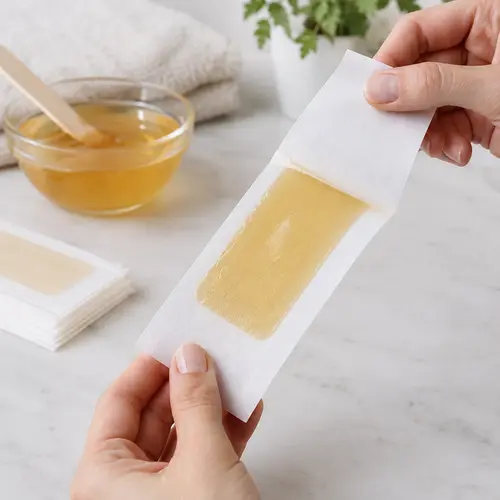
For wax strips, ask the ODM to define wax coat weight, coating tolerance, liner release, substrate specification, and adhesion after aging. A strip should grip hair without separating internally, tearing unpredictably, or leaving excessive wax on skin. Test the intended areas because legs, underarms, face, and bikini lines do not present the same hair, contours, or sensitivity considerations. If mild positioning is central, align the wax and aftercare plan with documented sensitive skin hair removal products.
For hot wax, request the supplier-defined softening, melting, application, and set behavior rather than accepting a single generic temperature claim. During sample review, observe flow from the spatula, spread thickness, edge formation, flexibility after setting, breakage during removal, residue, and consistency after reheating. Color and opacity should also be reviewed under studio lighting. A dramatic shade that photographs well in the jar may appear translucent or uneven when spread.
Packaging and Storage
Pre-waxed strips need a barrier pouch or equivalent pack that limits contamination, scent loss, liner movement, and wax migration. Confirm seal integrity after warm storage and transport simulation. Check whether strips remain easy to separate without wax transferring to the wrong surface. Carton dimensions should protect the strips from bending while staying efficient for parcel fulfillment.
Hot wax jars require material compatibility, closure fit, resistance to product seepage, and adequate headspace. If the format is filled warm, the jar and decoration must tolerate the supplier’s filling conditions. Spatulas, collars, tamper features, and instructions should be included in the packaging trial. For roll-on extensions, add cartridge leakage, roller rotation, cap retention, and flow consistency to the review.
A useful screening plan may include storage at 5°C, 25°C, and 40°C, plus three freeze-thaw cycles, where appropriate for the formula and intended markets. These are buyer checkpoints, not universal pass criteria. The ODM should define duration, acceptance limits, and shipment conditions for the specific SKU. Review how sampling, filling, packaging, inspection, and dispatch connect within the hair removal manufacturing process.

Safety, Labeling, and Sampling
No supplier can promise zero irritation. Buyers should instead verify ingredient review, batch traceability, use warnings, patch-test directions where appropriate, and clear restrictions for compromised or recently treated skin. Ingredient names can be checked against the INCI ingredient nomenclature database. US-bound brands should also review the FDA cosmetics overview and the agency’s small-business cosmetics fact sheet.
Do not approve from one attractive sample. Request production-representative samples in the intended package, then review them before and after storage. Confirm whether customization changes the sample fee, MOQ, testing scope, lead time, or documentation package. The hair removal OEM ODM services process should separate baseline choices from custom work, while a hair removal product RFQ should show BOM assumptions and estimated freight inputs clearly.
Decision Framework Table
| Factor | What to Check | Why It Matters | ODM Buyer Note |
|---|---|---|---|
| Launch speed | Available strip sizes, wax bases, jars, tools, and cartons | Existing components reduce sampling and compatibility work | Ask what can be sampled without new tooling |
| Consumer skill | Number of steps, heating needs, application control, and removal technique | More steps increase misuse and customer-support risk | Test instructions with first-time users |
| Visual impact | Color, opacity, stretch, spread, peel, and visible hair pickup | These traits determine whether the product reads clearly on video | Approve under final lighting and camera settings |
| Package fit | Pouch seals, liner release, jar closure, spatula, and carton protection | Package failure can create leakage, migration, or damaged units | Test the complete retail pack |
| Climate exposure | Warm storage, cold storage, cycling, and shipment simulation | Wax behavior can shift during international transport | Match conditions to launch markets |
| Assortment value | Aftercare gel, wipes, or post-removal lotion | A complete routine can raise perceived value and differentiation | Review compatible after wax care products |
Practical default: launch wax strips first when operational simplicity is the priority. Choose hot wax first when the melting and peel sequence is essential to the brand story and the team can support more consumer education. In either case, approve formula, package, instructions, storage results, and production sample as one connected system.
ODM Manufacturing Considerations
For a private label wax strips launch, sample approval should establish measurable production criteria rather than rely on a simple visual sign-off. Ask the supplier to create an approval sheet covering strip dimensions, wax distribution, fragrance, color, peel behavior, residue level, hair-removal performance, pouch count, and finished-pack appearance. For hot wax, record the target softening or melting range, working viscosity, application thickness, cooling time, flexibility, and removal behavior. Keep an approved reference sample from the same version documented on the specification sheet.
Customization should begin with the intended user, body area, climate, selling price, and brand claim. A supplier may adjust wax firmness, working time, fragrance, color, strip size, or included aftercare. Depilatory cream projects require additional attention to application time, pH, viscosity, odor, and separation risk. Clarify whether the proposed formula is a standard base with minor changes, an exclusive modification, or a fully custom development. Those options affect cost, MOQ, testing scope, ownership terms, and lead time.
Packaging compatibility includes more than whether a product fits inside a container. Confirm dimensional tolerances, closure fit, contact-material suitability, dispensing performance, print resistance, and pack deformation under expected distribution conditions. Hot wax containers must tolerate filling and consumer warming instructions. Roll-on wax cartridges need reliable cap fit, roller movement, and clean dispensing. Depilatory cream tubes must maintain closure performance while protecting the intended viscosity.
Stability review should track changes in odor, color, texture, viscosity, wax brittleness, oil migration, cream separation, and package shape across the expected shelf life and shipping environment. The supplier should define evaluation intervals, pass criteria, test batch identity, and responsibility for corrective work. Review the broader manufacturing process to understand when pilot materials transition to commercial production.
MOQ discussions should separate formula batch minimums from printed packaging minimums. A low product MOQ can still require a large order of custom pouches, cartons, or cartridges. Request a transparent BOM showing product, primary pack, secondary pack, inserts, tooling, testing, assembly, and freight assumptions. If a supplier advertises seven-day sampling, ask whether that timing covers stock formulas only or also customized fragrance, color, and packaging.
Before shipment, obtain the ingredient declaration, product specification, directions, warnings, batch-code format, artwork approval, and available test summaries. Shipment planning should document carton quantity, pallet configuration, route-related temperature exposure, container loading method, and any transport documents required by the carrier or destination. These details should be reviewed alongside the supplier’s OEM and ODM service scope.

Common Problems or Failure Cases
Wax becomes brittle: Hot wax may crack during removal if its firmness, application thickness, cooling time, or storage history falls outside the approved range. Compare the failed unit with retained samples and check whether the issue is formula-related, batch-related, or caused by transport exposure.
Strip adhesion declines: Wax strips can lose effective grip because of uneven wax distribution, unsuitable storage, aged materials, or contamination during handling. Acceptance checks should evaluate both hair pickup and residue, since stronger tack does not automatically mean better consumer performance.
Depilatory cream separates: Visible liquid release, graininess, or viscosity loss may indicate an unstable formula or an incompatible tube and closure system. The investigation should include bulk samples, filled units, batch records, and storage history rather than simply remixing the cream.
Roll-on cartridges leak: Leakage can originate from component tolerances, cap fit, roller assembly, filling conditions, or deformation during transport. Inspect upright, inverted, and side-positioned units from multiple cartons.
Fragrance causes complaints: A strong fragrance may support differentiation but can also increase sensitivity concerns or mask an undesirable base odor. Review fragrance level, allergen-document availability, intended body area, warnings, and unscented alternatives before approval.
Packaging deforms: Jars, tubes, cartridges, or cartons may warp, dent, or lose closure alignment in distribution. Specify acceptable cosmetic defects and functional failures separately so disputes are resolved against written limits.
Supplier Checklist
- Confirm experience with wax strips, hot wax, sugar wax, depilatory cream, roll-on cartridges, and aftercare relevant to the project.
- Request the exact sample scope, revision count, sample fees, timing, and freight responsibility.
- Define measurable formula targets, including texture, melting or softening range, viscosity, application behavior, and residue expectations where relevant.
- Verify ingredient traceability, incoming-material controls, batch records, finished-product checks, and retained-sample practices.
- Ask for an irritation-risk review, directions, warnings, and claim limitations appropriate to the intended body area.
- Review package drawings, component tolerances, closure performance, filling limits, and shipping-carton specifications.
- Separate formula MOQ, packaging MOQ, production lead time, and reorder lead time.
- Require a line-item BOM and logistics estimate, including assumptions that could change the final cost.
- Confirm available labeling documents and who reviews destination-market requirements.
- Document confidentiality, formula ownership, artwork ownership, approved subcontracting, and restrictions on sample display.
- Examine capacity allocation, peak-season planning, backup lines, and the process for urgent replenishment.
Buyers comparing formats can also review the supplier’s hair-removal product categories to determine whether one manufacturer can support future extensions without forcing the first launch into an unnecessarily broad range.

FAQ
Can a factory use my idea or formula for another brand?
No agreement can eliminate every commercial risk, but buyers can reduce exposure. Use a mutual confidentiality agreement, identify which information existed before the project, define ownership of custom work, prohibit unauthorized display of samples or artwork, and state whether the factory may sell a similar base formula. Remember that changing fragrance or color on a standard base does not necessarily create an exclusive formula.
How can I communicate with a supplier if I do not understand technical ingredients?
Provide a buyer brief focused on observable outcomes: body area, user profile, texture, working time, residue, fragrance strength, pack format, target cost, and content-launch date. A capable account manager should translate those marketing needs into sample variables and written acceptance criteria without expecting you to use laboratory terminology.
What happens if social content drives a sudden order spike?
Ask for monthly capacity by product type, normal utilization, component lead times, minimum reorder quantity, and the production slots reserved for repeat customers. Agree on demand-update intervals and identify which materials can be held in reserve. Capacity statements are more useful when supported by line schedules and realistic packaging availability.
Are wax strips usually easier to launch than hot wax?
Wax strips can simplify consumer use, but they require accurate conversion, paired-sheet handling, and dependable individual packaging. Hot wax may offer stronger professional positioning and more texture customization, yet it adds warming instructions and container considerations. The easier format is the one that matches the user, channel, target cost, and acceptable complaint risk.
Which documents should I receive before approving production?
At minimum, request the approved specification, ingredient list using INCI names, directions, warnings, artwork, batch-code plan, available safety information, test summary, packaging specification, and commercial quotation. Destination-specific requirements should be assigned to a named party rather than assumed to be included.
Should I approve the cheapest sample that performs adequately?
Not automatically. Compare the complete BOM, MOQ, packaging quality, documentation, expected reject handling, freight, and reorder timing. A lower unit price can be offset by excess printed inventory, leakage losses, unstable lead times, or costly artwork changes. Use an RFQ brief that asks each supplier to quote the same scope.
References
- U.S. Food and Drug Administration: Cosmetics — general U.S. information on cosmetic safety, labeling, ingredients, and business responsibilities.
- FDA: Small Businesses and Homemade Cosmetics Fact Sheet — overview of manufacturer and marketer responsibilities for safe, properly labeled cosmetics.
- The INCI ingredient nomenclature database — a practical terminology reference for reviewing ingredient names; destination-market documents should still be checked by a qualified reviewer.