Direct Answer
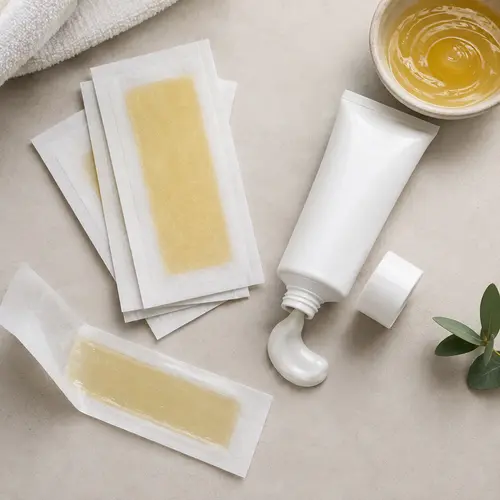
For most creator-led launches, the choice between wax strips vs depilatory cream comes down to content format, customer tolerance, and operational risk. Wax strips create a more visible demonstration: apply, pull, reveal. They are easy to bundle, travel well, and avoid the filling and leakage concerns associated with creams. However, adhesion consistency, residue, pain perception, and storage temperature can affect reviews.
Depilatory cream offers a gentler-looking, no-pull ritual and can support sensitive-skin positioning when the formula is appropriately developed and assessed. Its tradeoffs are more demanding formula stability, odor control, application timing, packaging compatibility, and label precision.
Choose strips when social demonstration and simple fulfillment lead the brief. Choose cream when sensory experience, broader body-area use, and repeat purchase matter more. Before committing, compare both through camera tests, controlled user evaluations, storage checks, and fulfillment-ready pilot samples.
Key Takeaways for Private Label Buyers
- Source against a use case. Define body area, hair type, customer experience, selling channel, and target retail price before requesting samples.
- Review the complete system. A strong wax formula can fail through weak strip material; a stable cream can fail through an incompatible tube, cap, or applicator.
- Test what the camera sees. Evaluate spread, opacity, residue, removal reveal, and skin appearance under the lighting used for TikTok, Instagram, and product photography.
- Model fulfillment conditions. Heat, cold, vibration, compression, and long storage can change wax adhesion or expose cream leakage and separation.
- Ask for transparent scope. The quote should distinguish formula, primary packaging, printed components, testing, labeling support, samples, freight preparation, and optional aftercare.
- Keep the first run flexible. A 1,000-unit pilot can validate conversion and review quality before larger inventory is committed, provided the supplier can scale the same approved specification.
Buyer Context
Hair-removal products are unusually exposed to expectation gaps. Customers can see whether hair was removed, feel whether residue remains, and quickly connect redness or discomfort to the product. That makes the product demonstration part of quality control, not simply creative production.
Wax strips tend to suit creator brands built around an immediate visual payoff. The format is compact, understandable without a lengthy tutorial, and suitable for kits with wipes or after wax care products. The challenge is delivering repeatable adhesion across strip lots, storage conditions, hair lengths, and body contours. A dramatic pull on camera is valuable only when ordinary customers can reproduce it.
Depilatory cream supports a slower routine: apply, wait, remove, rinse. That creates room for texture, scent, applicator, and skin-feel differentiation. It also places more pressure on instructions, exposure time, ingredients, and irritation-risk review. Buyers exploring this route should compare options through a specialist depilatory cream OEM brief rather than selecting a generic base by fragrance and color alone.
Channel economics matter too. Amazon customers often compare count, net contents, application area, reviews, and ease of cleanup. DTC and TikTok Shop launches can place more weight on distinctive texture, ritual, bundles, and creator storytelling. Business of Fashion beauty intelligence can help teams monitor the wider market, but product selection should still be grounded in a measurable sample scorecard.
A founder without an internal product team also needs a clear path from content concept to approved SKU. The right hair removal OEM ODM services partner should translate visual references into sample variables, provide a BOM with defined inclusions, and explain what can be assessed during a seven-day sampling target. Final production timing should then be confirmed separately from sample timing.
Technical and Packaging Factors
Wax Strip Performance
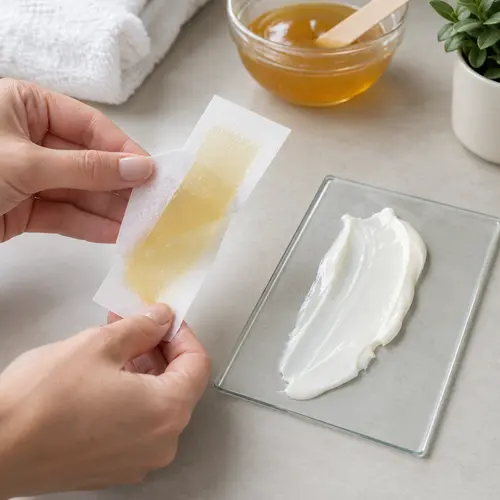
For wax strips, request the wax coat weight specification, strip dimensions, nonwoven material, peel behavior, and acceptable storage range. Buyers should test adhesion after heat and cold exposure, not only from a fresh sample kept in an office. Over-soft wax can transfer, bleed toward pouch seals, or leave heavy residue. Wax that becomes too firm may show poor hair capture or require excessive warming between the hands.
The pouch is part of the performance system. Confirm seal integrity, wax-to-film compatibility, tear behavior, print rub resistance, and whether paired strips separate cleanly. Ask the wax strips OEM to retain aged samples and document lot-level checks. If the range may later expand into sugar wax or roll-on cartridges, review the broader waxing product solutions early so naming, aftercare, and carton formats can remain coherent.
Depilatory Cream Performance
For cream, viscosity must support controlled spreading without dragging, dripping, or becoming difficult to remove. Review appearance, odor, spread, rinse-off, residue, and package dispensing at the beginning and end of storage evaluation. The supplier should define the target viscosity range and test method because a number without spindle, speed, and temperature conditions is not comparable.
Packaging review should cover tube or bottle material, cap fit, liner selection, applicator compatibility, fill weight, seal quality, and leakage after temperature conditioning and transit simulation. Formula contact can affect paneling, discoloration, odor transmission, or component stress over time. Follow the documented hair removal manufacturing process from approved sample through filling and finished-goods inspection.
Instructions should state body areas, application method, timing, removal, rinsing, patch-test direction, warnings, and storage. Claims and market status must be reviewed for each destination. Australia’s TGA cosmetic-therapeutic boundary guidance illustrates why wording can affect product classification, while the Philippine FDA warning concerning an unauthorized hair-removal cream shows the practical risk of launching without market-ready authorization and labeling records.
For sensitive-positioned products, ask for a documented ingredient review, fragrance options, intended-use boundaries, and a defined evaluation plan. The mild hair removal formula discussion should cover performance and foreseeable misuse rather than relying on a soft-sounding claim.
Decision Framework
| Factor | What to Check | Why It Matters | ODM Buyer Note |
|---|---|---|---|
| Content payoff | Hair-removal reveal, residue visibility, texture, and finish on camera | Determines whether customer results match creator demonstrations | Film both formats under final production lighting |
| Formula control | Wax coat consistency or cream viscosity, odor, spread, and rinse-off | Controls application reliability and review sentiment | Approve measurable specifications with the final sample |
| Primary pack | Pouch seals, tube barrier, cap fit, dispensing, and print durability | Reduces leakage, drying, contamination, and damaged deliveries | Test decorated production-equivalent components |
| Storage | Heat, cold, aging, compression, and vibration response | Products may cross climates before reaching the customer | Request acceptance criteria and photo records |
| Customer tolerance | Body area, use time, removal force, residue, redness, and aftercare | Hair-removal performance must be balanced with user comfort | Include foreseeable misuse in the risk review |
| Launch operations | MOQ, sample scope, BOM, labeling files, lead time, and scaling plan | Prevents content dates from outrunning inventory readiness | Use a written hair removal product RFQ |

ODM Manufacturing Considerations
For buyers comparing wax strips vs depilatory cream, ODM planning should begin with a written sample brief rather than a general request for a better product. Define the intended body area, target hair type, removal time, acceptable residue, fragrance direction, pack format, retail channel, and target landed cost. The supplier should convert these commercial requirements into measurable sample criteria.
Sample confirmation should include a retained reference signed or otherwise approved by both parties. Record the cream texture, spread, color, fragrance intensity, application time, removal behavior, and after-feel. For wax strips, record flexibility, grip, ease of separation, hair pickup, residue, and performance at the intended use temperature. Photos and short application videos help confirm that visual appearance remains consistent under content-production lighting.
Formula customization should have defined boundaries. Changes to depilatory ingredients, fragrance, color, or soothing components may alter odor, viscosity, removal performance, or irritation potential. Wax changes can affect melting behavior, flexibility, residue, and grip. Each approved revision should receive a unique sample code so feedback does not become mixed across different formulations.
Packaging should be evaluated with the actual product and decoration method. Depilatory creams may interact differently with tube layers, seals, pumps, or closure liners. Wax, sugar wax, and roll-on wax cartridges can soften, migrate, or seep when stored outside their expected temperature range. Printed surfaces, labels, cartons, and pouches should also remain legible and correctly shaped after warehouse and shipment conditioning.
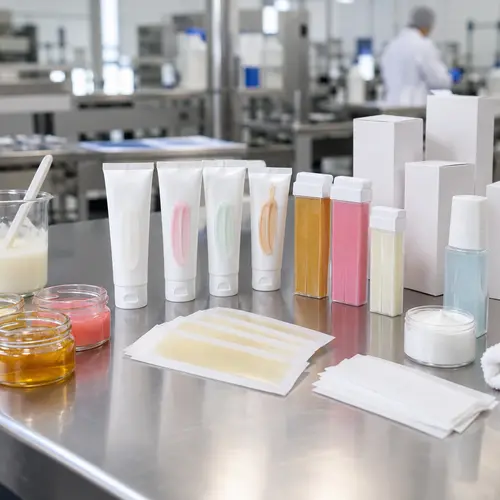
A useful stability review covers the proposed formula in the final retail pack under normal, warmer, cooler, and changing storage conditions. Buyers should agree on observation intervals and acceptance limits for color, odor, texture, viscosity range, wax flexibility, pack distortion, closure seepage, and usable product delivery. Any accelerated result should be considered alongside real-time retained samples.
MOQ discussions should separate bulk production, filling, printed components, cartons, and accessories. A transparent BOM should identify which element creates the highest commitment and whether neutral components can support a flexible first order. Ask for separate estimates for production, inspection, freight preparation, and destination shipping so margin assumptions are not distorted by hidden additions.
Before artwork approval, request the ingredient declaration, product specifications, directions, warnings, batch coding format, shelf-life basis, and available safety documents. Product classification and permitted claims depend on the destination market and presentation. For example, Australia’s TGA cosmetic-therapeutic boundary guidance explains why intended use and claims matter when determining whether a product is treated as a cosmetic.
Shipment planning should state carton quantity, pallet configuration, storage limits, transport mode, seasonal route risks, and responsibility for export documents. Buyers can compare this work against the supplier’s manufacturing process overview and OEM/ODM service scope before approving a contract.
Common Problems or Failure Cases
- Wax brittleness: Strips crack or shed wax when bent because the wax system, backing, or storage temperature is unsuitable. Confirm flexibility across the expected distribution range.
- Loss of strip grip: Hair pickup falls after storage, or the product leaves residue without removing enough hair. Compare aged samples with the approved reference on consistent hair lengths.
- Cream separation: Liquid collects near the opening or the texture becomes uneven. Check filled samples in multiple orientations and confirm whether remixing is acceptable.
- Cartridge leakage: Roll-on wax escapes around the roller or closure during warm storage. Examine component tolerances, fill level, sealing, and carton protection.
- Fragrance sensitivity: A strong masking fragrance may create additional consumer complaints without fully covering the base odor. Evaluate fragranced and lower-fragrance options during irritation-risk review.
- Packaging deformation: Tubes, pouches, or cartridges warp, weaken, or lose decoration in storage. Use production-equivalent materials before final approval.
Failures should be documented with batch number, sample code, storage history, photographs, and a repeatable observation method. Corrective samples need a clear explanation of what changed; otherwise, a visually improved sample may conceal a new performance tradeoff.

Supplier Checklist
Use the following checks when comparing hair-removal contract manufacturing partners:
- Confirm experience with wax strips, depilatory cream, sugar wax, roll-on cartridges, and relevant aftercare.
- Request sample codes, written specifications, acceptance limits, and retained reference samples.
- Review ingredient options, fragrance limits, target texture, viscosity range, and wax melting behavior where relevant.
- Verify irritation-risk assessment, batch release checks, traceability, complaint handling, and recall responsibilities.
- Confirm that production-equivalent packaging is included in stability and shipment evaluations.
- Separate finished-product MOQ from printed component and accessory minimums.
- Request an itemized BOM, tooling charges, testing costs, freight assumptions, and payment milestones.
- Review labeling files, claims support, batch coding, shelf-life basis, and destination documents before printing.
- Ask for realistic capacity allocation, lead-time assumptions, and expansion options if a DTC video or Amazon listing creates a demand spike.
- Evaluate relevant overseas brand examples without accepting confidential customer information as proof.
FAQ
Which format is easier for a first Amazon launch?
Wax strips are often easier to demonstrate and portion, while depilatory cream can offer broader coverage and a familiar application format. The better choice depends on claim strategy, target body area, review sensitivity, shipping conditions, and whether the brand can explain directions clearly.
Can an OEM or ODM supplier take my product idea and sell it elsewhere?
No contract can remove every commercial risk. Use mutual confidentiality terms, define ownership of custom formulas, artwork, tooling, and test data, and restrict unauthorized production. Share information in stages and keep dated briefs, sample codes, approvals, and payment records.
How can I confirm that the sample will look right on camera?
Ask for production-equivalent samples and evaluate them under the lighting, background, and recording settings used for brand content. Approve observable limits for cream color, texture, spread, wax appearance, residue, and packaging finish. Do not rely only on edited supplier videos.
Can quality controls guarantee that no customer will experience irritation?
No. Individual reactions, misuse, excessive application time, and use on unsuitable areas cannot be eliminated completely. Risk can be reduced through ingredient review, appropriate warnings, controlled manufacturing, patch-test directions where suitable, batch traceability, and prompt complaint investigation.
Should a face-use version share the same formula as a body product?
Not automatically. Intended use affects performance targets, directions, warnings, exposure, and irritation-risk decisions. A product should not be presented for the face merely because the body version removes hair effectively. Confirm the exact use area before sampling and label development.
What evidence supports a supplier’s ability to scale after launch?
Request documented line capacity, normal and peak lead times, component availability, backup filling options, and allocation terms. Relevant case examples from overseas DTC or creator brands can be useful, but purchase-order history and delivery records are stronger evidence than marketing claims.